
Pulp Fiction, 1865 · page 222 of 400
The Argosy — page 222: what you’re looking at
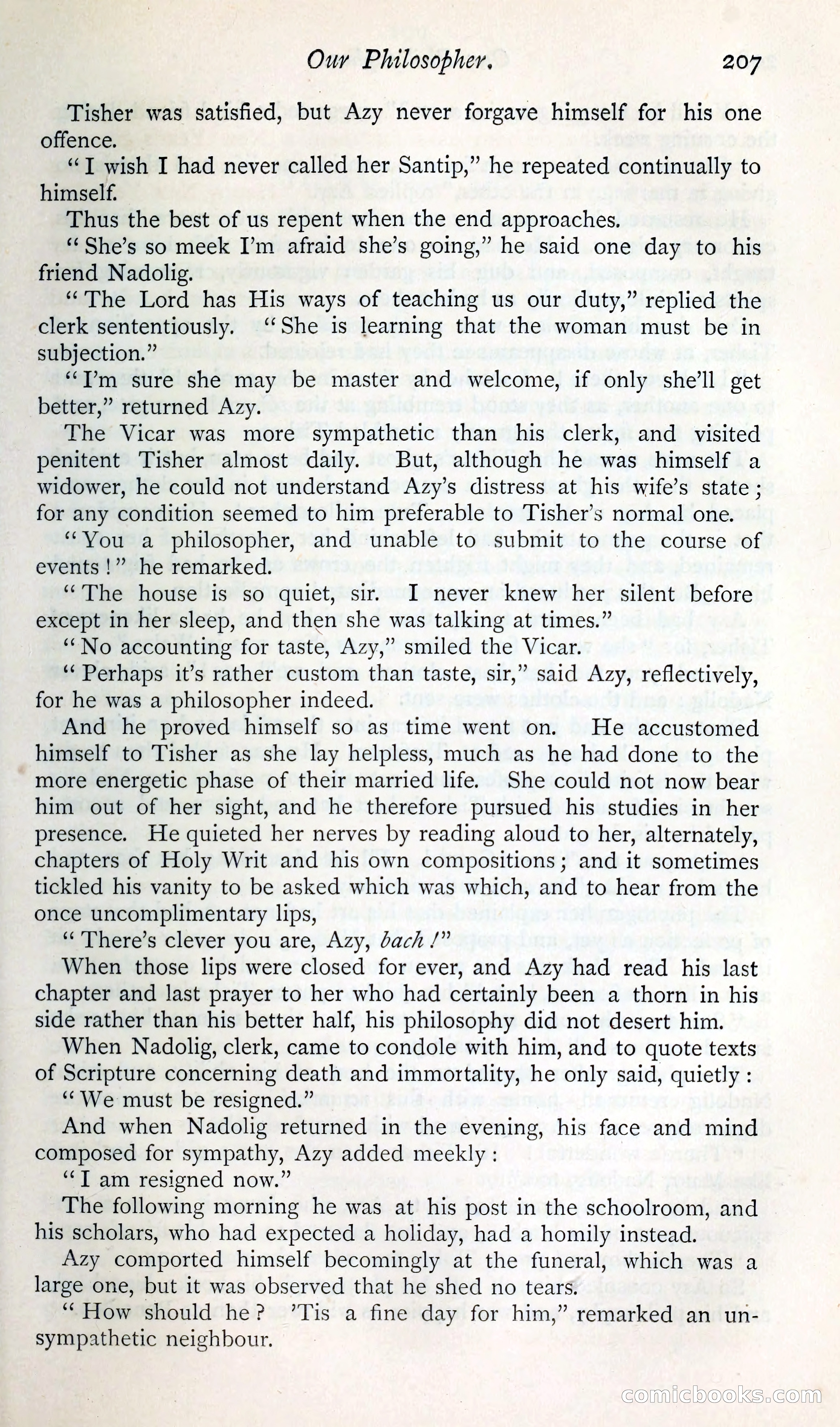
A restored page from Pulp Fiction, 1865. Page through the whole issue in the reader above.
📄 Transcribed text from this page (OCR, searchable)
Machine-transcribed from the original scan — historical spelling and the odd misread are preserved.
Our Plulosopher. 207 Tisher was satisfied, but Azy never forgave himself for his one offence. “J wish I had never called her Santip,” he repeated continually to himself. Thus the best of us repent when the end approaches. ‘¢She’s so meek I’m afraid she’s going,” he said one day to his friend Nadolig. “The Lord has His ways of teaching us our duty,” replied the clerk sententiously. ‘‘She is learning that the woman must be in subjection.” ““T’m sure she may be master and welcome, if only she'll get better,” returned Azy. The Vicar was more sympathetic than his clerk, and visited penitent Tisher almost daily. But, although he was himself a widower, he could not understand Azy’s distress at his wife’s state; for any condition seemed to him preferable to Tisher’s normal one. “You a philosopher, and unable to submit to the course of events!” he remarked. “The house is so quiet, sir. I never knew her silent before except in her sleep, and then she was talking at times.” ‘No accounting for taste, Azy,” smiled the Vicar. ‘Perhaps it’s rather custom than taste, sir,” said Azy, reflectively, for he was a philosopher indeed. And he proved himself so as time went on. He accustomed himself to Tisher as she lay helpless, much as he had done to the more energetic phase of their married life. She could not now bear him out of her sight, and he therefore pursued his studies in her presence. He quieted her nerves by reading aloud to her, alternately, chapters of Holy Writ and his own compositions; and it sometimes tickled his vanity to be asked which was which, and to hear from the once uncomplimentary lips, ‘“'There’s clever you are, Azy, dach /” When those lips were closed for ever, and Azy had read his last chapter and last prayer to her who had certainly been a thorn in his side rather than his better half, his philosophy did not desert him. When Nadolig, clerk, came to condole with him, and to quote texts of Scripture concerning death and immortality, he only said, quietly : ‘We must be resigned.” And when Nadolig returned in the evening, his face and mind composed for sympathy, Azy added meekly : ‘““T am resigned now.” The following morning he was at his post in the schoolroom, and his scholars, who had expected a holiday, had a homily instead. Azy comported himself becomingly at the funeral, which was a large one, but it was observed that he shed no tears. “How should he? ’Tis a fine day for him,” remarked an un- sympathetic neighbour. ECoORnnicloooks (CO)