
Pulp Fiction, 1865 · page 217 of 400
The Argosy — page 217: what you’re looking at
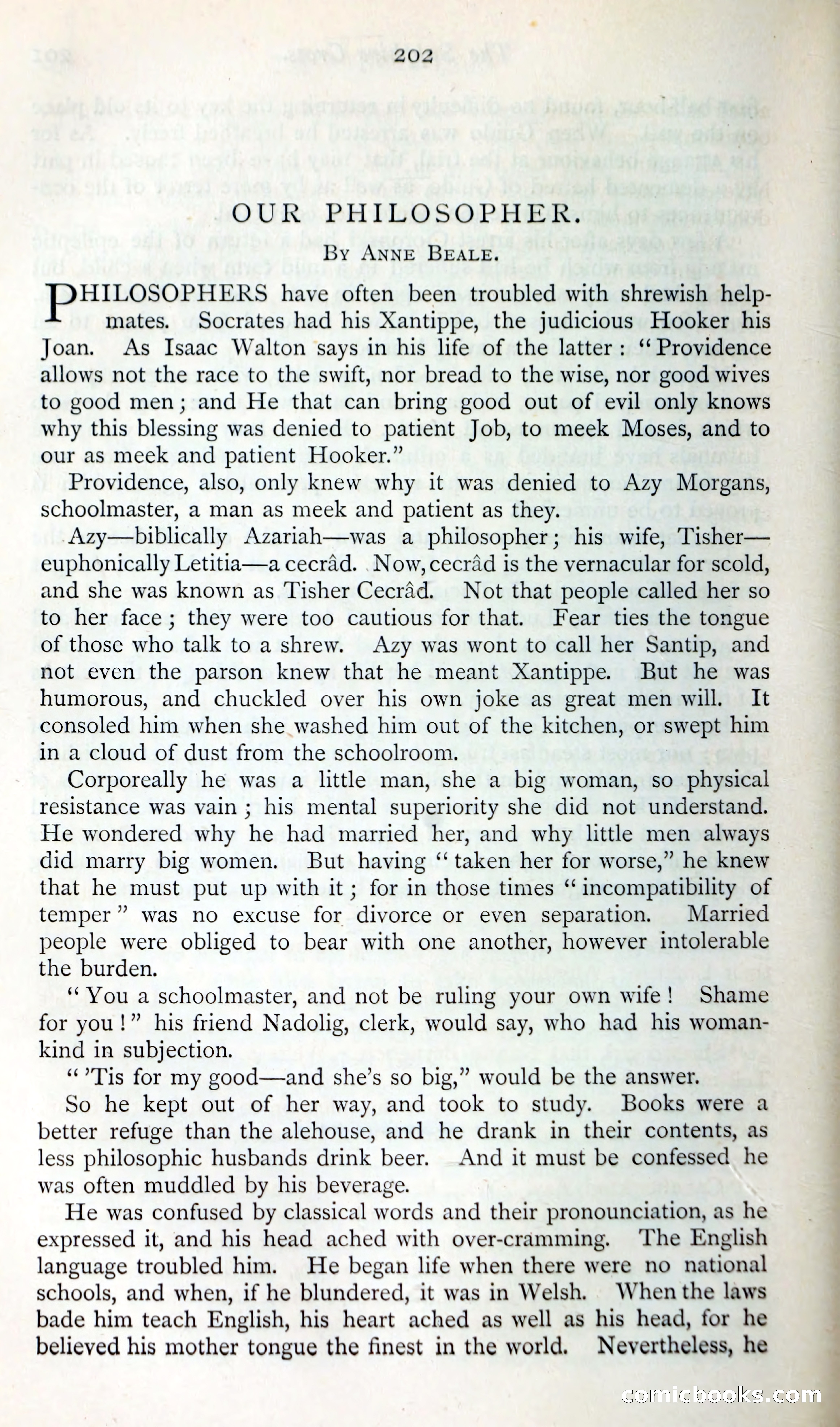
A restored page from Pulp Fiction, 1865. Page through the whole issue in the reader above.
📄 Transcribed text from this page (OCR, searchable)
Machine-transcribed from the original scan — historical spelling and the odd misread are preserved.
202 OUR PHILOSOPHER. By ANNE BEALE. HILOSOPHERS have often been troubled with shrewish help- mates. Socrates had his Xantippe, the judicious Hooker his Joan. As Isaac Walton says in his life of the latter: ‘* Providence allows not the race to the swift, nor bread to the wise, nor good wives to good men; and He that can bring good out of evil only knows why this blessing was denied to patient Job, to meek Moses, and to our as meek and patient Hooker.” Providence, also, only knew why it was denied to Azy Morgans, schoolmaster, a man as meek and patient as they. Azy—biblically Azariah—was a philosopher; his wife, Tisher— euphonically Letitia—a cecrad. .Now, cecrad is the vernacular for scold, and she was known as Tisher Cecrad. Not that people called her so to her face; they were too cautious for that. Fear ties the tongue of those who talk to a shrew. Azy was wont to call her Santip, and not even the parson knew that he meant Xantippe. But he was humorous, and chuckled over his own joke as great men will. It consoled him when she washed him out of the kitchen, or swept him in a cloud of dust from the schoolroom. Corporeally he was a little man, she a big woman, so physical resistance was vain ; his mental superiority she did not understand. He wondered why he had married her, and why little men always did marry big women. But having ‘‘ taken her for worse,” he knew that he must put up with it; for in those times “ incompatibility of temper” was no excuse for divorce or even separation. Married people were obliged to bear with one another, however intolerable the burden. ‘You a schoolmaster, and not be ruling your own wife! Shame for you!” his friend Nadolig, clerk, would say, who had his woman- kind in subjection. “?Tis for my good—and she’s so big,” would be the answer. So he kept out of her way, and took to study. Books were a better refuge than the alehouse, and he drank in their contents, as less philosophic husbands drink beer. And it must be confessed he was often muddled by his beverage. He was confused by classical words and their pronounciation, as he expressed it, and his head ached with over-cramming. ‘The English language troubled him. He began life when there were no national schools, and when, if he blundered, it was in Welsh. When the laws bade him teach English, his heart ached as well as his head, for he believed his mother tongue the finest in the world. Nevertheless, he Gomicbooks (E(@) . | | 1 P