
Pulp Fiction, 1865 · page 203 of 400
The Argosy — page 203: what you’re looking at
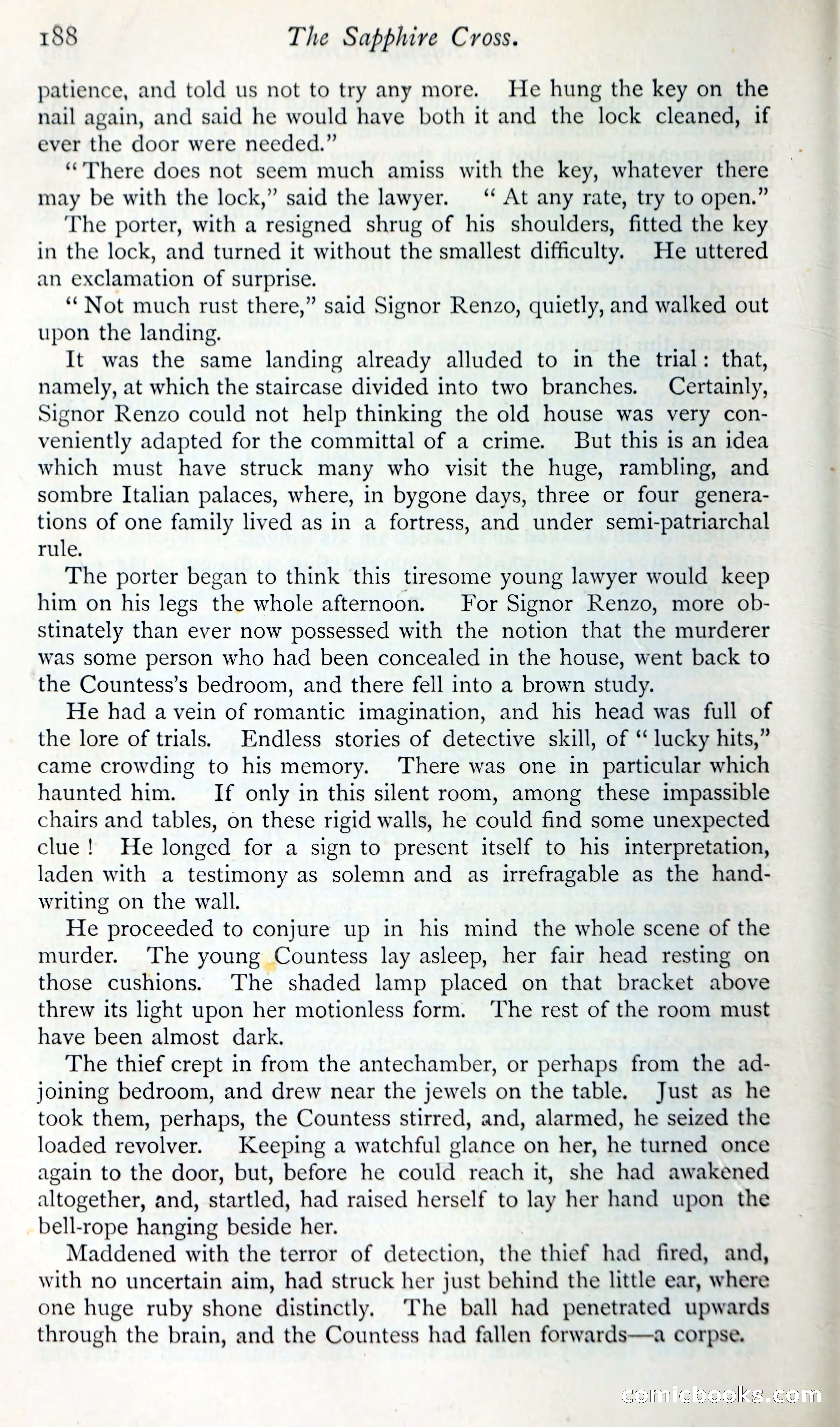
A restored page from Pulp Fiction, 1865. Page through the whole issue in the reader above.
📄 Transcribed text from this page (OCR, searchable)
Machine-transcribed from the original scan — historical spelling and the odd misread are preserved.
188 The Sapphire Cross. patience, and told us not to try any more. He hung the key on the nail again, and said he would have both it and the lock cleaned, if ever the door were needed.” ‘There does not seem much amiss with the key, whatever there may be with the lock,” said the lawyer. ‘‘ At any rate, try to open.” The porter, with a resigned shrug of his shoulders, fitted the key in the lock, and turned it without the smallest difficulty. He uttered an exclamation of surprise. ‘“Not much rust there,” said Signor Renzo, quietly, and walked out upon the landing. It was the same landing already alluded to in the trial: that, namely, at which the staircase divided into two branches. Certainly, Signor Renzo could not help thinking the old house was very con- veniently adapted for the committal of a crime. But this is an idea which must have struck many who visit the huge, rambling, and sombre Italian palaces, where, in bygone days, three or four genera- tions of one family lived as in a fortress, and under semi-patriarchal rule. The porter began to think this tiresome young lawyer would keep him on his legs the whole afternoon. For Signor Renzo, more ob- stinately than ever now possessed with the notion that the murderer was some person who had been concealed in the house, went back to the Countess’s bedroom, and there fell into a brown study. He had a vein of romantic imagination, and his head was full of the lore of trials. Endless stories of detective skill, of ‘‘ lucky hits,” came crowding to his memory. There was one in particular which haunted him. If only in this silent room, among these impassible chairs and tables, on these rigid walls, he could find some unexpected clue! He longed for a sign to present itself to his interpretation, laden with a testimony as solemn and as irrefragable as the hand- writing on the wall. He proceeded to conjure up in his mind the whole scene of the murder. ‘The young Countess lay asleep, her fair head resting on those cushions. The shaded lamp placed on that bracket above threw its light upon her motionless form. ‘The rest of the room must have been almost dark. The thief crept in from the antechamber, or perhaps from the ad- joining bedroom, and drew near the jewels on the table. Just as he took them, perhaps, the Countess stirred, and, alarmed, he seized the loaded revolver. Keeping a watchful glance on her, he turned once again to the door, but, before he could reach it, she had awakened altogether, and, startled, had raised herself to lay her hand upon the bell-rope hanging beside her. Maddened with the terror of detection, the thief had fired, and, with no uncertain aim, had struck her just behind the little ear, where one huge ruby shone distinctly. ‘The ball had penetrated upwards through the brain, and the Countess had fallen forwards—a corpse. CORNICE OOO KS (E(@)