
Pulp Fiction, 1865 · page 146 of 400
The Argosy — page 146: what you’re looking at
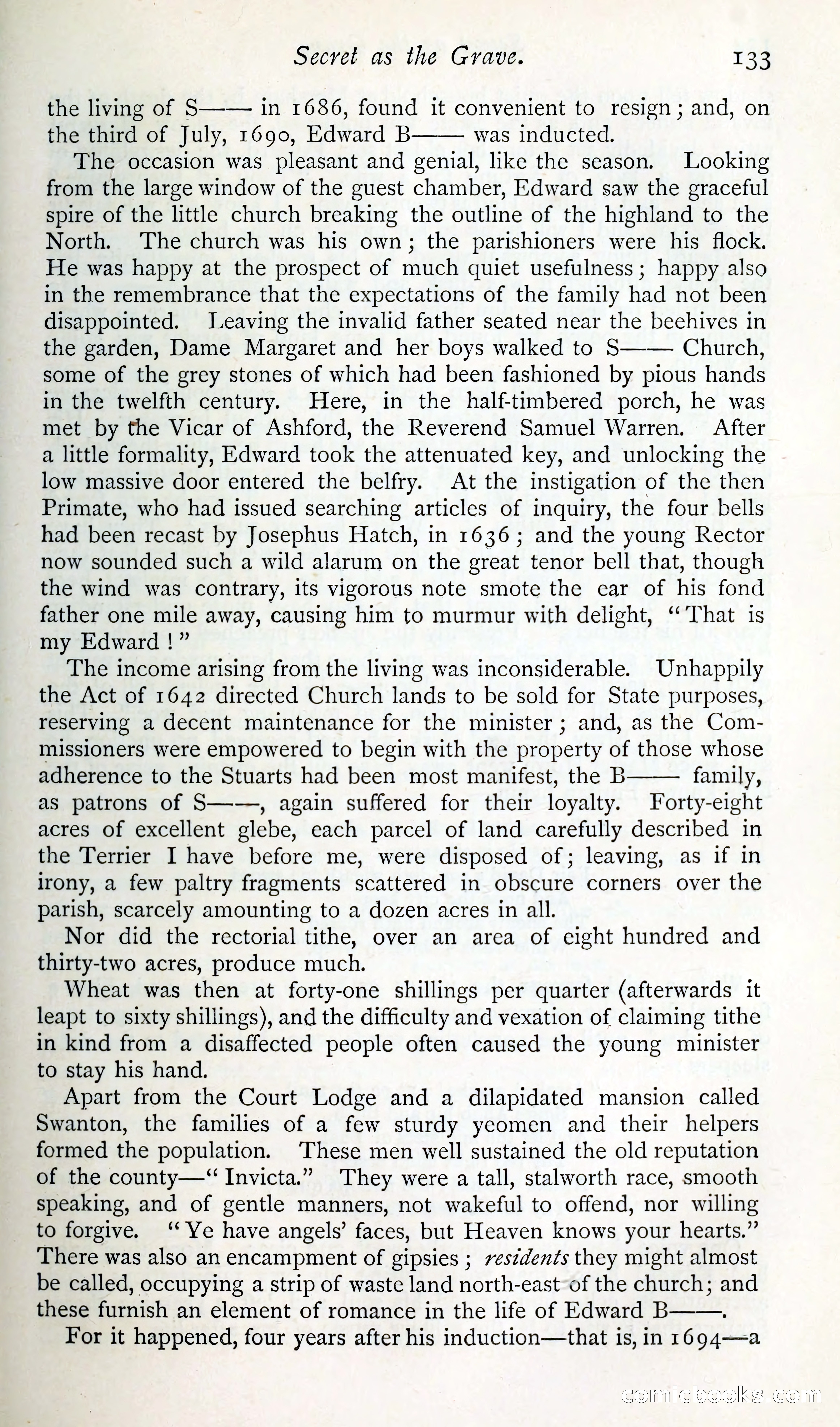
A restored page from Pulp Fiction, 1865. Page through the whole issue in the reader above.
📄 Transcribed text from this page (OCR, searchable)
Machine-transcribed from the original scan — historical spelling and the odd misread are preserved.
Secret as the Grave. 133 the living of S—— in 1686, found it convenient to resign; and, on the third of July, 1690, Edward B—— was inducted. The occasion was pleasant and genial, like the season. Looking from the large window of the guest chamber, Edward saw the graceful spire of the little church breaking the outline of the highland to the North. ‘The church was his own; the parishioners were his flock. He was happy at the prospect of much quiet usefulness; happy also in the remembrance that the expectations of the family had not been disappointed. Leaving the invalid father seated near the beehives in the garden, Dame Margaret and her boys walked to S—— Church, some of the grey stones of which had been fashioned by pious hands in the twelfth century. Here, in the half-timbered porch, he was met by the Vicar of Ashford, the Reverend Samuel Warren. After a little formality, Edward took the attenuated key, and unlocking the low massive door entered the belfry. At the instigation of the then Primate, who had issued searching articles of inquiry, the four bells had been recast by Josephus Hatch, in 1636; and the young Rector now sounded such a wild alarum on the great tenor bell that, though the wind was contrary, its vigorous note smote the ear of his fond father one mile away, causing him to murmur with delight, ‘‘’That 1s my Edward !” The income arising from the living was inconsiderable. Unhappily the Act of 1642 directed Church lands to be sold for State purposes, reserving a decent maintenance for the minister; and, as the Com- missioners were empowered to begin with the property of those whose adherence to the Stuarts had been most manifest, the B——— family, as patrons of S—-—, again suffered for their loyalty. Forty-eight acres of excellent glebe, each parcel of land carefully described in the Terrier I have before me, were disposed of; leaving, as if in irony, a few paltry fragments scattered in obscure corners over the parish, scarcely amounting to a dozen acres in all. Nor did the rectorial tithe, over an area of eight hundred and thirty-two acres, produce much. Wheat was then at forty-one shillings per quarter (afterwards it leapt to sixty shillings), and the difficulty and vexation of claiming tithe in kind from a disaffected people often caused the young minister to stay his hand. Apart from the Court Lodge and a dilapidated mansion called Swanton, the families of a few sturdy yeomen and their helpers formed the population. ‘These men well sustained the old reputation of the county—“ Invicta.” They were a tall, stalworth race, smooth speaking, and of gentle manners, not wakeful to offend, nor willing to forgive. ‘‘ Ye have angels’ faces, but Heaven knows your hearts.” There was also an encampment of gipsies ; vesédents they might almost be called, occupying a strip of waste land north-east of the church; and these furnish an element of romance in the life of Edward B——. For it happened, four years after his induction—that is, in 1694—a GOMIGDOOkKS (SO)