
Pulp Fiction, 1865 · page 144 of 400
The Argosy — page 144: what you’re looking at
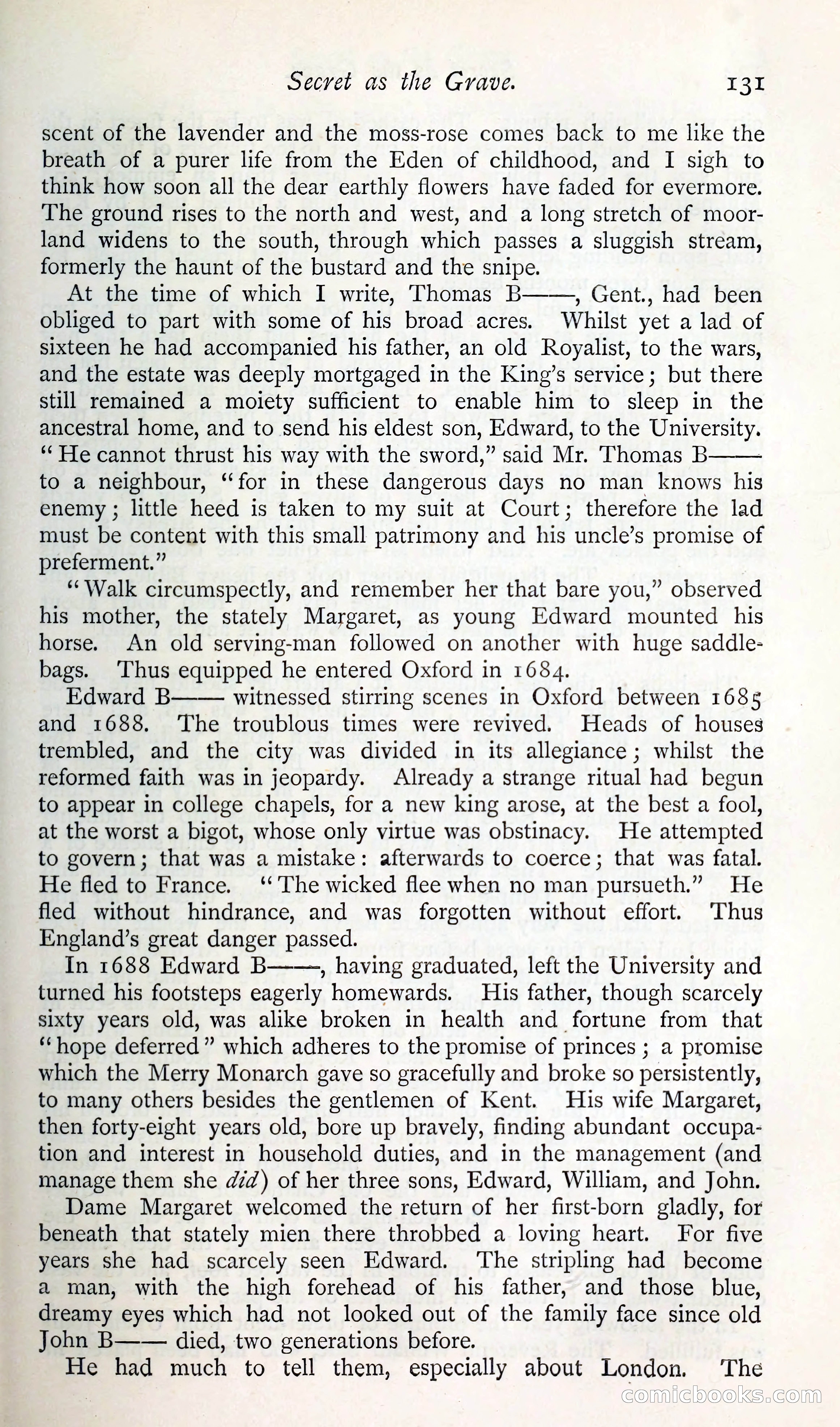
A restored page from Pulp Fiction, 1865. Page through the whole issue in the reader above.
📄 Transcribed text from this page (OCR, searchable)
Machine-transcribed from the original scan — historical spelling and the odd misread are preserved.
Secret as the Grave. 131 scent of the lavender and the moss-rose comes back to me like the breath of a purer life from the Eden of childhood, and I sigh to think how soon all the dear earthly flowers have faded for evermore. The ground rises to the north and west, and a long stretch of moor- land widens to the south, through which passes a sluggish stream, formerly the haunt of the bustard and the snipe. At the time of which I write, Thomas B——, Gent., had been obliged to part with some of his broad acres. Whilst yet a lad of sixteen he had accompanied his father, an old Royalist, to the wars, and the estate was deeply mortgaged in the King’s service; but there still remained a moiety sufficient to enable him to sleep in the ancestral home, and to send his eldest son, Edward, to the University. ‘He cannot thrust his way with the sword,” said Mr. Thomas B to a neighbour, “for in these dangerous days no man knows his enemy ; little heed is taken to my suit at Court; therefore the lad must be content with this small patrimony and his uncle’s promise of preferment.” ‘Walk circumspectly, and remember her that bare you,” observed his mother, the stately Margaret, as young Edward mounted his horse. An old serving-man followed on another with huge saddle- bags. ‘Thus equipped he entered Oxford in 1684. Edward B—-— witnessed stirring scenes in Oxford between 1685 and 1688. ‘The troublous times were revived. Heads of houses trembled, and the city was divided in its allegiance; whilst the reformed faith was in jeopardy. Already a strange ritual had begun to appear in college chapels, for a new king arose, at the best a fool, at the worst a bigot, whose only virtue was obstinacy. He attempted to govern; that was a mistake: afterwards to coerce; that was fatal. He fled to France. ‘‘ The wicked flee when no man pursueth.” He fled without hindrance, and was forgotten without effort. ‘Thus Kngland’s great danger passed. In 1688 Edward B—-—, having graduated, left the University and turned his footsteps eagerly homewards. His father, though scarcely sixty years old, was alike broken in health and fortune from that “hope deferred” which adheres to the promise of princes ; a promise which the Merry Monarch gave so gracefully and broke so persistently, to many others besides the gentlemen of Kent. His wife Margaret, then forty-eight years old, bore up bravely, finding abundant occupa- tion and interest in household duties, and in the management (and manage them she d7d@) of her three sons, Edward, William, and John. Dame Margaret welcomed the return of her first-born gladly, for beneath that stately mien there throbbed a loving heart. For five years she had scarcely seen Edward. ‘The stripling had become a man, with the high forehead of his father, and those blue, dreamy eyes which had not looked out of the family face since old John B—— died, two generations before. He had much to tell them, especially about London. The GOnlGaooks (C©) mn