
Pulp Fiction, 1865 · page 141 of 400
The Argosy — page 141: what you’re looking at
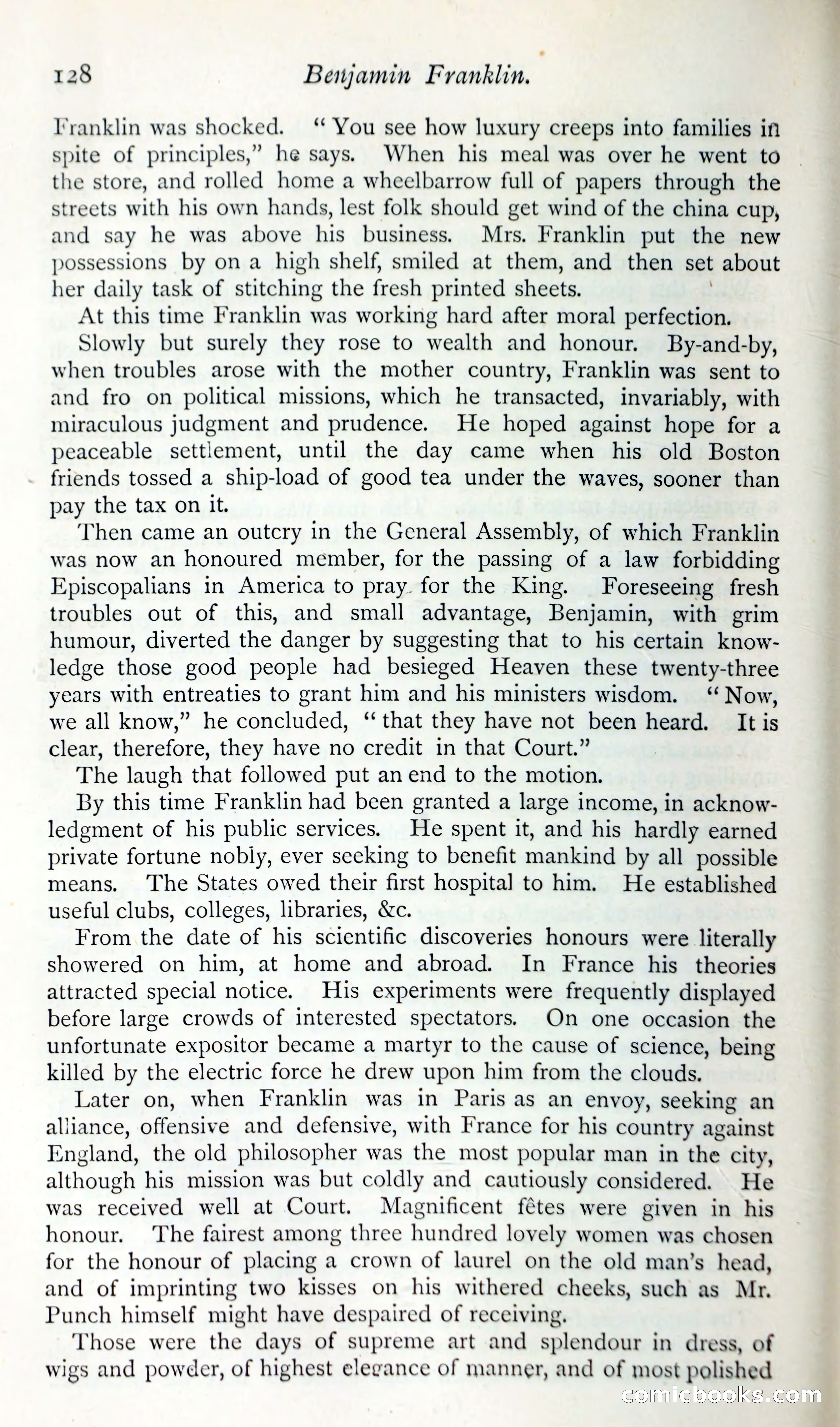
A restored page from Pulp Fiction, 1865. Page through the whole issue in the reader above.
📄 Transcribed text from this page (OCR, searchable)
Machine-transcribed from the original scan — historical spelling and the odd misread are preserved.
128 Benjamin Franklin. I’ranklin was shocked. ‘* You see how luxury creeps into families in spite of principles,” he says. When his meal was over he went to the store, and rolled home a wheelbarrow full of papers through the streets with his own hands, lest folk should get wind of the china cup, and say he was above his business. Mrs. Franklin put the new possessions by on a high shelf, smiled at them, and then set about her daily task of stitching the fresh printed sheets. At this time Franklin was working hard after moral perfection. Slowly but surely they rose to wealth and honour. By-and-by, when troubles arose with the mother country, Franklin was sent to and fro on political missions, which he transacted, invariably, with miraculous judgment and prudence. He hoped against hope for a peaceable settlement, until the day came when his old Boston friends tossed a ship-load of good tea under the waves, sooner than pay the tax on it. Then came an outcry in the General Assembly, of which Franklin was now an honoured member, for the passing of a law forbidding Episcopalians in America to pray. for the King. Foreseeing fresh troubles out of this, and small advantage, Benjamin, with grim humour, diverted the danger by suggesting that to his certain know- ledge those good people had besieged Heaven these twenty-three years with entreaties to grant him and his ministers wisdom. ‘“ Now, we all know,” he concluded, ‘‘ that they have not been heard. It is clear, therefore, they have no credit in that Court.” The laugh that followed put an end to the motion. By this time Franklin had been granted a large income, in acknow- ledgment of his public services. He spent it, and his hardly earned private fortune nobly, ever seeking to benefit mankind by all possible means. ‘The States owed their first hospital to him. He established useful clubs, colleges, libraries, &c. From the date of his scientific discoveries honours were literally showered on him, at home and abroad. In France his theories attracted special notice. His experiments were frequently displayed before large crowds of interested spectators. On one occasion the unfortunate expositor became a martyr to the cause of science, being killed by the electric force he drew upon him from the clouds. Later on, when Franklin was in Paris as an envoy, seeking an alliance, offensive and defensive, with France for his country against England, the old philosopher was the most popular man in the city, although his mission was but coldly and cautiously considered. He was received well at Court. Magnificent fetes were given in his honour. The fairest among three hundred lovely women was chosen for the honour of placing a crown of laurel on the old man’s head, and of imprinting two kisses on his withered cheeks, such as Mr. Punch himself might have despaired of receiving. Those were the days of supreme art and splendour in dress, of wigs and powder, of highest elegance of manner, and of most polished COMIC LOOKS, (E00)