
Pulp Fiction, 1865 · page 137 of 400
The Argosy — page 137: what you’re looking at
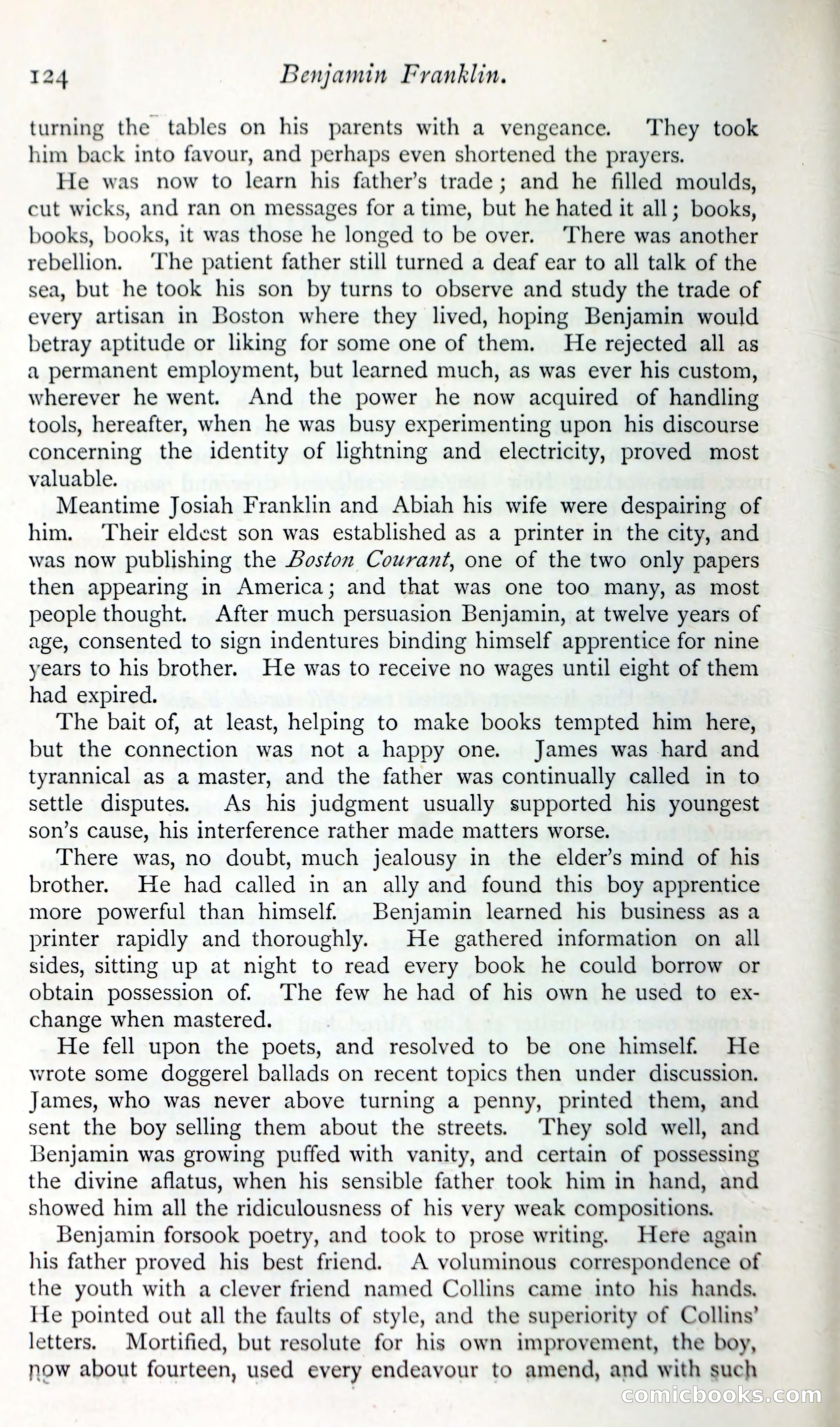
A restored page from Pulp Fiction, 1865. Page through the whole issue in the reader above.
📄 Transcribed text from this page (OCR, searchable)
Machine-transcribed from the original scan — historical spelling and the odd misread are preserved.
124 Benjamin Franklin. turning the tables on his parents with a vengeance. They took him back into favour, and perhaps even shortened the prayers. He was now to learn his father’s trade; and he filled moulds, cut wicks, and ran on messages for a time, but he hated it all; books, books, books, it was those he longed to be over. ‘There was another rebellion. ‘The patient father still turned a deaf ear to all talk of the sea, but he took his son by turns to observe and study the trade of every artisan in Boston where they lived, hoping Benjamin would betray aptitude or liking for some one of them. He rejected all as a permanent employment, but learned much, as was ever his custom, wherever he went. And the power he now acquired of handling tools, hereafter, when he was busy experimenting upon his discourse concerning the identity of lightning and electricity, proved most valuable. Meantime Josiah Franklin and Abiah his wife were despairing of him. ‘Their eldest son was established as a printer in the city, and was now publishing the Boston Courant, one of the two only papers then appearing in America; and that was one too many, as most people thought. After much persuasion Benjamin, at twelve years of age, consented to sign indentures binding himself apprentice for nine years to his brother. He was to receive no wages until eight of them had expired. The bait of, at least, helping to make books tempted him here, but the connection was not a happy one. James was hard and tyrannical as a master, and the father was continually called in to settle disputes. As his judgment usually supported his youngest son’s cause, his interference rather made matters worse. There was, no doubt, much jealousy in the elder’s mind of his brother. He had called in an ally and found this boy apprentice more powerful than himself. Benjamin learned his business as a printer rapidly and thoroughly. He gathered information on all sides, sitting up at night to read every book he could borrow or obtain possession of. The few he had of his own he used to ex- change when mastered. He fell upon the poets, and resolved to be one himself. He wrote some doggerel ballads on recent topics then under discussion. James, who was never above turning a penny, printed them, and sent the boy selling them about the streets. They sold well, and Benjamin was growing puffed with vanity, and certain of possessing the divine aflatus, when his sensible father took him in hand, and showed him all the ridiculousness of his very weak compositions. Benjamin forsook poetry, and took to prose writing. Here again his father proved his best friend. A voluminous correspondence of the youth with a clever friend named Collins came into his hands, He pointed out all the faults of style, and the superiority of Collins’ letters. Mortified, but resolute for his own improvement, the boy, now about fourteen, used every endeavour to amend, and with such CORNICE OOO KS (E)