
Pulp Fiction, 1865 · page 120 of 400
The Argosy — page 120: what you’re looking at
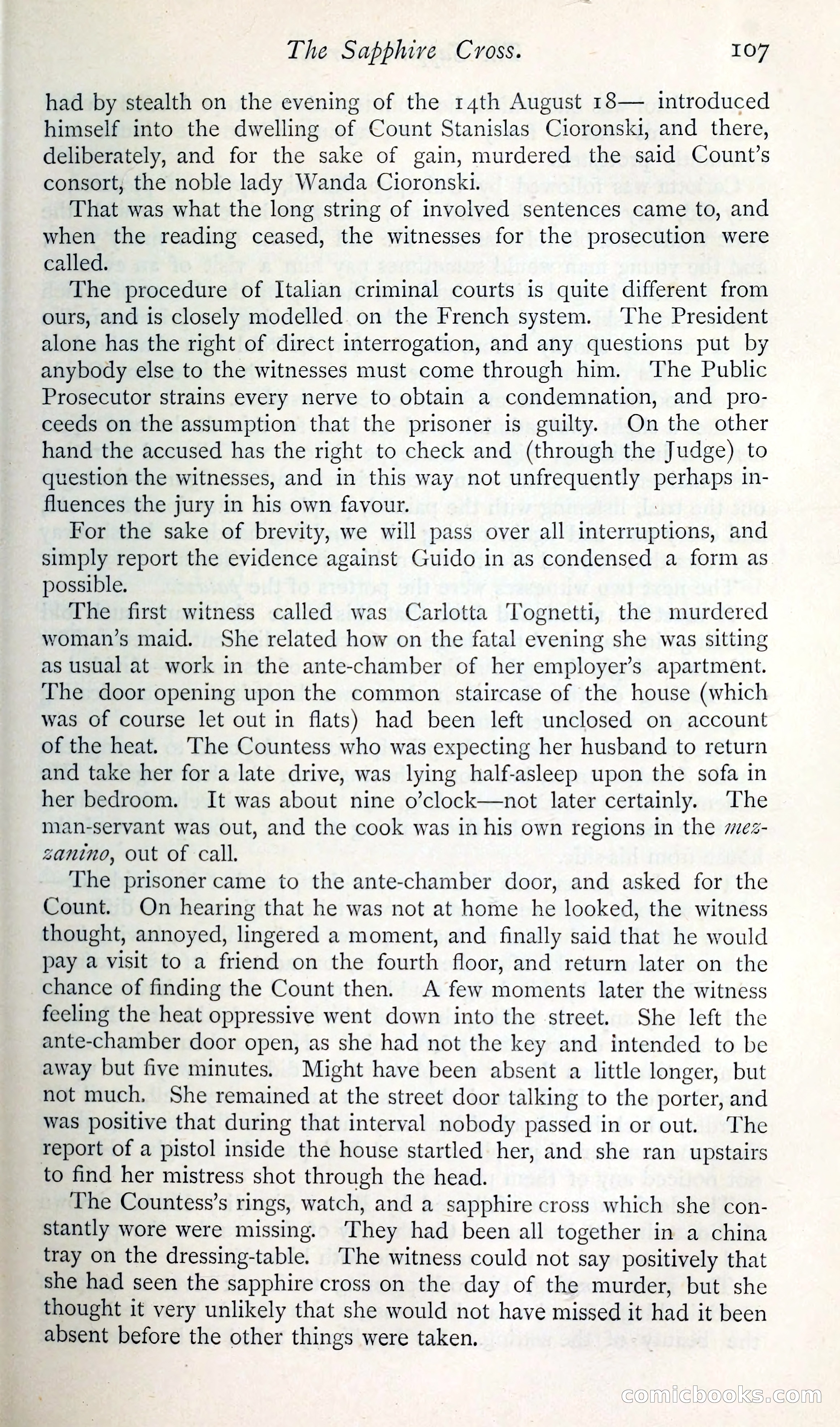
A restored page from Pulp Fiction, 1865. Page through the whole issue in the reader above.
📄 Transcribed text from this page (OCR, searchable)
Machine-transcribed from the original scan — historical spelling and the odd misread are preserved.
The Sapphire Cross. 107 had by stealth on the evening of the 14th August 18— introduced himself into the dwelling of Count Stanislas Cioronski, and there, deliberately, and for the sake of gain, murdered the said Count’s consort, the noble lady Wanda Cioronski. That was what the long string of involved sentences came to, and when the reading ceased, the witnesses for the prosecution were called. The procedure of Italian criminal courts is quite different from ours, and is closely modelled on the French system. The President alone has the right of direct interrogation, and any questions put by anybody else to the witnesses must come through him. ‘The Public Prosecutor strains every nerve to obtain a condemnation, and pro- ceeds on the assumption that the prisoner is guilty. On the other hand the accused has the right to check and (through the Judge) to question the witnesses, and in this way not unfrequently pashan in- fluences the jury in his own favour. For the sake of brevity, we will pass over all eae and simply report the evidence against Guido in as condensed a form as possible. The first witness called was Carlotta Tognetti, the murdered woman’s maid. She related how on the fatal evening she was sitting as usual at work in the ante-chamber of her employer’s apartment. The door opening upon the common staircase of the house (which was of course let out in flats) had been left unclosed on account of the heat. ‘The Countess who was expecting her husband to return and take her for a late drive, was lying half-asleep upon the sofa in her bedroom. It was about nine o’clock—not later certainly. The man-servant was out, and the cook was in his own regions in the mez- zsanino, out of call. The prisoner came to the ante-chamber door, and asked for the Count. On hearing that he was not at home he looked, the witness thought, annoyed, lingered a moment, and finally said that he would pay a visit to a friend on the fourth floor, and return later on the chance of finding the Count then. A few moments later the witness feeling the heat oppressive went down into the street. She left the ante-chamber door open, as she had not the key and intended to be away but five minutes. Might have been absent a little longer, but not much. She remained at the street door talking to the porter, and was positive that during that interval nobody passed in or out. The report of a pistol inside the house startled her, and she ran upstairs to find her mistress shot through the head. The Countess’s rings, watch, and a sapphire cross which she con- stantly wore were missing. They had been all together in a china tray on the dressing-table. ‘The witness could not say positively that she had seen the sapphire cross on the day of the murder, but she thought it very unlikely that she would not have missed it had it been absent before the other things were taken. COnnicloooks (CO)