
Pulp Fiction, 1865 · page 119 of 400
The Argosy — page 119: what you’re looking at
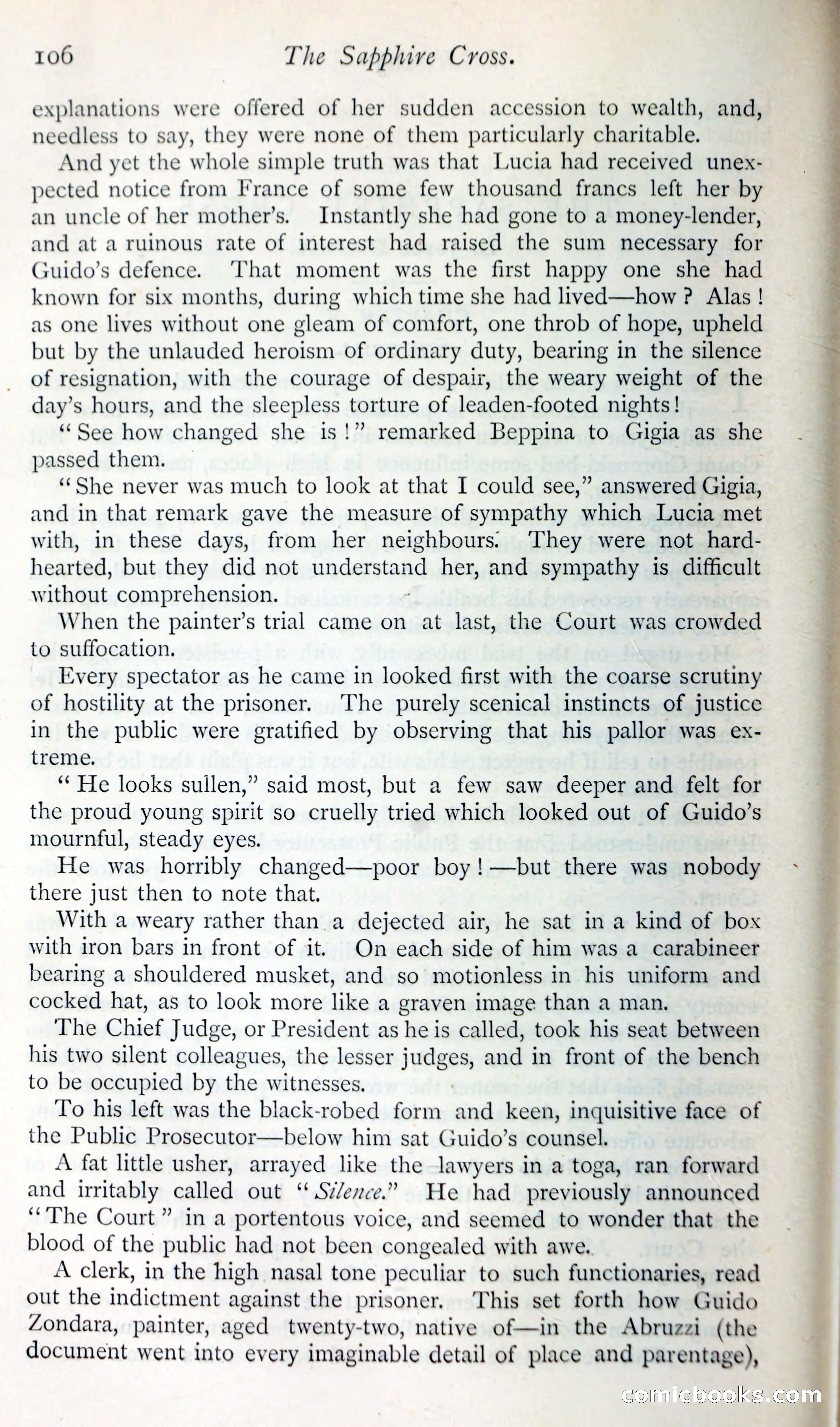
A restored page from Pulp Fiction, 1865. Page through the whole issue in the reader above.
📄 Transcribed text from this page (OCR, searchable)
Machine-transcribed from the original scan — historical spelling and the odd misread are preserved.
106 The Sapphire Cross. explanations were offered of her sudden accession to wealth, and, needless to say, they were none of them particularly charitable. And yet the whole simple truth was that Lucia had received unex- pected notice from France of some few thousand frances left her by an uncle of her mother’s. Instantly she had gone to a money-lender, and at a ruinous rate of interest had raised the sum necessary for Guido’s defence. ‘That moment was the first happy one she had known for six months, during which time she had lived—how ? Alas! as one lives without one gleam of comfort, one throb of hope, upheld but by the unlauded heroism of ordinary duty, bearing in the silence of resignation, with the courage of despair, the weary weight of the day’s hours, and the sleepless torture of leaden-footed nights! “See how changed she is!” remarked Beppina to Gigia as she passed them. | ‘‘She never was much to look at that I could see,” answered Gigia, and in that remark gave the measure of sympathy which Lucia met with, in these days, from her neighbours. ‘They were not hard- hearted, but they did not understand her, and sympathy is difficult without comprehension. ; When the painter’s trial came on at last, the Court was crowded to suffocation. Every spectator as he came in looked first with the coarse scrutiny of hostility at the prisoner. ‘The purely scenical instincts of justice in the public were gratified by observing that his pallor was ex- treme. | ‘“ He looks sullen,” said most, but a few saw deeper and felt for the proud young spirit so cruelly tried which looked out of Guido’s mournful, steady eyes. He was horribly changed—poor boy !—but there was nobody there just then to note that. With a weary rather than a dejected air, he sat in a kind of box with iron bars in front of it. On each side of him was a carabineer bearing a shouldered musket, and so motionless in his uniform and cocked hat, as to look more like a graven image than a man. The Chief Judge, or President as he is called, took his seat between his two silent colleagues, the lesser judges, and in front of the bench to be occupied by the witnesses. . To his left was the black-robed form and keen, inquisitive face of the Public Prosecutor—below him sat Guido’s counsel. A fat little usher, arrayed like the lawyers in a toga, ran forward and irritably called out ‘ S7/ence.” He had previously announced ‘The Court” in a portentous voice, and seemed to wonder that the blood of the public had not been congealed with awe. A clerk, in the high nasal tone peculiar to such functionaries, read out the indictment against the prisoner. This set forth how Guido Zondara, painter, aged twenty-two, native of—in the Abruzzi (the document went into every imaginable detail of place and parentage), (EO MMNIKE OKO KS