
Pulp Fiction, 1865 · page 102 of 400
The Argosy — page 102: what you’re looking at
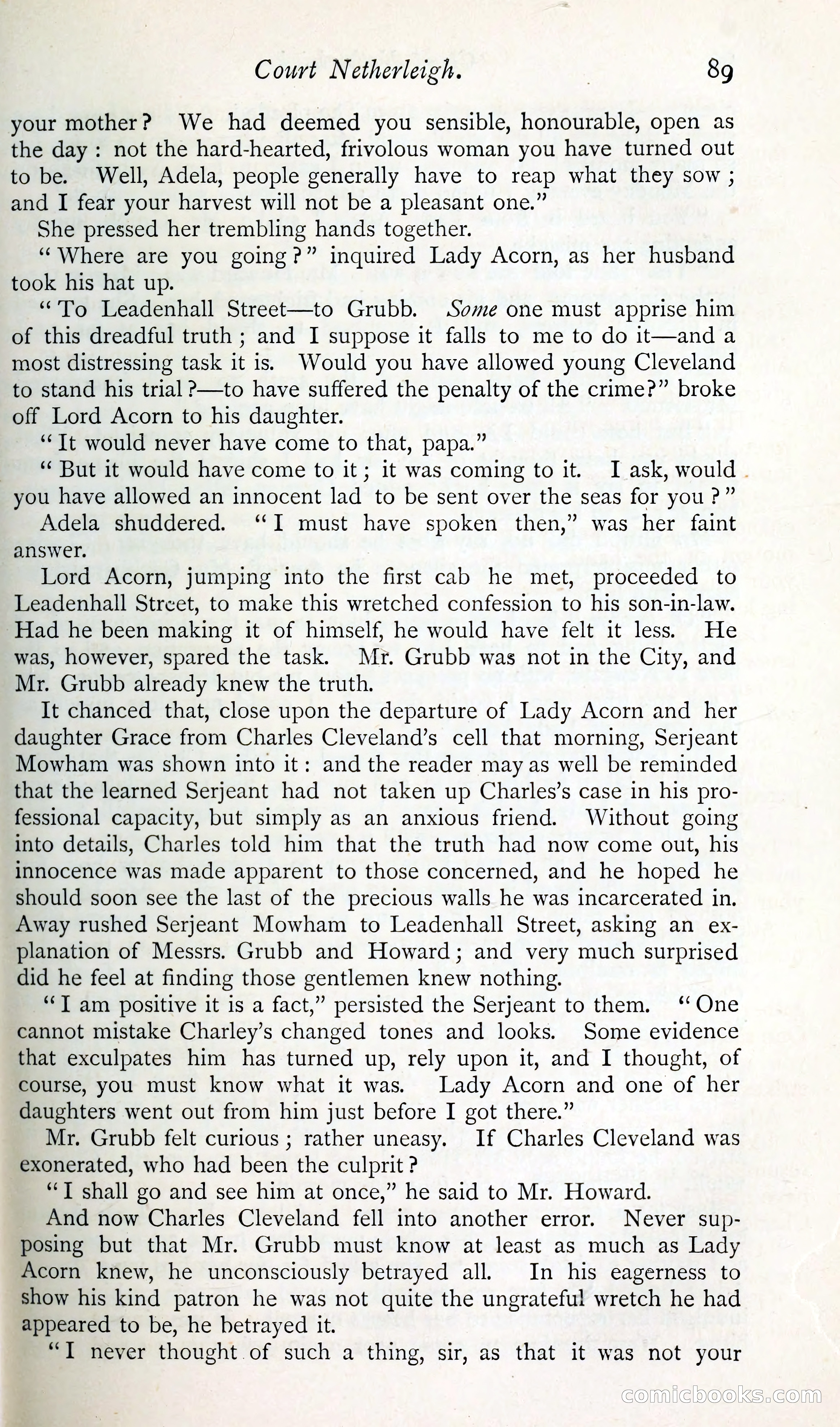
A restored page from Pulp Fiction, 1865. Page through the whole issue in the reader above.
📄 Transcribed text from this page (OCR, searchable)
Machine-transcribed from the original scan — historical spelling and the odd misread are preserved.
Court Netherleigh. | 8g your mother? We had deemed you sensible, honourable, open as the day: not the hard-hearted, frivolous woman you have turned out to be. Well, Adela, people generally have to reap what they sow ; and I fear your harvest will not be a pleasant one.” She pressed her trembling hands together. “Where are you going?” inquired Lady Acorn, as her husband took his hat up. “To Leadenhall Street—to Grubb. Some one must apprise him of this dreadful truth ; and I suppose it falls to me to do it—and a most distressing task it is. Would you have allowed young Cleveland to stand his trial >—to have suffered the penalty of the crimeP” broke off Lord Acorn to his daughter. ‘Tt would never have come to that, papa.” ‘“‘ But it would have come to it; it was coming to it. I ask, would you have allowed an innocent lad to be sent over the seas for you ?” Adela shuddered. ‘“‘I must have spoken then,” was her faint answer. Lord Acorn, jumping into the first cab he met, proceeded to Leadenhall Street, to make this wretched confession to his son-in-law. Had he been making it of himself, he would have felt it less. He was, however, spared the task. Mr. Grubb was not in the City, and Mr. Grubb already knew the truth. It chanced that, close upon the departure of Lady Acorn and her daughter Grace from Charles Cleveland’s cell that morning, Serjeant Mowham was shown into it: and the reader may as well be reminded that the learned Serjeant had not taken up Charles’s case in his pro- fessional capacity, but simply as an anxious friend. Without going into details, Charles told him that the truth had now come out, his innocence was made apparent to those concerned, and he hoped he should soon see the last of the precious walls he was incarcerated in, Away rushed Serjeant Mowham to Leadenhall Street, asking an ex- planation of Messrs. Grubb and Howard; and very much surprised did he feel at finding those gentlemen knew nothing. ‘“‘T am positive it is a fact,” persisted the Serjeant to them. ‘‘One cannot mistake Charley’s changed tones and looks. Some evidence that exculpates him has turned up, rely upon it, and I thought, of course, you must know what it was. Lady Acorn and one of her daughters went out from him just before I got there.” Mr. Grubb felt curious ; rather uneasy. If Charles Cleveland was exonerated, who had been the culprit ? ““T shall go and see him at once,” he said to Mr. Howard. And now Charles Cleveland fell into another error. Never sup- posing but that Mr. Grubb must know at least as much as Lady Acorn knew, he unconsciously betrayed all. In his eagerness to show his kind patron he was not quite the ungrateful wretch he had appeared to be, he betrayed it. “I never thought.of such a thing, sir, as that it was not your COMIC OOO SS) (SO)