
Pulp Fiction, 1865 · page 90 of 400
The Argosy — page 90: what you’re looking at
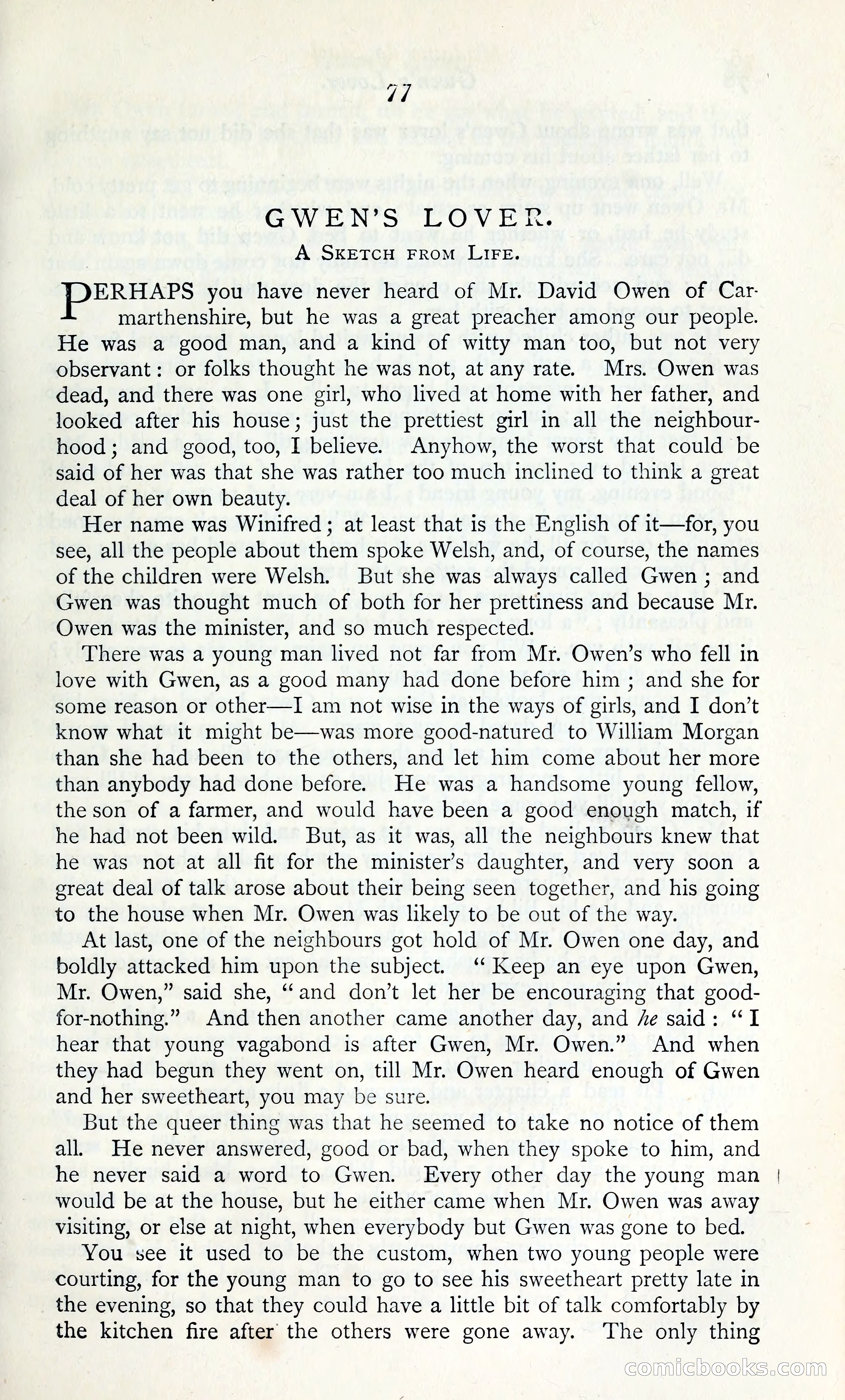
A restored page from Pulp Fiction, 1865. Page through the whole issue in the reader above.
📄 Transcribed text from this page (OCR, searchable)
Machine-transcribed from the original scan — historical spelling and the odd misread are preserved.
GWEN’S LOVER. A SKETCH FROM LIFE. oS you have never heard of Mr. David Owen of Car- marthenshire, but he was a great preacher among our people. He was a good man, and a kind of witty man too, but not very observant: or folks thought he was not, at any rate. Mrs. Owen was dead, and there was one girl, who lived at home with her father, and looked after his house; just the prettiest girl in all the neighbour- hood; and good, too, I believe. Anyhow, the worst that could be said of her was that she was rather too much inclined to think a great deal of her own beauty. Her name was Winifred; at least that is the English of it—for, you see, all the people about them spoke Welsh, and, of course, the names of the children were Welsh. But she was always called Gwen ; and Gwen was thought much of both for her prettiness and because Mr. Owen was the minister, and so much respected. There was a young man lived not far from Mr. Owen’s who fell in love with Gwen, as a good many had done before him ; and she for some reason or other—I am not wise in the ways of girls, and I don’t know what it might be—was more good-natured to William Morgan than she had been to the others, and let him come about her more than anybody had done before. He was a handsome young fellow, the son of a farmer, and would have been a good enough match, if he had not been wild. But, as it was, all the neighbours knew that he was not at all fit for the minister’s daughter, and very soon a great deal of talk arose about their being seen together, and his going to the house when Mr. Owen was hkely to be out of the way. At last, one of the neighbours got hold of Mr. Owen one day, and boldly attacked him upon the subject. ‘‘ Keep an eye upon Gwen, Mr. Owen,” said she, “‘and don’t let her be encouraging that good- for-nothing.” And then another came another day, and he said: “I hear that young vagabond is after Gwen, Mr. Owen.” And when they had begun they went on, till Mr. Owen heard enough of Gwen and her sweetheart, you may be sure. But the queer thing was that he seemed to take no notice of them all. He never answered, good or bad, when they spoke to him, and he never said a word to Gwen. Every other day the young man would be at the house, but he either came when Mr. Owen was away visiting, or else at night, when everybody but Gwen was gone to bed. You see it used to be the custom, when two young people were courting, for the young man to go to see his sweetheart pretty late in the evening, so that they could have a little bit of talk comfortably by the kitchen fire after the others were gone away. ‘The only thing conniclooolkks (C(O)