
Pulp Fiction, 1865 · page 74 of 400
The Argosy — page 74: what you’re looking at
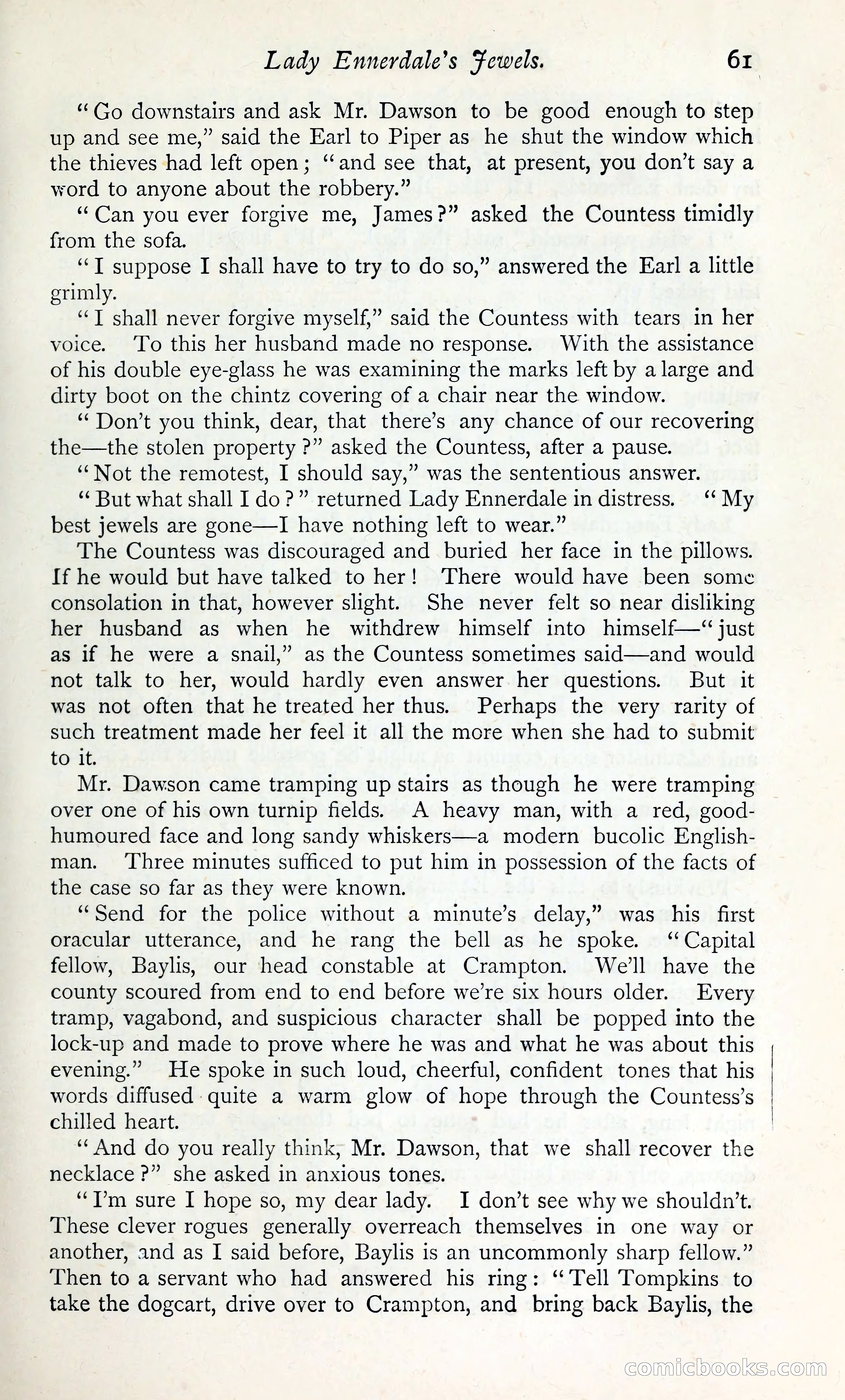
A restored page from Pulp Fiction, 1865. Page through the whole issue in the reader above.
📄 Transcribed text from this page (OCR, searchable)
Machine-transcribed from the original scan — historical spelling and the odd misread are preserved.
Lady Ennerdale’s Fewels. 61 ‘Go downstairs and ask Mr. Dawson to be good enough to step up and see me,” said the Earl to Piper as he shut the window which the thieves had left open; ‘‘and see that, at present, you don’t say a word to anyone about the robbery.” “Can you ever forgive me, James?” asked the Countess timidly from the sofa. ‘“‘T suppose I shall have to try to do so,” answered the Ear! a little grimly. ‘““T shall never forgive myself,” said the Countess with tears in her voice. ‘To this her husband made no response. With the assistance of his double eye-glass he was examining the marks left by a large and dirty boot on the chintz covering of a chair near the window. “ Don’t you think, dear, that there’s any chance of our recovering the—the stolen property ?” asked the Countess, after a pause. ‘Not the remotest, I should say,” was the sententious answer. ‘“ But what shall I do?” returned Lady Ennerdale in distress. ‘‘ My best jewels are gone—I have nothing left to wear.” The Countess was discouraged and buried her face in the pillows. If he would but have talked to her! ‘There would have been some consolation in that, however slight. She never felt so near disliking her husband as when he withdrew himself into himself—‘“ just as if he were a snail,” as the Countess sometimes said—and would not talk to her, would hardly even answer her questions. But it was not often that he treated her thus. Perhaps the very rarity of such treatment made her feel it all the more when she had to submit to it. Mr. Dawson came tramping up stairs as though he were tramping over one of his own turnip fields. A heavy man, with a red, good- humoured face and long sandy whiskers—a modern bucolic English- man. ‘Three minutes sufficed to put him in possession of the facts of the case so far as they were known. “Send for the police without a minute’s delay,” was his first oracular utterance, and he rang the bell as he spoke. “Capital fellow, Baylis, our head constable at Crampton. We’ll have the county scoured from end to end before we’re six hours older. Every tramp, vagabond, and suspicious character shall be popped into the lock-up and made to prove where he was and what he was about this evening.” He spoke in such loud, cheerful, confident tones that his words diffused: quite a warm glow of hope through the Countess’s chilled heart. “And do you really think, Mr. Dawson, that we shall recover the necklace ?” she asked in anxious tones. ‘““Y’m sure I hope so, my dear lady. I don’t see why we shouldn't. These clever rogues generally overreach themselves in one way or another, and as I said before, Baylis is an uncommonly sharp fellow.” Then to a servant who had answered his ring: ‘‘ Tell Tompkins to take the dogcart, drive over to Crampton, and bring back Baylis, the Se cConniclooolkks (C(O)