
Pulp Fiction, 1865 · page 69 of 400
The Argosy — page 69: what you’re looking at
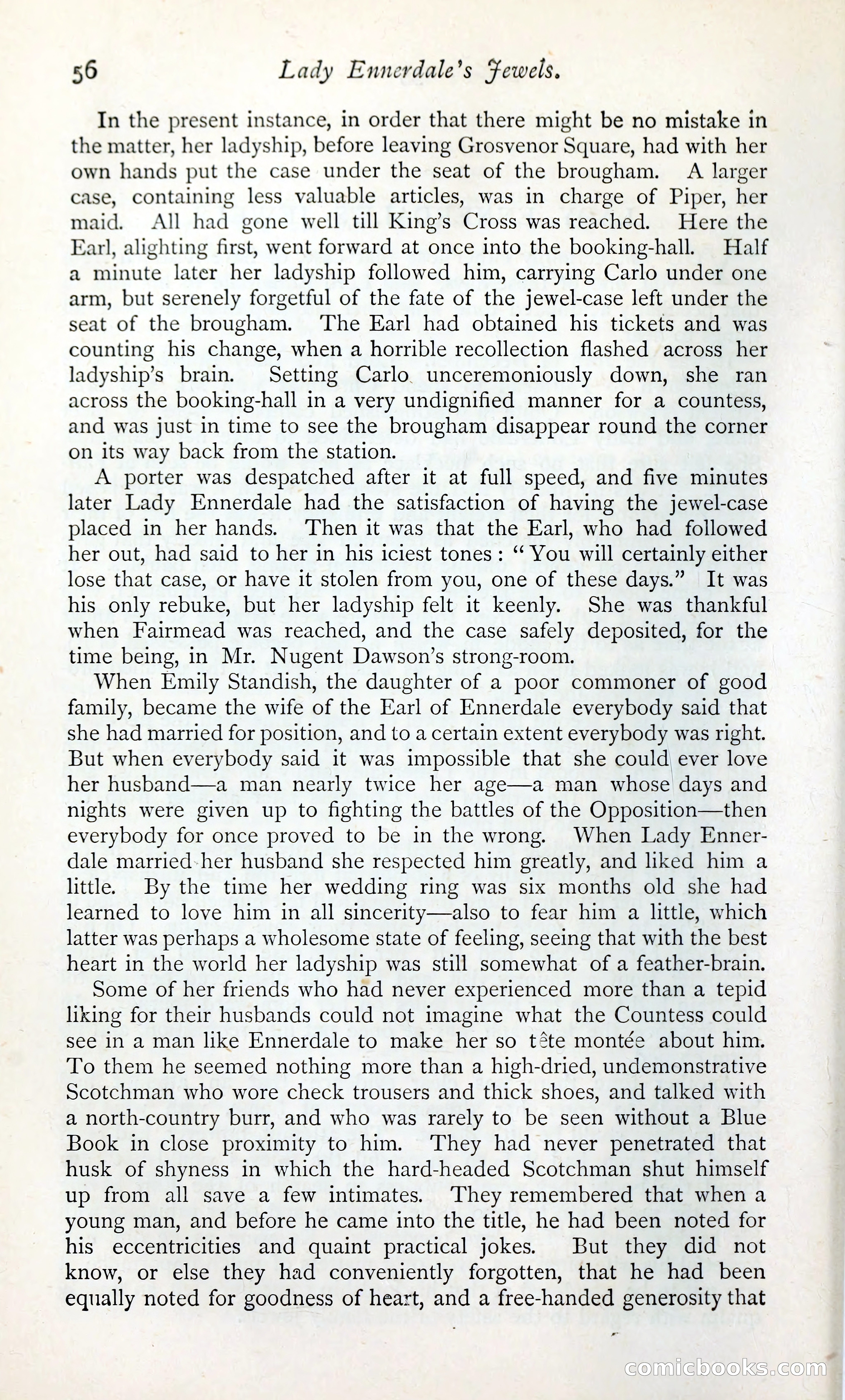
A restored page from Pulp Fiction, 1865. Page through the whole issue in the reader above.
📄 Transcribed text from this page (OCR, searchable)
Machine-transcribed from the original scan — historical spelling and the odd misread are preserved.
56 Lady Ennerdale’s Fewels. In the present instance, in order that there might be no mistake in the matter, her ladyship, before leaving Grosvenor Square, had with her own hands put the case under the seat of the brougham. A larger case, containing less valuable articles, was in charge of Piper, her maid. All had gone well till King’s Cross was reached. Here the Earl, alighting first, went forward at once into the booking-hall. Half a minute later her ladyship followed him, carrying Carlo under one arm, but serenely forgetful of the fate of the jewel-case left under the seat of the brougham. ‘The Earl had obtained his tickets and was counting his change, when a horrible recollection flashed across her ladyship’s brain. Setting Carlo. unceremoniously down, she ran across the booking-hall in a very undignified manner for a countess, and was just in time to see the brougham disappear round the corner on its way back from the station. A porter was despatched after it at full speed, and five minutes later Lady Ennerdale had the satisfaction of having the jewel-case placed in her hands. ‘Then it was that the Earl, who had followed her out, had said to her in his iciest tones: “ You will certainly either lose that case, or have it stolen from you, one of these days.” It was his only rebuke, but her ladyship felt it keenly. She was thankful when Fairmead was reached, and the case safely deposited, for the time being, in Mr. Nugent Dawson’s strong-room. When Emily Standish, the daughter of a poor commoner of good family, became the wife of the Earl of Ennerdale everybody said that she had married for position, and to a certain extent everybody was right. But when everybody said it was impossible that she conta ever love her husband—a man nearly twice her age—a man whose days and nights were given up to fighting the battles of the Opposition—then everybody for once proved to be in the wrong. When Lady Enner- dale married-her husband she respected him greatly, and liked him a little. By the time her wedding ring was six months old she had learned to love him in all sincerity—also to fear him a little, which latter was perhaps a wholesome state of feeling, seeing that with the best heart in the world her ladyship was still somewhat of a feather-brain. Some of her friends who had never experienced more than a tepid liking for their husbands could not imagine what the Countess could see in a man like Ennerdale to make her so téte montée about him. To them he seemed nothing more than a high-dried, undemonstrative Scotchman who wore check trousers and thick shoes, and talked with a north-country burr, and who was rarely to be seen without a Blue Book in close proximity to him. ‘They had never penetrated that husk of shyness in which the hard-headed Scotchman shut himself up from all save a few intimates. ‘They remembered that when a young man, and before he came into the title, he had been noted for his eccentricities and quaint practical jokes. But they did not know, or else they had conveniently forgotten, that he had been equally noted for goodness of heart, and a free-handed generosity that CoOnnicloooks (CO)