
Pulp Fiction, 1865 · page 291 of 400
The Argosy — page 291: what you’re looking at
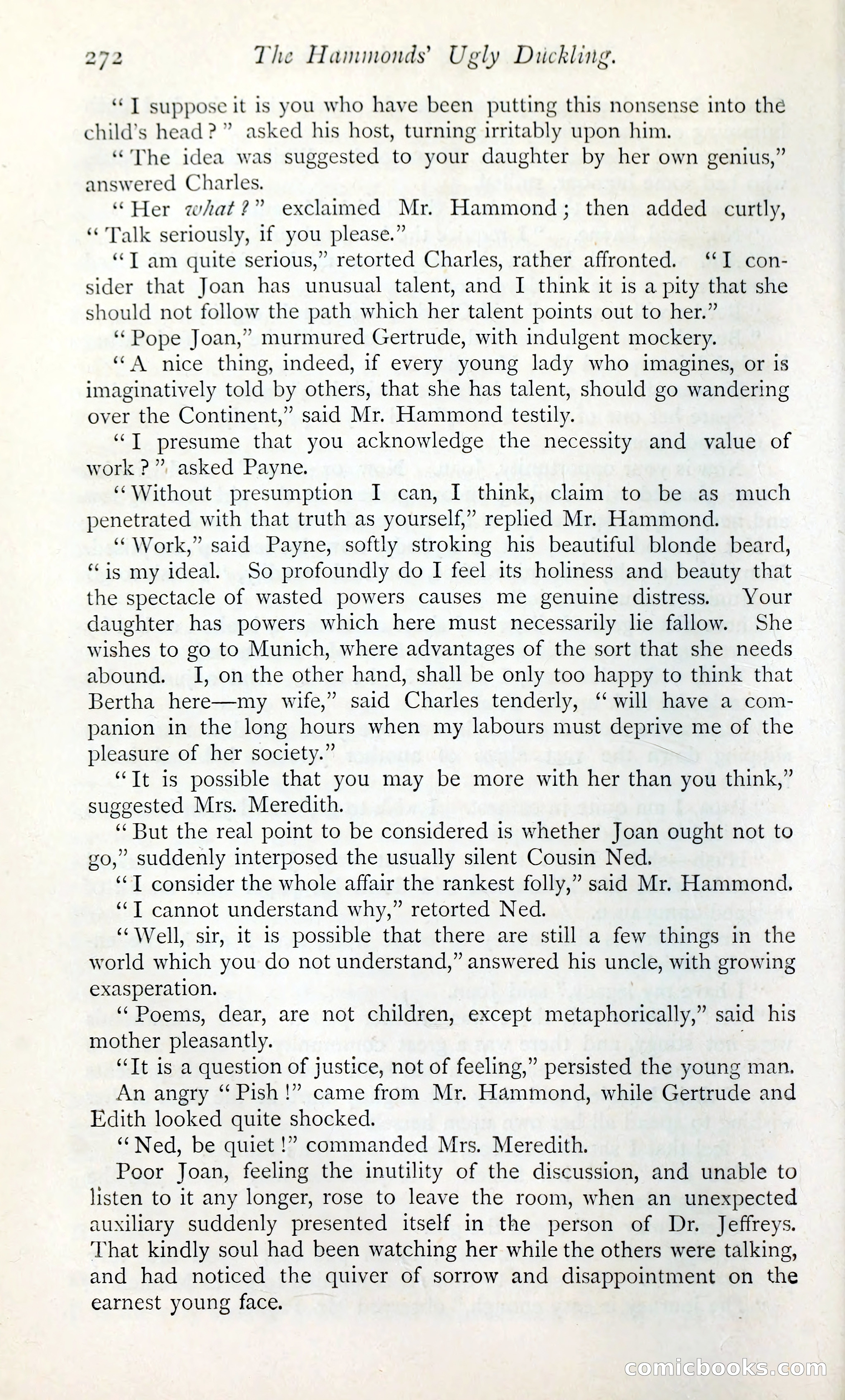
A restored page from Pulp Fiction, 1865. Page through the whole issue in the reader above.
📄 Transcribed text from this page (OCR, searchable)
Machine-transcribed from the original scan — historical spelling and the odd misread are preserved.
272 The Hammonds’ Ugly Dhiickling. ‘“T suppose it is you who have been putting this nonsense into the child’s head?” asked his host, turning irritably upon him. “The idea was suggested to your daughter by her own genius,” answered Charles. “Her what?” exclaimed Mr. Hammond; then added curtly, “Talk seriously, 1f you please.” ‘“T am quite serious,” retorted Charles, rather affronted. ‘‘I con- sider that Joan has unusual talent, and I think it is a pity that she should not follow the path which her talent points out to her.” ‘Pope Joan,” murmured Gertrude, with indulgent mockery. “A nice thing, indeed, if every young lady who imagines, or is imaginatively told by others, that she has talent, should go wandering over the Continent,” said Mr. Hammond testily. “JT presume that you acknowledge the necessity and value of work ?”, asked Payne. ‘Without presumption I can, I think, claim to be as much penetrated with that truth as yourself,” replied Mr. Hammond. “Work,” said Payne, softly stroking his beautiful blonde beard, “is my ideal. So profoundly do I feel its holiness and beauty that the spectacle of wasted powers causes me genuine distress. Your daughter has powers which here must necessarily lie fallow. She wishes to go to Munich, where advantages of the sort that she needs abound. I, on the other hand, shall be only too hapas to think that Bertha here—my wife,” said Charles tenderly, “will have a com- panion in the long hours when my labours must deprive me of the pleasure of her society.” “Tt is possible that you may be more with her than you think,” suggested Mrs. Meredith. ‘But the real point to be considered is whether Joan ought not to go,” suddenly interposed the usually silent Cousin Ned. ‘T consider the whole affair the rankest folly,” said Mr. Hammond. “JT cannot understand why,” retorted Ned. ‘Well, sir, it 1s possible that there are still a few things in the world which you do not understand,” answered his uncle, with growing exasperation. “Poems, dear, are not children, except metaphorically,” said his mother pleasantly. “Tt is a question of justice, not of feeling,” persisted the young man. An angry ‘ Pish!” came from Mr. Hammond, while Gertrude and Edith looked quite shocked. “Ned, be quiet!” commanded Mrs. Meredith. Poor Joan, feeling the inutility of the discussion, and unable to listen to it any longer, rose to leave the room, when an unexpected auxiliary suddenly presented itself in the person of Dr. Jeffreys. That kindly soul had been watching her while the others were talking, and had noticed the quiver of sorrow and disappointment on the earnest young face. EORNIELIOOKS .E@