
Pulp Fiction, 1865 · page 276 of 400
The Argosy — page 276: what you’re looking at
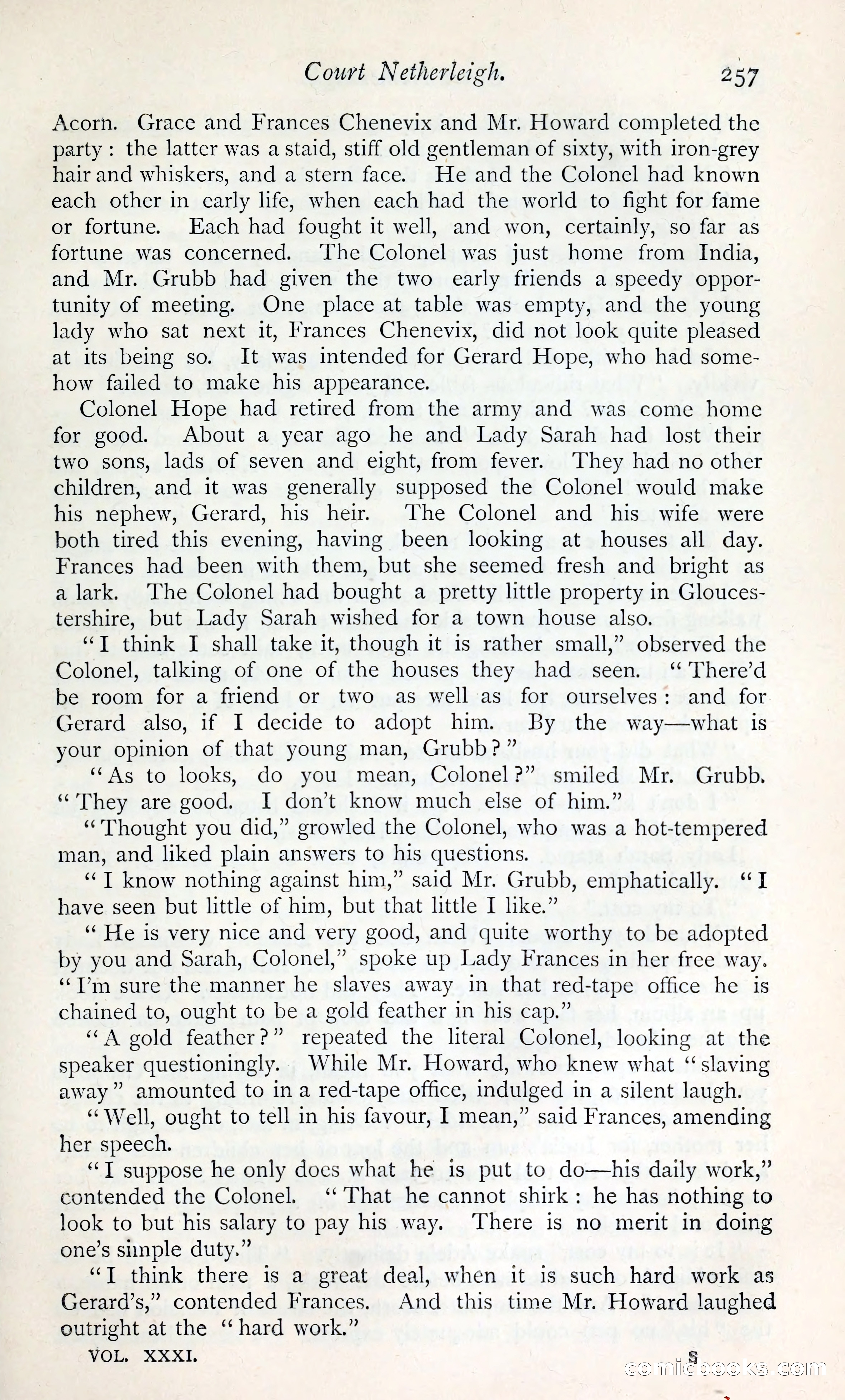
A restored page from Pulp Fiction, 1865. Page through the whole issue in the reader above.
📄 Transcribed text from this page (OCR, searchable)
Machine-transcribed from the original scan — historical spelling and the odd misread are preserved.
Court Netherleigh. 257 Acorn. Grace and Frances Chenevix and Mr. Howard completed the party: the latter was a staid, stiff old gentleman of sixty, with 1ron-grey hair and whiskers, and a stern face. He and the Colonel had known each other in early life, when each had the world to fight for fame or fortune. Each had fought it well, and won, certainly, so far as fortune was concerned. ‘The Colonel was just home from India, and Mr. Grubb had given the two early friends a speedy oppor- tunity of meeting. One place at table was empty, and the young lady who sat next it, Frances Chenevix, did not look quite pleased at its being so. It was intended for Gerard Hope, who had some- how failed to make his appearance. Colonel Hope had retired from the army and was come home for good. About a year ago he and Lady Sarah had lost their two sons, lads of seven and eight, from fever. ‘They had no other children, and it was generally supposed the Colonel would make his nephew, Gerard, his heir. The Colonel and his wife were both tired this evening, having been looking at houses all day. Frances had been with them, but she seemed fresh and bright as a lark. The Colonel had bought a pretty little property in Glouces- tershire, but Lady Sarah wished for a town house also. “T think I shall take it, though it is rather small,” observed the Colonel, talking of one of the houses they had seen. ‘ There’d be room for a friend or two as well as for ourselves: and for Gerard also, if I decide to adopt him. By the way—what is your opinion of that young man, Grubb?” “As to looks, do you mean, Colonel?” smiled Mr. Grubb. “They are good. I don’t know much else of him.” “Thought you did,” growled the Colonel, who was a hot-tempered man, and liked plain answers to his questions. ‘JT know nothing against him,” said Mr. Grubb, emphatically. ‘I have seen but little of him, but that little I hke.” ‘He is very nice and very good, and quite worthy to be adopted by you and Sarah, Colonel,” spoke up Lady Frances in her free way. ‘Tm sure the manner he slaves away in that red-tape office he is chained to, ought to be a gold feather in his cap.” ‘A gold feather?” repeated the literal Colonel, looking at the speaker questioningly. While Mr. Howard, who knew what “slaving away” amounted to in a red-tape office, indulged in a silent laugh. “Well, ought to tell in his favour, I mean,” said Frances, amending her speech. ‘“T suppose he only does what he is put to do—his daily work,” contended the Colonel. ‘‘’ That he cannot shirk: he has nothing to look to but his salary to pay his way. ‘There is no merit in doing one’s sinple duty.” “T think there is a great deal, when it is such hard work as Gerard’s,” contended Frances. And this time Mr. Howard laughed outright at the “ hard work.” VOL, XXXI. COnn Gi NOOKS (C(O) ~