
Pulp Fiction, 1865 · page 137 of 400
The Argosy — page 137: what you’re looking at
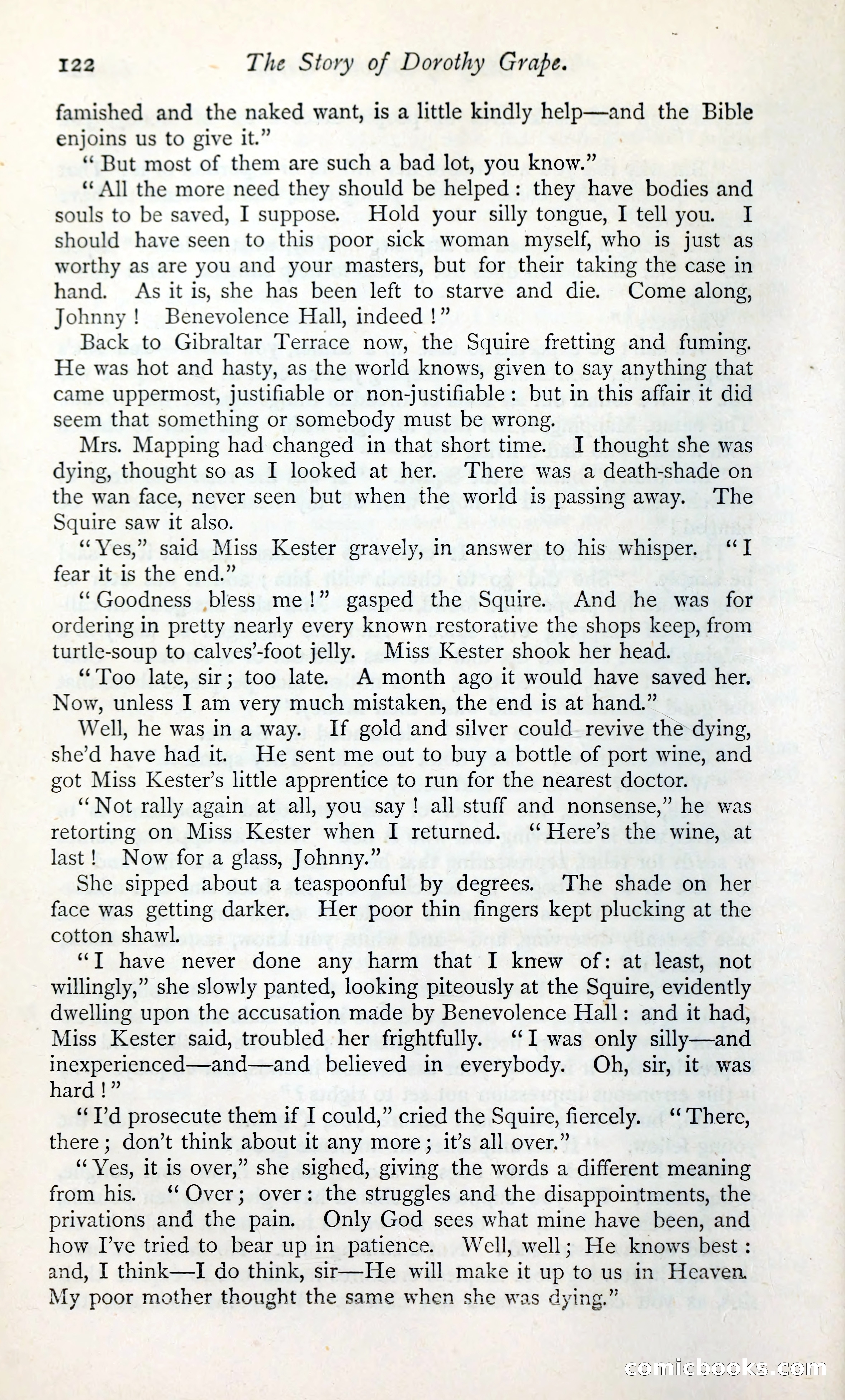
A restored page from Pulp Fiction, 1865. Page through the whole issue in the reader above.
📄 Transcribed text from this page (OCR, searchable)
Machine-transcribed from the original scan — historical spelling and the odd misread are preserved.
122 The Story of Dorothy Grape. famished and the naked want, is a little kindly help—and the Bible enjoins us to give it.” ‘ But most of them are such a bad lot, you know.” “All the more need they should be helped: they have bodies and souls to be saved, I suppose. Hold your silly tongue, I tell you. I should have seen to this poor sick woman myself, who is just as worthy as are you and your masters, but for their taking the case in hand. As it 1s, she has been left to starve and die. Come along, Johnny! Benevolence Hall, indeed !” Back to Gibraltar Terrace now, the Squire fretting and fuming. He was hot and hasty, as the world knows, given to say anything that came uppermost, justifiable or non-justifiable: but in this affair it did seem that something or somebody must be wrong. Mrs. Mapping had changed in that short time. I thought she was dying, thought so as I looked at her. ‘There was a death-shade on the wan face, never seen but when the world is passing away. ‘The Squire saw it also. “Ves,” said Miss Kester gravely, in answer to his whisper. ‘I fear it is the end.” “Goodness bless me!” gasped a Squire. And he was for ordering in pretty nearly every known restorative the shops keep, from turtle-soup to calves’-foot jelly. Miss Kester shook her head. “Too late, sir; too late. A month ago it would have saved her. Now, unless I am very much mistaken, the end 1s at hand.” Well, he was ina way. If gold and silver could revive the dying, she’d have had it. He sent me out to buy a bottle of port wine, and got Miss Kester’s little apprentice to run for the nearest doctor. “Not rally again at all, you say! all stuff and nonsense,” he was retorting on Miss Kester when I returned. ‘‘ Here’s the wine, at last! Now for a glass, Johnny.” She sipped about a teaspoonful by degrees. The shade on her face was getting darker. Her poor thin fingers kept plucking at the cotton shawl. “T have never done any harm that I knew of: at least, not willingly,” she slowly panted, looking piteously at the Squire, evidently dwelling upon the accusation made by Benevolence Hall: and it had, Miss Kester said, troubled her frightfully. ‘1 was only silly—and inexperienced—and—and believed in everybody. Oh, sir, it was hard !” “1d prosecute them if I could,” cried the Squire, fiercely. ‘‘ There, there; don’t think about it any more; it’s all over.” ‘Ves, it is over,” she sighed, giving the words a different meaning from his. ‘Over; over: the struggles and the disappointments, the privations and the pain. Only God sees what mine have been, and how I’ve tried to bear up in patience. Well, well; He knows best: and, I think—TI do think, sir—He will make it up to us in Heaven. My poor mother thought the same when she was dying.” Gomicbooks (C(O)