
Pulp Fiction, 1865 · page 132 of 400
The Argosy — page 132: what you’re looking at
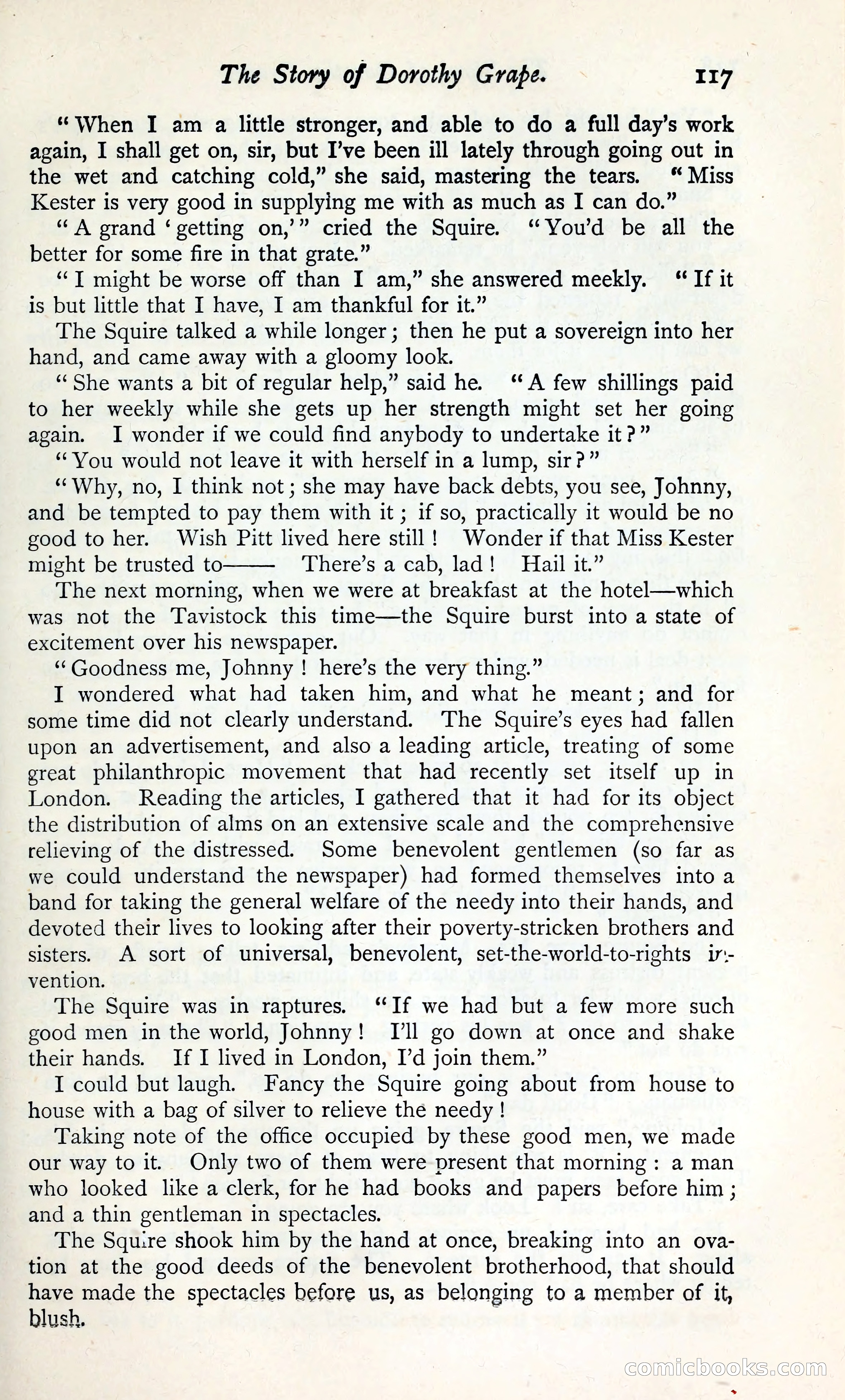
A restored page from Pulp Fiction, 1865. Page through the whole issue in the reader above.
📄 Transcribed text from this page (OCR, searchable)
Machine-transcribed from the original scan — historical spelling and the odd misread are preserved.
The Story of Dorothy Grape. 117 ‘When I am a little stronger, and able to do a full day’s work again, I shall get on, sir, but I’ve been ill lately through going out in the wet and catching cold,” she said, mastering the tears. “ Miss Kester is very good in supplying me with as much as I can do.” “ A grand ‘getting on,’” cried the Squire. ‘“You’d be all the better for some fire in that grate.” ‘‘T might be worse off than I am,” she answered meekly. “If it is but little that I have, I am thankful for it.” The Squire talked a while longer; then he put a sovereign into her hand, and came away with a gloomy look. ‘She wants a bit of regular help,” said he. ‘A few shillings paid to her weekly while she gets up her strength might set her going again. I wonder if we could find anybody to undertake it?” “Vou would not leave it with herself in a lump, sir?” ‘Why, no, I think not; she may have back debts, you see, Johnny, and be tempted to pay them with it; if so, practically 1t would be no good to her. Wish Pitt lived here still! Wonder if that Miss Kester might be trusted to ‘There’s a-cab, lad! Haalt1t.” The next morning, when we were at breakfast at the hotel—which was not the Tavistock this time—the Squire burst into a state of excitement over his newspaper. ‘‘Goodness me, Johnny ! here’s the very thing.” I wondered what had taken him, and what he meant; and for some time did not clearly understand. ‘The Squire’s eyes had fallen upon an advertisement, and also a leading article, treating of some great philanthropic movement that had recently set itself up in London. Reading the articles, I gathered that it had for its object the distribution of alms on an extensive scale and the comprehensive relieving of the distressed. Some benevolent gentlemen (so far as we could understand the newspaper) had formed themselves into a band for taking the general welfare of the needy into their hands, and devoted their lives to looking after their poverty-stricken brothers and sisters. A sort of universal, benevolent, set-the-world-to-rights m'- vention. The Squire was in raptures. “If we had but a few more such good men in the world, Johnny! Il go down at once and shake their hands. If I lived in London, I’d join them.” I could but laugh. Fancy the Squire going about from house to house with a bag of silver to relieve the needy ! Taking note of the office occupied by these good men, we made our way to it. Only two of them were present that morning: a man who looked like a clerk, for he had books and papers before him ; and a thin gentleman in spectacles. The Squ:re shook him by the hand at once, breaking into an ova- tion at the good deeds of the benevolent brotherhood, that should have made the spectacles before us, as belonging to a member of it, blush. COMICOOO© SS (C(O) *