
Pulp Fiction, 1865 · page 295 of 400
The Argosy — page 295: what you’re looking at
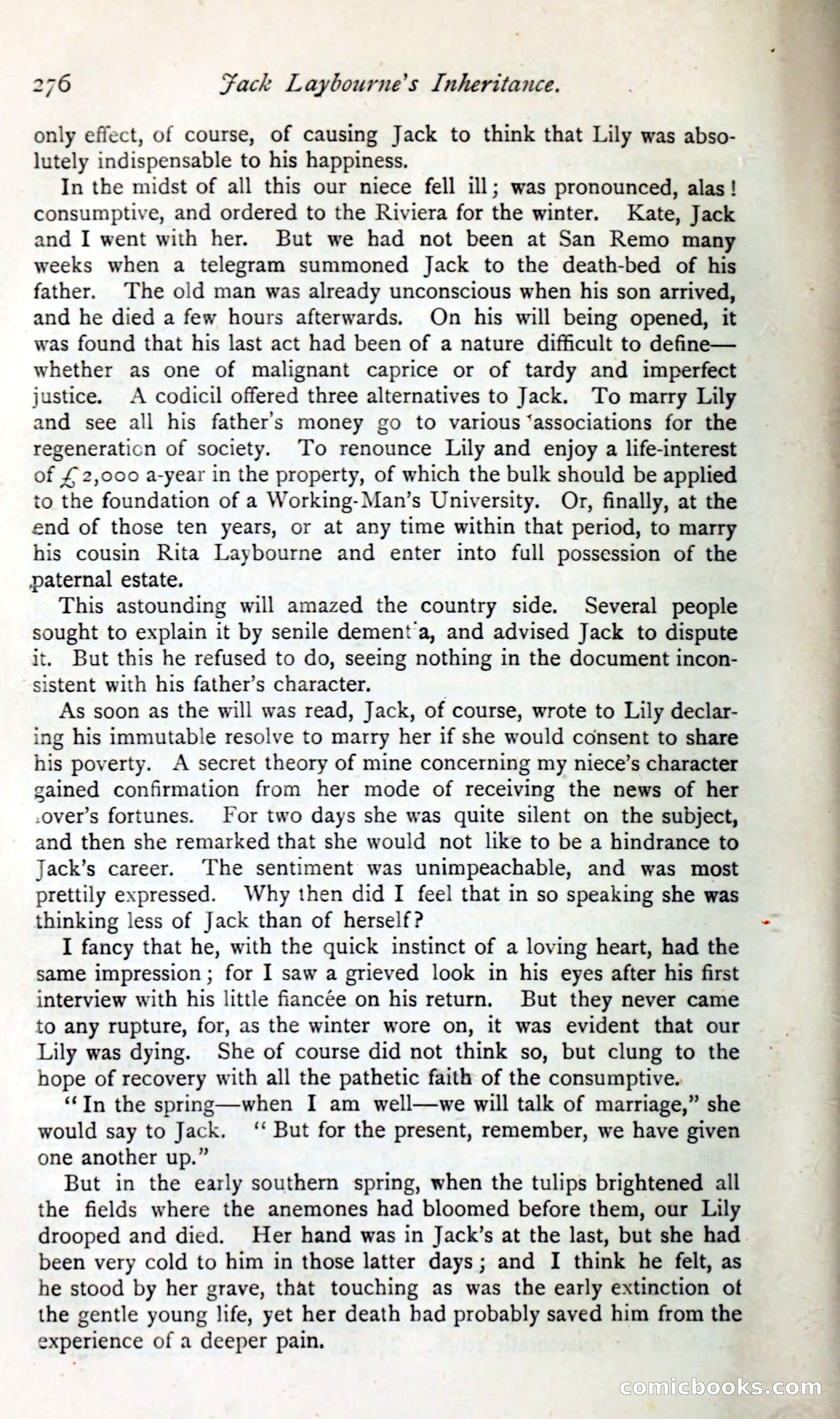
A restored page from Pulp Fiction, 1865. Page through the whole issue in the reader above.
📄 Transcribed text from this page (OCR, searchable)
Machine-transcribed from the original scan — historical spelling and the odd misread are preserved.
276 Fack Laybourne’s Inheritance. only effect, of course, of causing Jack to think that Lily was abso- lutely indispensable to his happiness. In the midst of all this our niece fell ill; was pronounced, alas! consumptive, and ordered to the Riviera for the winter. Kate, Jack and I went with her. But we had not been at San Remo many weeks when a telegram summoned Jack to the death-bed of his father. The old man was already unconscious when his son arrived, and he died a few hours afterwards. On his will being opened, it was found that his last act had been of a nature difficult to define— whether as one of malignant caprice or of tardy and imperfect justice. A codicil offered three alternatives to Jack. To marry Lily and see all his father’s money go to various ‘associations for the regeneration of society. To renounce Lily and enjoy a life-interest of £2,000 a-year in the property, of which the bulk should be applied to the foundation of a Working-Man’s University. Or, finally, at the end of those ten years, or at any time within that period, to marry his cousin Rita Laybourne and enter into full possession of the paternal estate. This astounding will amazed the country side. Several people sought to explain it by senile dement'a, and advised Jack to dispute it. But this he refused to do, seeing nothing in the document incon- sistent with his father’s character. | As soon as the will was read, Jack, of course, wrote to Lily declar- ing his immutable resolve to marry her if she would consent to share his poverty. A secret theory of mine concerning my niece’s character gained confirmation from her mode of receiving the news of her .over’s fortunes. For two days she was quite silent on the subject, and then she remarked that she would not like to be a hindrance to Jack’s career. ‘The sentiment was unimpeachable, and was most prettily expressed. Why then did I feel that in so speaking she was thinking less of Jack than of herself? I fancy that he, with the quick instinct of a loving heart, had the same impression ; for I saw a grieved look in his eyes after his first interview with his little fiancée on his return. But they never came to any rupture, for, as the winter wore on, it was evident that our Lily was dying. She of course did not think so, but clung to the hope of recovery with all the pathetic faith of the consumptive. ‘In the spring—when I am well—we will talk of marriage,” she would say to Jack. ‘‘ But for the present, remember, we have given one another up.” But in the early southern spring, when the tulips brightened all the fields where the anemones had bloomed before them, our Lily drooped and died. Her hand was in Jack’s at the last, but she had been very cold to him in those latter days; and I think he felt, as he stood by her grave, that touching as was the early extinction of the gentle young life, yet her death had probably saved him from the experience of a deeper pain. Gomichboo “S (E(0)