
Pulp Fiction, 1865 · page 211 of 400
The Argosy — page 211: what you’re looking at
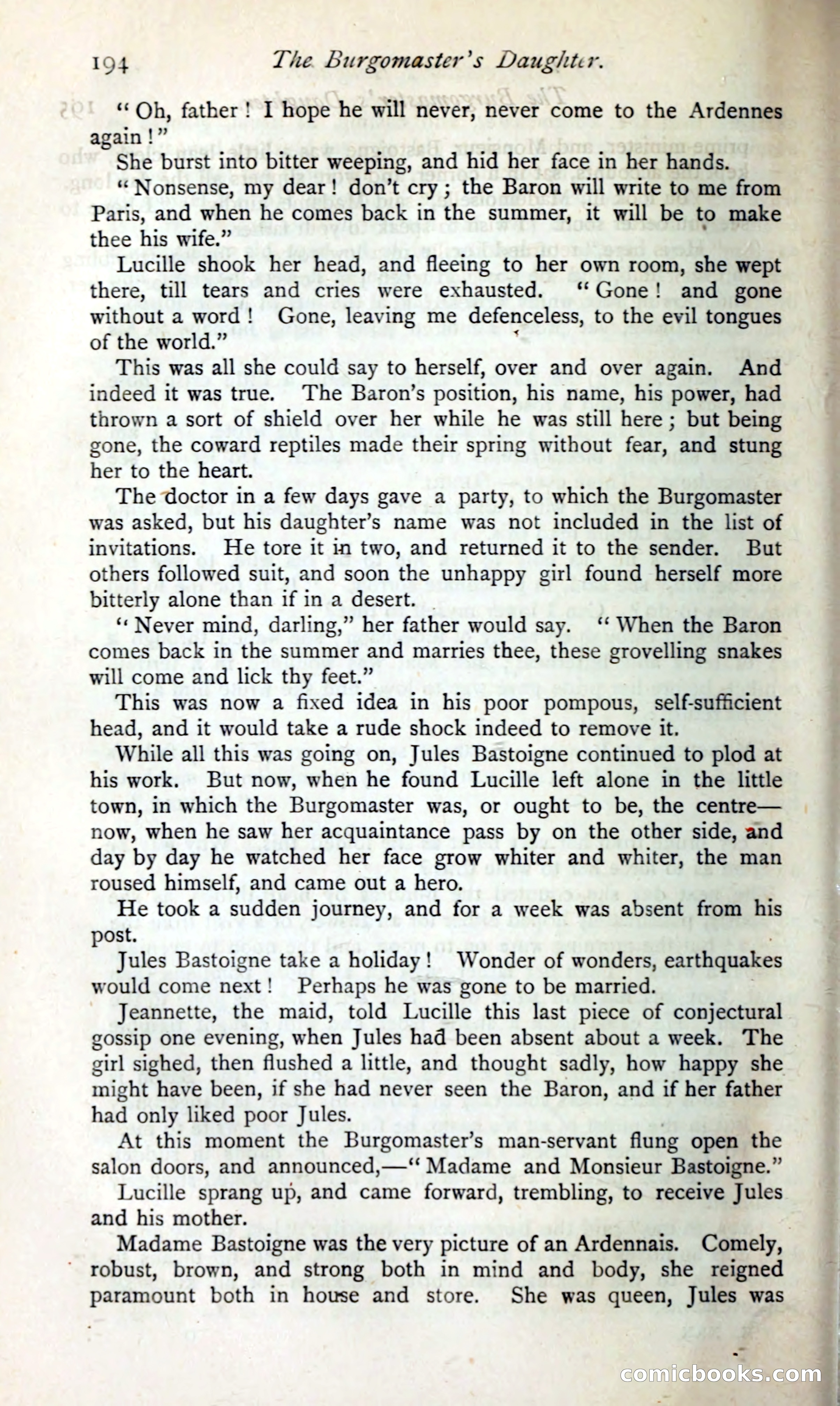
A restored page from Pulp Fiction, 1865. Page through the whole issue in the reader above.
📄 Transcribed text from this page (OCR, searchable)
Machine-transcribed from the original scan — historical spelling and the odd misread are preserved.
194 Lhe. Lurgomaster’s Sa r. ‘Oh, father! I hope he will never, never come to the Ardennes again !” ; She burst into bitter weeping, and hid her face in her hands. “Nonsense, my dear! don’t cry ; the Baron will write to me from Paris, and when he comes back in the summer, it will be to make thee his wife.” Lucille shook her head, and fleeing to her own room, she wept there, till tears and cries were exhausted. “Gone! and gone without a word! Gone, leaving me defenceless, to the evil tongues of the world.” . This was all she could say to herself, over and over again. And indeed it was true. The Baron’s position, his name, his power, had thrown a sort of shield over her while he was still here ; but being gone, the coward reptiles made their spring without fear, and stung her to the heart. The doctor in a few days gave a party, to which the Burgomaster was asked, but his daughter’s name was not included in the list of invitations. He tore it in two, and returned it to the sender. But others followed suit, and soon the unhappy girl found herself more bitterly alone than if in a desert. _ ‘« Never mind, darling,” her father would say. ‘‘ When the Baron comes back in the summer and marries thee, these grovelling snakes will come and lick thy feet.” This was now a fixed idea in his poor pompous, self-sufficient head, and it would take a rude shock indeed to remove it. While all this was going on, Jules Bastoigne continued to plod at his work. But now, when he found Lucille left alone in the little town, in which the Burgomaster was, or ought to be, the centre— now, when he saw her acquaintance pass by on the other side, and day by day he watched her face grow whiter and whiter, the man roused himself, and came out a hero. He took a sudden journey, and for a week was absent from his post. Jules Bastoigne take a holiday! Wonder of wonders, earthquakes would come next! Perhaps he was gone to be married. Jeannette, the maid, told Lucille this last piece of conjectural gossip one evening, when Jules had been absent about a week. The girl sighed, then flushed a little, and thought sadly, how happy she might have been, if she had never seen the Baron, and if her father had only liked poor Jules. At this moment the Burgomaster’s man-servant flung open the salon doors, and announced,—‘‘ Madame and Monsieur Bastoigne.” Lucille sprang up, and came forward, trembling, to receive Jules and his mother. | Madame Bastoigne was the very picture of an Ardennais. Comely, ' robust, brown, and strong both in mind and body, she reigned paramount both in house and store. She was queen, Jules was Gomicbooks.cor