
Pulp Fiction, 1865 · page 164 of 400
The Argosy — page 164: what you’re looking at
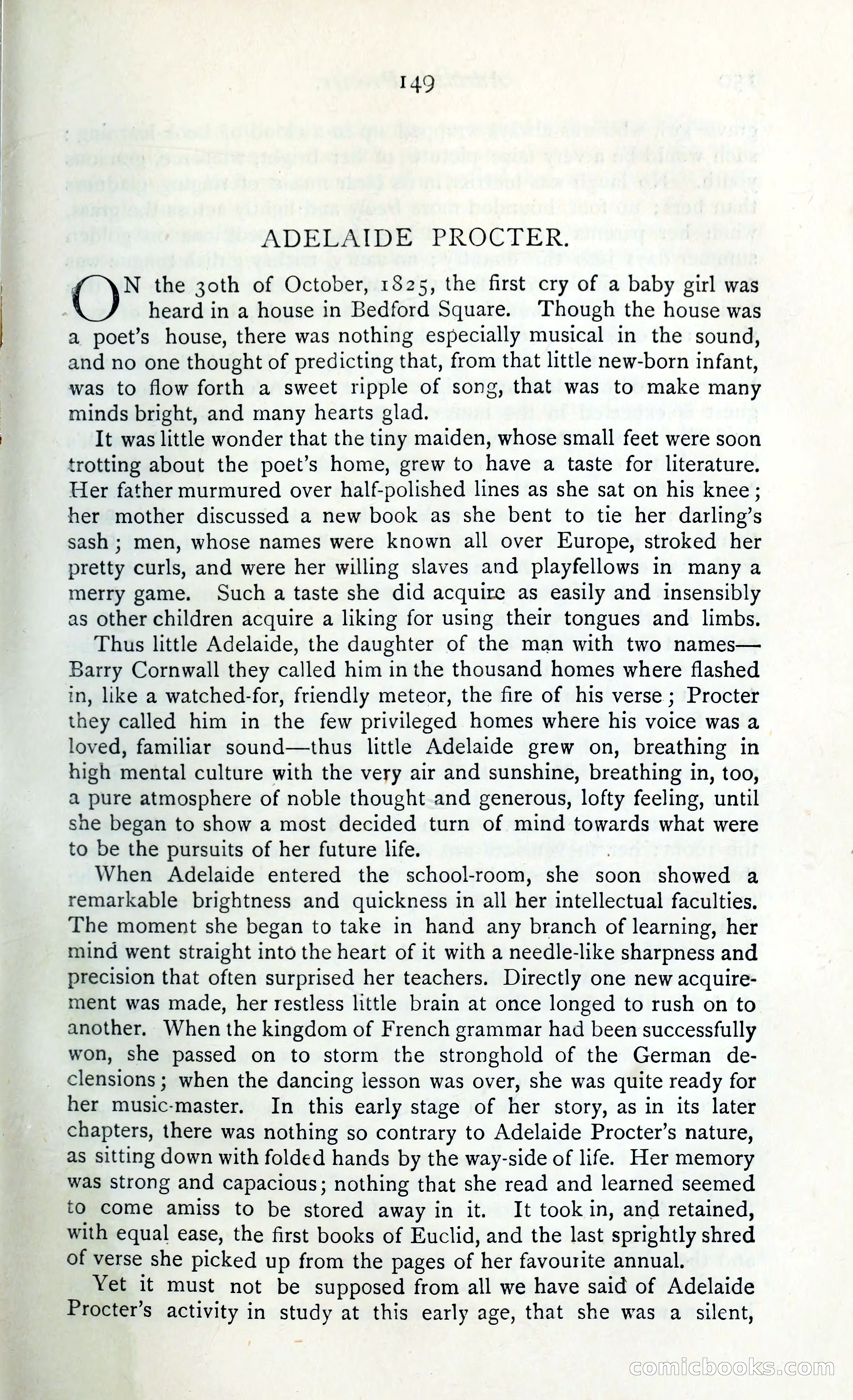
A restored page from Pulp Fiction, 1865. Page through the whole issue in the reader above.
📄 Transcribed text from this page (OCR, searchable)
Machine-transcribed from the original scan — historical spelling and the odd misread are preserved.
NS 149 ADELAIDE PROCTER. N the 30th of October, 1825, the first cry of a baby girl was heard in a house in Bedford Square. Though the house was a poet’s house, there was nothing especially musical in the sound, and no one thought of predicting that, from that little new-born infant, was to flow forth a sweet ripple of song, that was to make many minds bright, and many hearts glad. It was little wonder that the tiny maiden, whose small feet were soon trotting about the poet’s home, grew to have a taste for literature. Her father murmured over half-polished lines as she sat on his knee; her mother discussed a new book as she bent to tie her darling’s sash ; men, whose names were known all over Europe, stroked her pretty curls, and were her willing slaves and playfellows in many a merry game. Such a taste she did acquire as easily and insensibly as other children acquire a liking for using their tongues and limbs. Thus little Adelaide, the daughter of the man with two names— Barry Cornwall they called him in the thousand homes where flashed in, like a watched-for, friendly meteor, the fire of his verse ; Procter they called him in the few privileged homes where his voice was a loved, familiar sound—thus little Adelaide grew on, breathing in high mental culture with the very air and sunshine, breathing in, too, a pure atmosphere of noble thought and generous, lofty feeling, until she began to show a most decided turn of mind towards what were to be the pursuits of her future life. When Adelaide entered the school-room, she soon showed a remarkable brightness and quickness in all her intellectual faculties. The moment she began to take in hand any branch of learning, her mind went straight into the heart of it with a needle-like sharpness and precision that often surprised her teachers. Directly one new acquire- ment was made, her restless little brain at once longed to rush on to another. When the kingdom of French grammar had been successfully won, she passed on to storm the stronghold of the German de- _ Clensions; when the dancing iesson was over, she was quite ready for her music-master. In this early stage of her story, as in its later chapters, there was nothing so contrary to Adelaide Procter’s nature, as sitting down with folded hands by the way-side of life. Her memory was strong and capacious; nothing that she read and learned seemed to come amiss to be stored away in it. It took in, and retained, with equal ease, the first books of Euclid, and the last sprightly shred of verse she picked up from the pages of her favourite annual. Yet it must not be supposed from all we have said of Adelaide Procter’s activity in study at this early age, that she was a silent, CconnicloOolkks (C(O)