
Pulp Fiction, 1865 · page 140 of 400
The Argosy — page 140: what you’re looking at
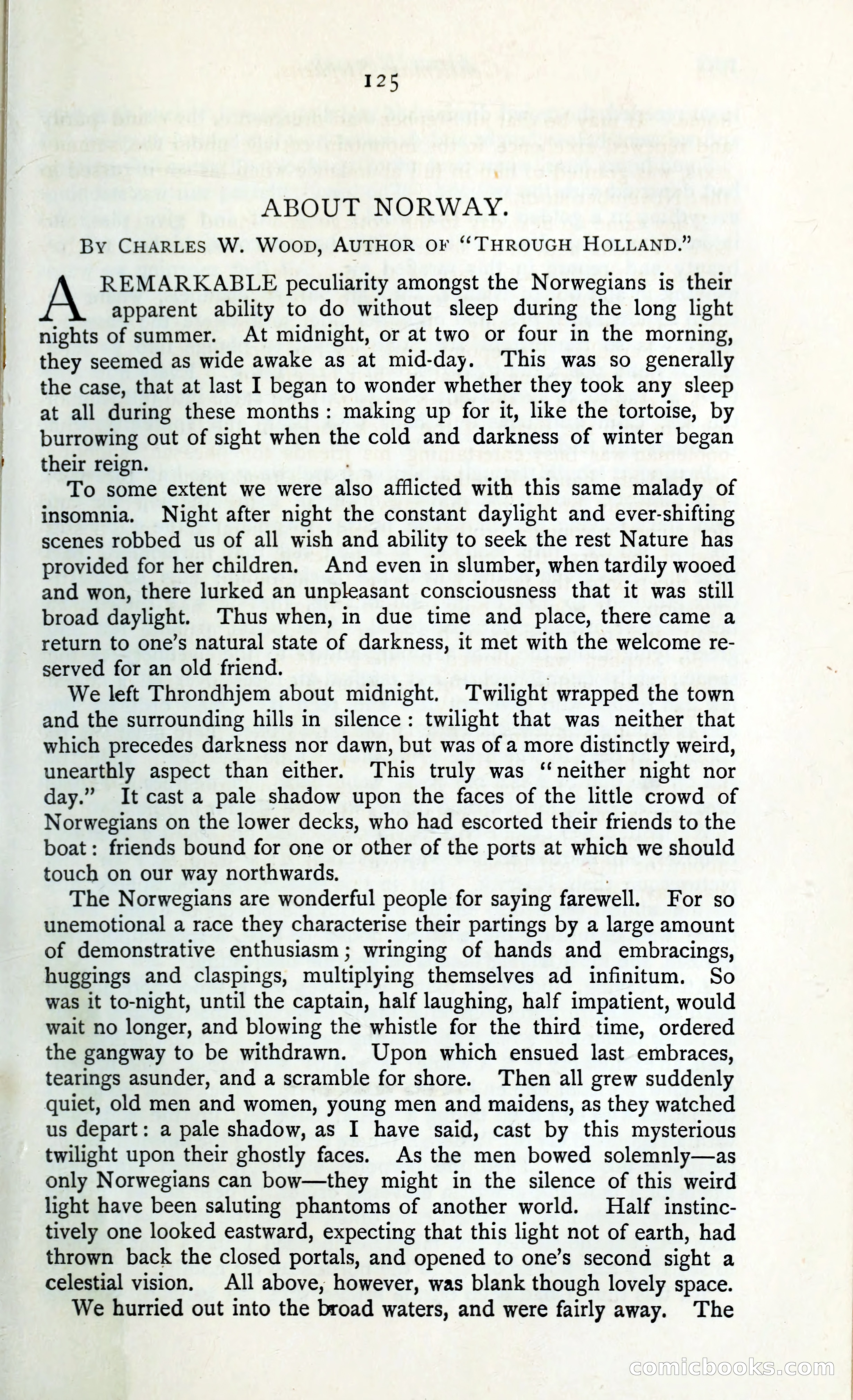
A restored page from Pulp Fiction, 1865. Page through the whole issue in the reader above.
📄 Transcribed text from this page (OCR, searchable)
Machine-transcribed from the original scan — historical spelling and the odd misread are preserved.
125 ABOUT NORWAY. By CHARLES W. Woop, AUTHOR OF “THROUGH HOLLAND.” REMARKABLE peculiarity amongst the Norwegians is their apparent ability to do without sleep during the long light nights of summer. At midnight, or at two or four in the morning, they seemed as wide awake as at mid-day. This was so generally the case, that at last I began to wonder whether they took any sleep at all during these months: making up for it, like the tortoise, by burrowing out of sight when the cold and darkness of winter began their reign. To some extent we were ‘18 afflicted with this same malady of insomnia. Night after night the constant daylight and ever-shifting scenes robbed us of all wish and ability to seek the rest Nature has provided for her children. And even in slumber, when tardily wooed and won, there lurked an unpleasant consciousness that it was still broad daylight. ‘Thus when, in due time and place, there came a return to one’s natural state of darkness, it met with the welcome re- served for an old friend. | We left Throndhjem about midnight. ‘Twilight wrapped the town and the surrounding hills in silence: twilight that was neither that which precedes darkness nor dawn, but was of a more distinctly weird, unearthly aspect than either. This truly was ‘neither night nor day.” It cast a pale shadow upon the faces of the little crowd of Norwegians on the lower decks, who had escorted their friends to the boat: friends bound for one or other of the ports at which we should touch on our way northwards. The Norwegians are wonderful people for saying farewell. For so unemotional a race they characterise their partings by a large amount of demonstrative enthusiasm; wringing of hands and embracings, huggings and claspings, multiplying themselves ad infinitum. So was it to-night, until the captain, half laughing, half impatient, would wait no longer, and blowing the whistle for the third time, ordered the gangway to be withdrawn. Upon which ensued last embraces, tearings asunder, and a scramble for shore. Then all grew suddenly quiet, old men and women, young men and maidens, as they watched us depart: a pale shadow, as I have said, cast by this mysterious twilight upon their ghostly faces. As the men bowed solemnly—as only Norwegians can bow—they might in the silence of this weird light have been saluting phantoms of another world. Half instinc- tively one looked eastward, expecting that this light not of earth, had thrown back the closed portals, and opened to one’s second sight a celestial vision. All above, however, was blank though lovely space. We hurried out into the broad waters, and were fairly away. The GOMGoIOO (C(O) am