
Pulp Fiction, 1865 · page 302 of 400
The Argosy — page 302: what you’re looking at
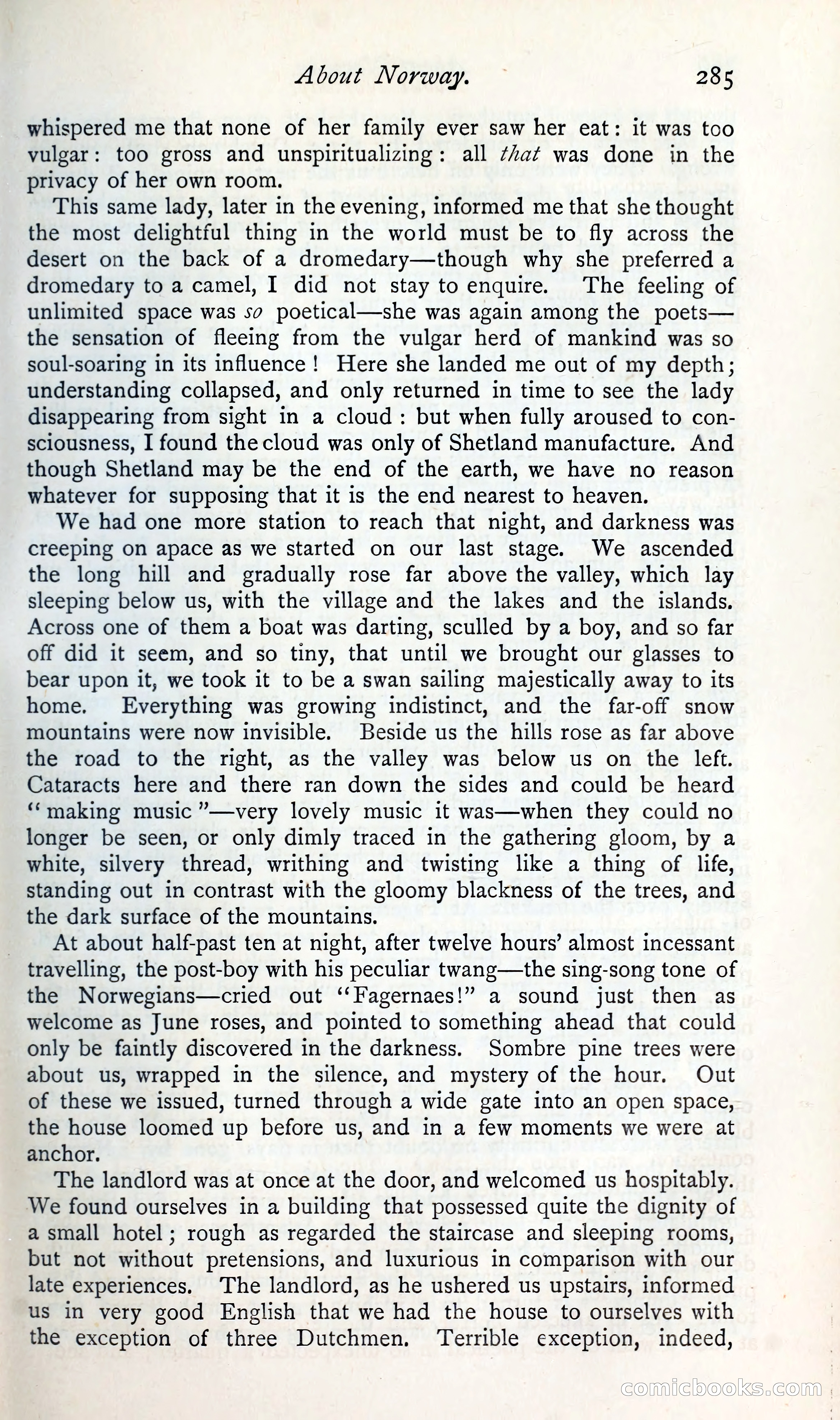
A restored page from Pulp Fiction, 1865. Page through the whole issue in the reader above.
📄 Transcribed text from this page (OCR, searchable)
Machine-transcribed from the original scan — historical spelling and the odd misread are preserved.
About Norway. — 285 whispered me that none of her family ever saw her eat: it was too vulgar: too gross and unspiritualizing: all ¢zat was done in the privacy of her own room. This same lady, later in the evening, informed me that she thought the most delightful thing in the world must be to fly across the desert on the back of a dromedary—though why she preferred a dromedary to a camel, I did not stay to enquire. The feeling of unlimited space was so poetical—she was again among the poets— the sensation of fleeing from the vulgar herd of mankind was so soul-soaring in its influence! Here she landed me out of my depth; understanding collapsed, and only returned in time to see the lady disappearing from sight in a cloud: but when fully aroused to con- sciousness, I found thecloud was only of Shetland manufacture. And though Shetland may be the end of the earth, we have no reason whatever for supposing that it is the end nearest to heaven. We had one more station to reach that night, and darkness was creeping on apace as we started on our last stage. We ascended the long hill and gradually rose far above the valley, which lay sleeping below us, with the village and the lakes and the islands. Across one of them a boat was darting, sculled by a boy, and so far off did it seem, and so tiny, that until we brought our glasses to bear upon it, we took it to be a swan sailing majestically away to its home. Everything was growing indistinct, and the far-off snow mountains were now invisible. Beside us the hills rose as far above the road to the right, as the valley was below us on the left. Cataracts here and there ran down the sides and could be heard “‘making music ”—very lovely music 1t was—when they could no longer be seen, or only dimly traced in the gathering gloom, by a white, silvery thread, writhing and twisting like a thing of life, standing out in contrast with the gloomy blackness of the trees, and the dark surface of the mountains. At about half-past ten at night, after twelve hours’ almost incessant travelling, the post-boy with his peculiar twang—the sing-song tone of the Norwegians—cried out ‘‘Fagernaes!” a sound just then as welcome as June roses, and pointed to something ahead that could only be faintly discovered in the darkness. Sombre pine trees were about us, wrapped in the silence, and mystery of the hour. Out of these we issued, turned through a wide gate into an open space, the house loomed up before us, and in a few moments we were at anchor. The landlord was at once at the door, and welcomed us hospitably. We found ourselves in a building that possessed quite the dignity of a small hotel; rough as regarded the staircase and sleeping rooms, but not without pretensions, and luxurious in comparison with our late experiences. The landlord, as he ushered us upstairs, informed us in very good English that we had the house to ourselves with the exception of three Dutchmen, Terrible exception, indeed, COMIC OOO SS (CO)