
Pulp Fiction, 1865 · page 301 of 400
The Argosy — page 301: what you’re looking at
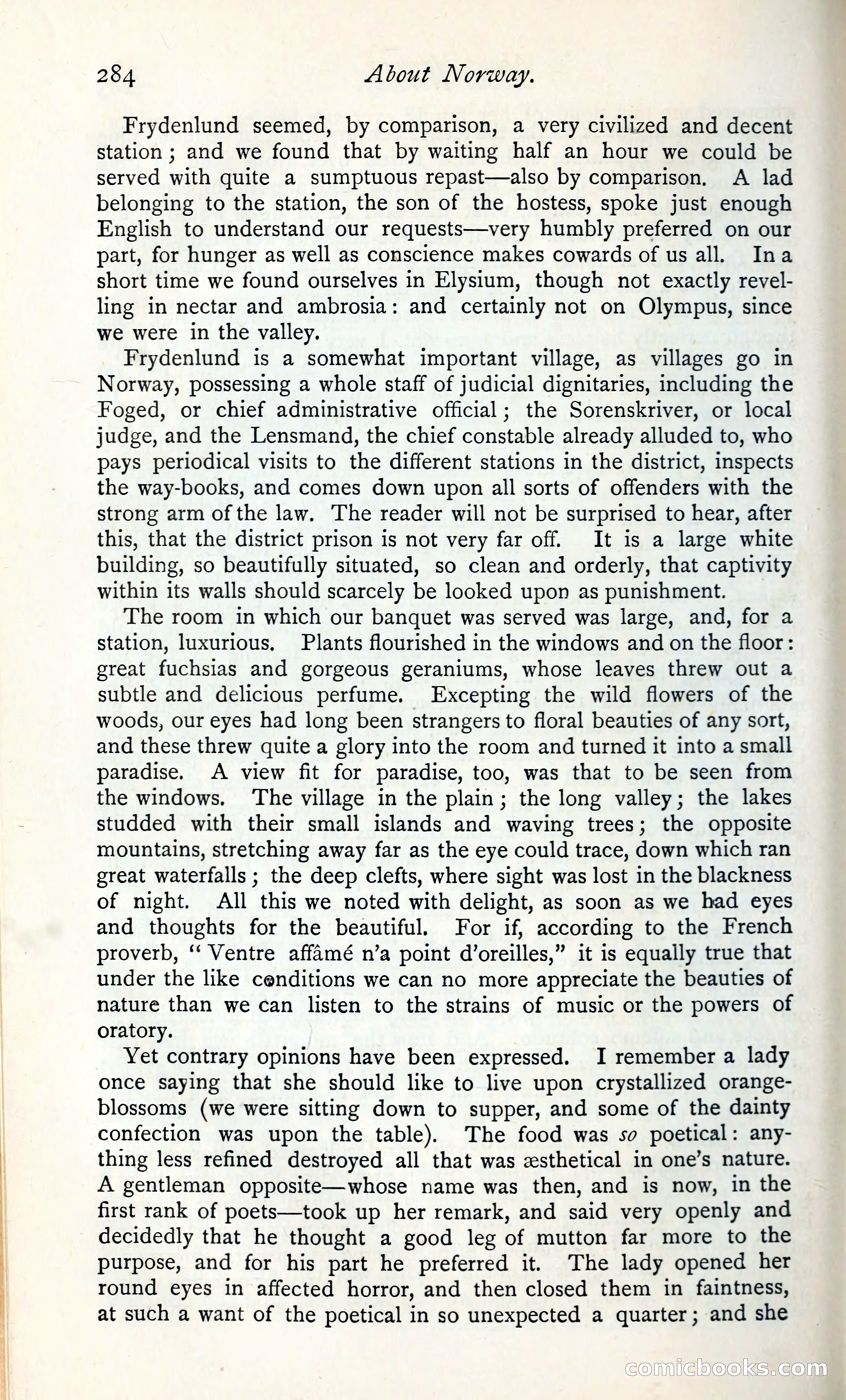
A restored page from Pulp Fiction, 1865. Page through the whole issue in the reader above.
📄 Transcribed text from this page (OCR, searchable)
Machine-transcribed from the original scan — historical spelling and the odd misread are preserved.
-_ —_— #- — «pie 284 About Norway. Frydenlund seemed, by comparison, a very civilized and decent station ; and we found that by waiting half an hour we could be served with quite a sumptuous repast—also by comparison, A lad belonging to the station, the son of the hostess, spoke just enough English to understand our requests—very humbly preferred on our part, for hunger as well as conscience makes cowards of us all. Ina short time we found ourselves in Elysium, though not exactly revel- ling in nectar and ambrosia: and certainly not on Olympus, since we were in the valley. Frydenlund is a somewhat important village, as villages go in Norway, possessing a whole staff of judicial dignitaries, including the Foged, or chief administrative official; the Sorenskriver, or local judge, and the Lensmand, the chief constable already alluded to, who pays periodical visits to the different stations in the district, inspects the way-books, and comes down upon all sorts of offenders with the strong arm of the law. The reader will not be surprised to hear, after this, that the district prison is not very far off. It is a large white building, so beautifully situated, so clean and orderly, that captivity within its walls should scarcely be looked upon as punishment. The room in which our banquet was served was large, and, for a station, luxurious. Plants flourished in the windows and on the floor: great fuchsias and gorgeous geraniums, whose leaves threw out a subtle and delicious perfume. Excepting the wild flowers of the woods, our eyes had long been strangers to floral beauties of any sort, and these threw quite a glory into the room and turned it into a small paradise. A view fit for paradise, too, was that to be seen from the windows. The village in the plain; the long valley; the lakes studded with their small islands and waving trees; the opposite mountains, stretching away far as the eye could trace, down which ran great waterfalls ; the deep clefts, where sight was lost in the blackness of night. All this we noted with delight, as soon as we had eyes and thoughts for the beautiful. For if, according to the French proverb, ‘‘ Ventre affamé n’a point d’oreilles,” it is equally true that under the like cenditions we can no more appreciate the beauties of nature than we can listen to the strains of music or the powers of oratory. _ Yet contrary opinions have been expressed. I remember a lady once saying that she should like to live upon crystallized orange- blossoms (we were sitting down to supper, and some of the dainty confection was upon the table). The food was so poetical: any- thing less refined destroyed all that was zxsthetical in one’s nature. A gentleman opposite—whose name was then, and is now, in the first rank of poets—took up her remark, and said very openly and decidedly that he thought a good leg of mutton far more to the purpose, and for his part he preferred it. The lady opened her round eyes in affected horror, and then closed them in faintness, at such a want of the poetical in so unexpected a quarter; and she CONMMICELOOOKSsE)