
Pulp Fiction, 1865 · page 166 of 400
The Argosy — page 166: what you’re looking at
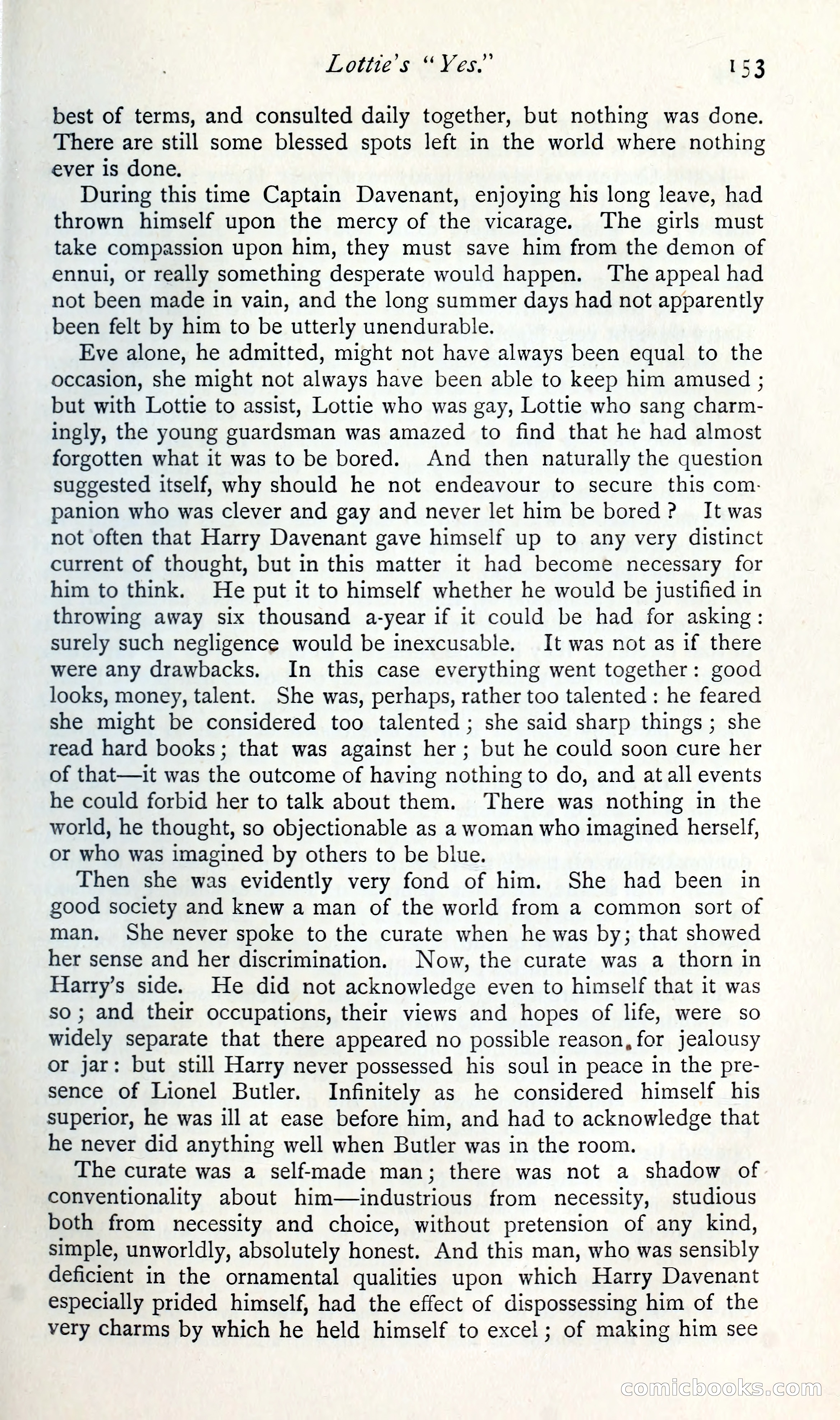
A restored page from Pulp Fiction, 1865. Page through the whole issue in the reader above.
📄 Transcribed text from this page (OCR, searchable)
Machine-transcribed from the original scan — historical spelling and the odd misread are preserved.
Lottie’s “Yes.” 153 best of terms, and consulted daily together, but nothing was done. There are still some blessed spots left in the world where nothing ever is done. During this time Captain Davenant, enjoying his long leave, had thrown himself upon the mercy of the vicarage. The girls must take compassion upon him, they must save him from the demon of ennui, or really something desperate would happen. ‘The appeal had not been made in vain, and the long summer days had not apparently been felt by him to be utterly unendurable. Eve alone, he admitted, might not have always been equal to the occasion, she might not always have been able to keep him amused ; but with Lottie to assist, Lottie who was gay, Lottie who sang charm- ingly, the young guardsman was amazed to find that he had almost forgotten what it was to be bored. And then naturally the question suggested itself, why should he not endeavour to secure this com. panion who was clever and gay and never let him be bored? It was not often that Harry Davenant gave himself up to any very distinct current of thought, but in this matter it had become necessary for him to think. He put it to himself whether he would be justified in throwing away six thousand a-year if it could be had for asking: surely such negligence would be inexcusable. It was not as if there were any drawbacks. In this case everything went together: good looks, money, talent. She was, perhaps, rather too talented : he feared she might be considered too talented ; she said sharp things; she read hard books; that was against her; but he could soon cure her of that—it was the outcome of having nothing to do, and at all events he could forbid her to talk about them. There was nothing in the world, he thought, so objectionable as a woman who imagined herself, or who was imagined by others to be blue. Then she was evidently very fond of him. She had been in good society and knew a man of the world from a common sort of man. She never spoke to the curate when he was by; that showed her sense and her discrimination. Now, the curate was a thorn in Harry’s side. He did not acknowledge even to himself that it was so; and their occupations, their views and hopes of life, were so widely separate that there appeared no possible reason, for jealousy or jar: but still Harry never possessed his soul in peace in the pre- sence of Lionel Butler. Infinitely as he considered himself his superior, he was ill at ease before him, and had to acknowledge that he never did anything well when Butler was in the room. The curate was a self-made man; there was not a shadow of conventionality about him—industrious from necessity, studious both from necessity and choice, without pretension of any kind, simple, unworldly, absolutely honest. And this man, who was sensibly deficient in the ornamental qualities upon which Harry Davenant especially prided himself, had the effect of dispossessing him of the very charms by which he held himself to excel; of making him see COMmMicoooks (CO) im