
Pulp Fiction, 1865 · page 375 of 400
The Argosy — page 375: what you’re looking at
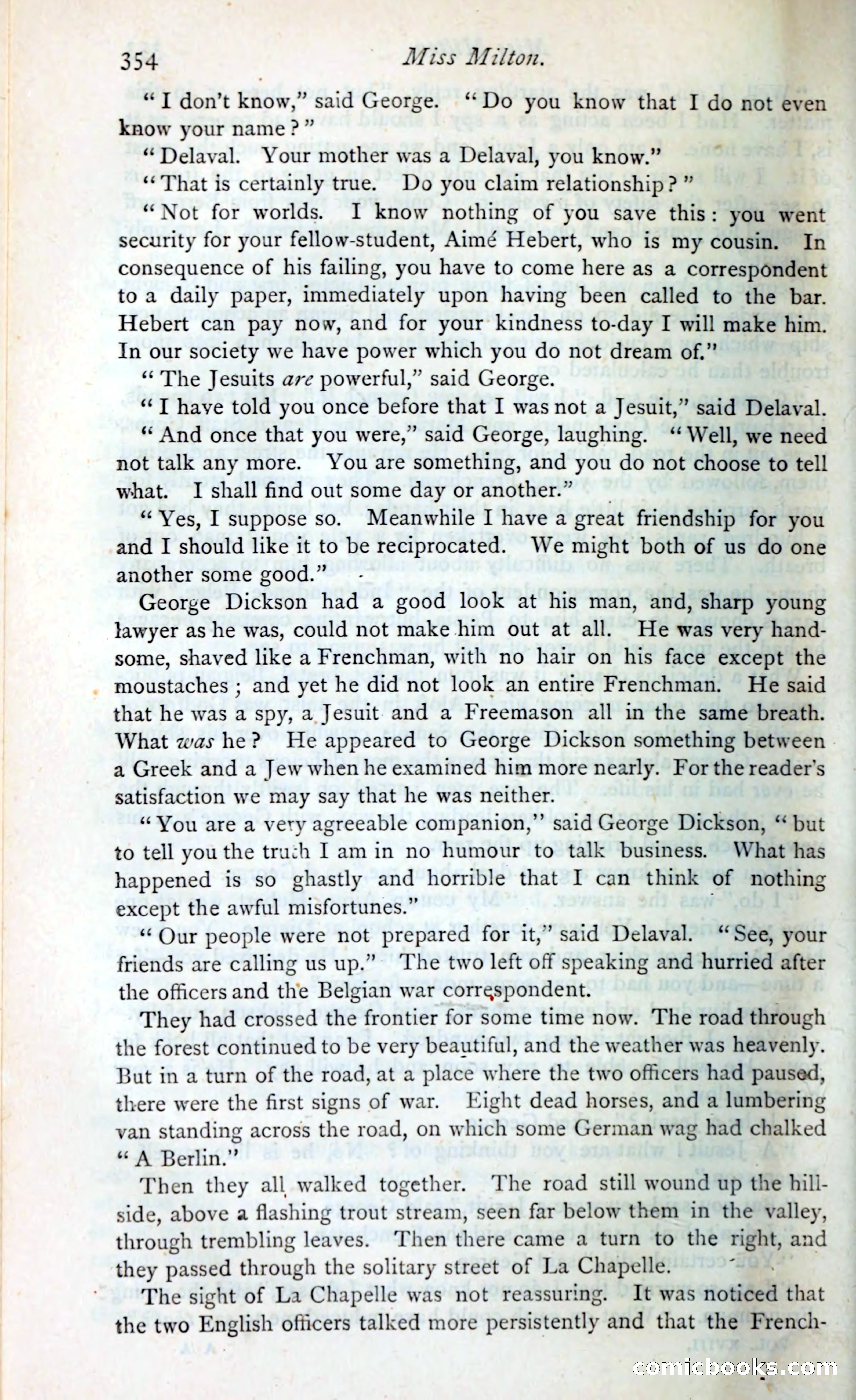
A restored page from Pulp Fiction, 1865. Page through the whole issue in the reader above.
📄 Transcribed text from this page (OCR, searchable)
Machine-transcribed from the original scan — historical spelling and the odd misread are preserved.
' 354 Miss Milton. “T don’t know,” said George. ‘‘Do you know that I do not even know your name?” “Delaval. Your mother was a Delaval, you know.” “That is certainly true. Do you claim relationship? ” “Not for worlds. I know nothing of you save this: you went security for your fellow-student, Aimé Hebert, who is my cousin. In consequence of his failing, you have to come here as a correspondent to a daily paper, immediately upon having been called to the bar. Hebert can pay now, and for your kindness to-day I will make him. In our society we have power which you do not dream of.” “The Jesuits ave powerful,” said George. ‘‘T have told you once before that I was not a Jesuit,” said Delaval. * And once that you were,” said George, laughing. ‘“‘ Well, we need not talk any more. You are something, and you do not choose to tell what. I shall find out some day or another.” __ “Ves, I suppose so. Meanwhile I have a great friendship for you and I should like it to be reciprocated. We might both of us do one another some good.” George Dickson had a good look at his man, and, sharp young lawyer as he was, could not make him out at all. He was very hand- some, shaved like a Frenchman, with no hair on his face except the _ moustaches ; and yet he did not look an entire Frenchman. He said that he was a spy, a Jesuit and a Freemason all in the same breath. What was he? He appeared to George Dickson something between | a Greek and a Jew when he examined him more nearly. For the reader's satisfaction we may say that he was neither. “Vou are a very agreeable companion,”’ said George Dickson, “ but to tell you the truch Iam in no humour to talk business. What has happened is so ghastly and horrible that I can think of nothing except the awful misfortunes.” | “Our people were not prepared for it,” said Delaval. “See, your friends are calling us up.” The two left off speaking and hurried after the officers and the Belgian war correspondent. They had crossed the frontier for some time now. The road through the forest continued to be very beautiful, and the weather was heavenly. But in a turn of the road, at a place where the two officers had paused, there were the first signs of war. Eight dead horses, and a lumbering van standing across the road, on which some German wag had chalked “A Berlin.” 7 Then they all walked together. The road still wound up the hill- side, above a flashing trout stream, seen far below them in the valley, through trembling leaves. Then there came a turn to the right, and they passed through the solitary street of La Chapelle. : The sight of La Chapelle was not reassuring. It was noticed that the two English officers talked more persistently and that the French- Eomicbooks.com t