
Pulp Fiction, 1865 · page 374 of 400
The Argosy — page 374: what you’re looking at
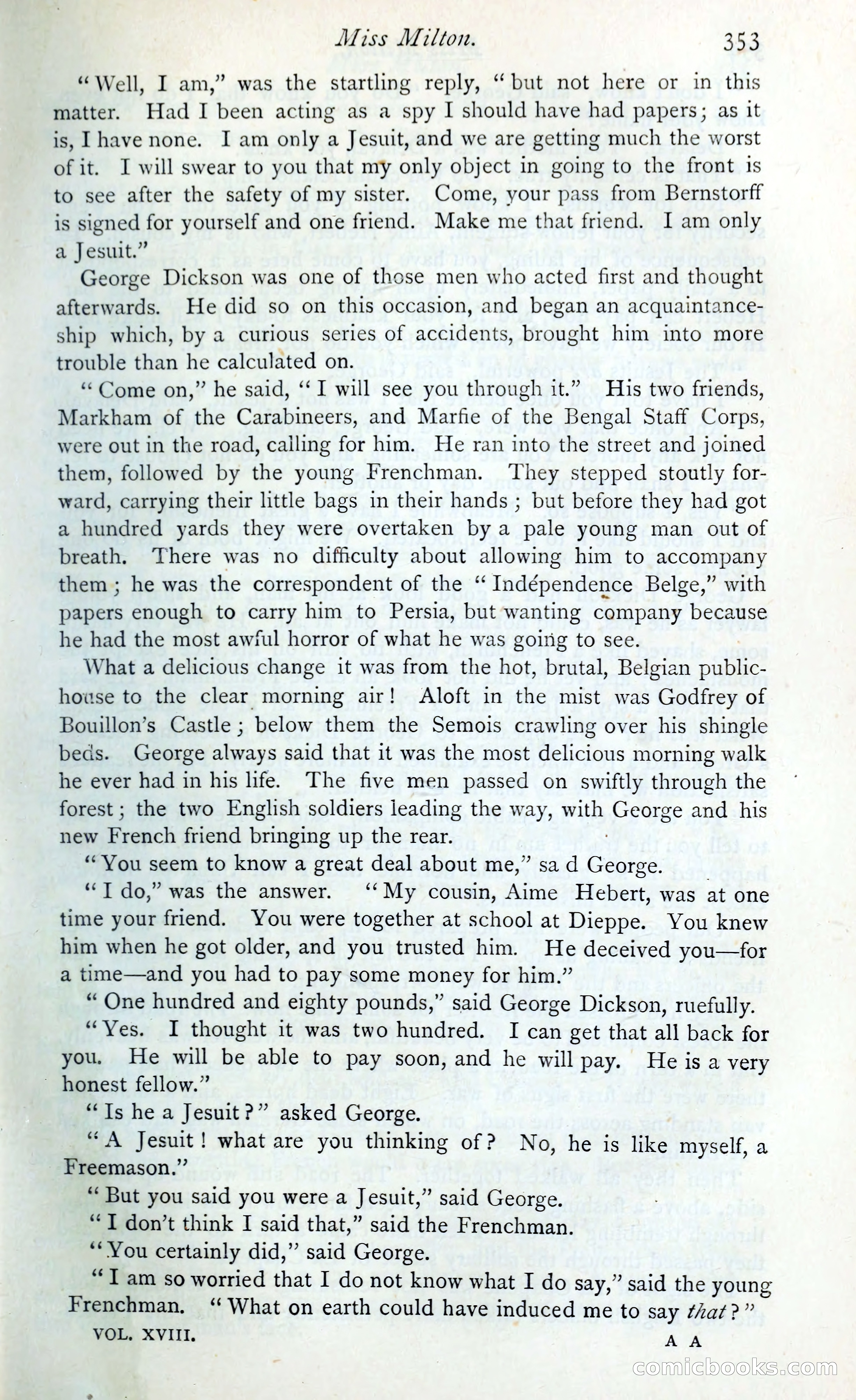
A restored page from Pulp Fiction, 1865. Page through the whole issue in the reader above.
📄 Transcribed text from this page (OCR, searchable)
Machine-transcribed from the original scan — historical spelling and the odd misread are preserved.
Miss Milton. 353 “Well, I am,” was the startling reply, ‘ but not here or in this matter. Had I been acting as a spy I should have had papers; as it is, [have none. I am only a Jesuit, and we are getting much the worst of it. I will swear to you that my only object in going to the front 1s to see after the safety of my sister. Come, your pass from Bernstorff is signed for yourself and one friend. Make me that friend. I am only a Jesuit.” George Dickson was one of those men who acted first and thought afterwards. He did so on this occasion, and began an acquaintance- ship which, by a curious series of accidents, brought him into more trouble than he calculated on. “Come on,” he said, ‘“‘I will see you through it.” Hus two friends, Markham of the Carabineers, and Marfie of the Bengal Staff Corps, were out in the road, cailing for him. He ran into the street and joined them, followed by the young Frenchman. ‘They stepped stoutly for- ward, carrying their little bags in their hands ; but before they had got a hundred yards they were overtaken bya pale young man out of breath. There was no difficulty about allowing him to accompany them ; he was the correspondent of the “ Indépendence Belge,” with papers enough to carry him to Persia, but wanting company because he had the most awrul horror of what he was goitig to see. What a delicious change it was from the hot, brutal, Belgian public- house to the clear morning air! Aloft in the mist was Godfrey of Bouillon’s Castle ; below them the Semois crawling over his shingle beds. George Ses said that it was the most delicious morning walk he ever had in his life. The five men passed on swiftly through the forest ; the two English soldiers leading the way, with George and his new French friend bringing up the rear. “You seem to know a great deal about me,” sa d Biel ‘““T do,” was the answer. ‘‘My cousin, Aime Hebert, was at one time your friend. You were together at school at Dieppe. You knew him when he got older, and you trusted him. He deceived you—for a time—and you had to pay some money for him.” “ One hundred and eighty pounds,” said George Dickson, ruefully. “Yes. I thought it was two hundred. I can get that all back for you. He will be able to pay soon, and he will pay. He is a very ~ honest fellow.” “Is he a Jesuit?” asked George. “A Jesuit! what are you thinking of? No, he is like myself, a Freemason.” “ But you said you were a Jesuit,” said George. “I don’t think I said that,” said the Frenchman. ‘You certainly did,” said George. ‘“‘T am so worried that I do not know what I do say,” said the young Frenchman. ‘ What on earth could have induced me to say that?” VOL. XVIII. A A connicloooks Go am