
Pulp Fiction, 1865 · page 366 of 400
The Argosy — page 366: what you’re looking at
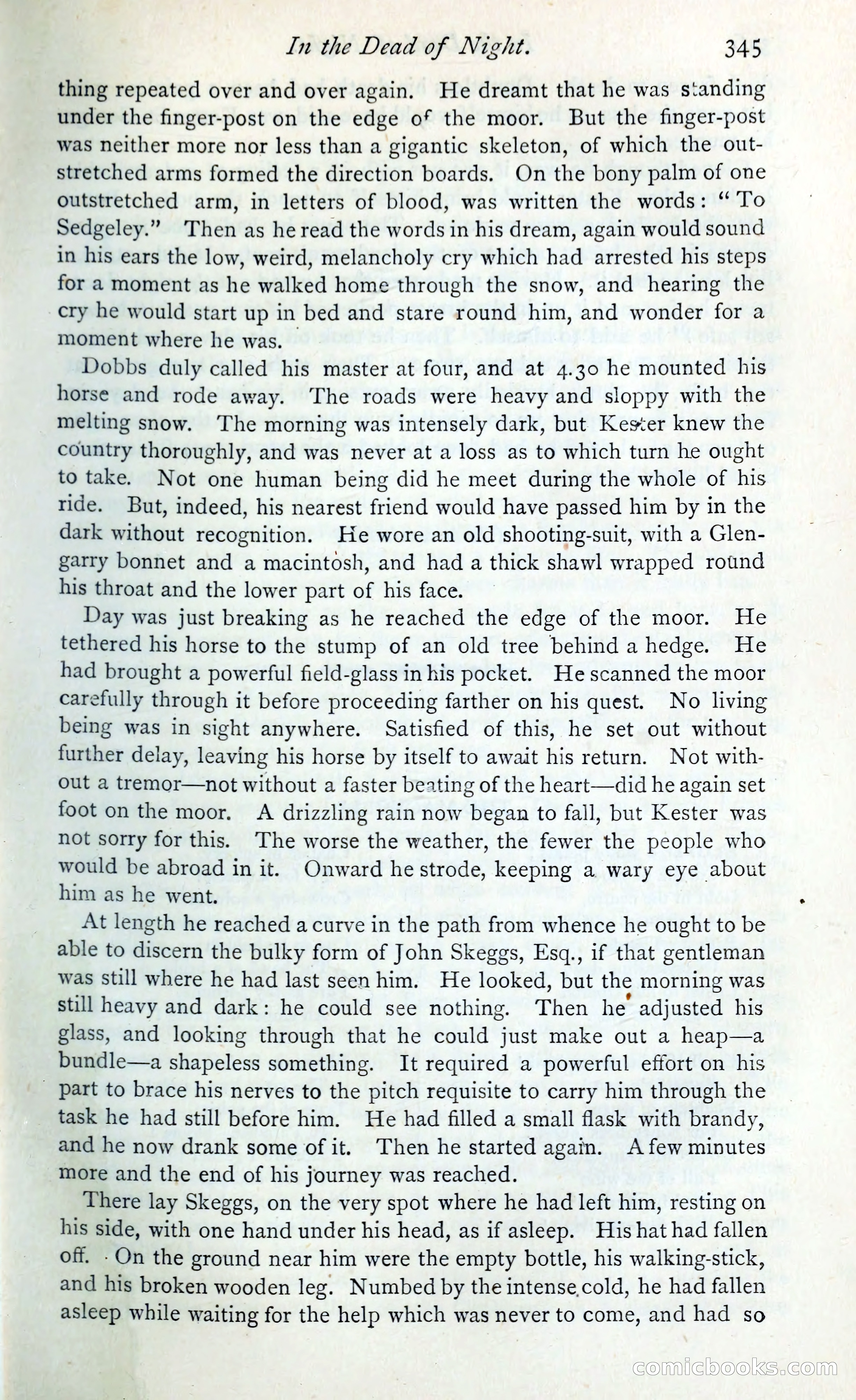
A restored page from Pulp Fiction, 1865. Page through the whole issue in the reader above.
📄 Transcribed text from this page (OCR, searchable)
Machine-transcribed from the original scan — historical spelling and the odd misread are preserved.
In the Dead of Night. 345 thing repeated over and over again. He dreamt that he was standing under the finger-post on the edge of the moor. But the finger-post was neither more nor less than a gigantic skeleton, of which the out- stretched arms formed the direction boards. On the bony palm of one outstretched arm, in letters of blood, was written the words: “ lo Sedgeley.” Then as heread the words in his dream, again would sound in his ears the low, weird, melancholy cry which had arrested his steps for a moment as he walked home through the snow, and hearing the cry he would start up in bed and stare round him, and wonder for a moment where he was. | Dobbs duly called his master at four, and at 4.30 he mounted his horse and rode away. The roads were heavy and sloppy with the melting snow. The morning was intensely dark, but Kester knew the country thoroughly, and was never at a loss as to which turn he ought to take. Not one human being did he meet during the whole of his ride. But, indeed, his nearest friend would have passed him by in the dark without recognition. He wore an old shooting-suit, with a Glen- garry bonnet and a macintosh, and had a thick shawl wrapped rotind his throat and the lower part of his face. Day was just breaking as he reached the edge of the moor. He tethered his horse to the stump of an old tree behind a hedge. He had brought a powerful field-glass in his pocket. He scanned the moor carefully through it before proceeding farther on his quest. No living being was in sight anywhere. Satisfied of this, he set out without further delay, leaving his horse by itself to await his return. Not with- out a tremor—not without a faster beating of the heart—did he again set foot on the moor. A drizzling rain now began to fall, but Kester was not sorry for this. The worse the weather, the fewer the people who would be abroad in it. Onward he strode, keeping a wary eye about him as he went. At length he reached acurve in the path from whence he ought to be able to discern the bulky form of John Skeggs, Esq., if that gentleman was still where he had last seen him. He looked, but the morning was still heavy and dark: he could see nothing. Then he adjusted his glass, and looking through that he could just make out a heap—a bundle—a shapeless something. It required a powerful effort on his _ part to brace his nerves to the pitch requisite to carry him through the task he had still before him. He had filled a small flask with brandy, and he now drank some of it. Then he started again. A few minutes more and the end of his journey was reached. There lay Skeggs, on the very spot where he had left him, resting on his side, with one hand under his head, as if asleep. His hat had fallen off. -On the ground near him were the empty bottle, his walking-stick, and his broken wooden leg. Numbed by the intense.cold, he had fallen asleep while waiting for the help which was never to come, and had so COnniicloool<s Go im