
Pulp Fiction, 1865 · page 365 of 400
The Argosy — page 365: what you’re looking at
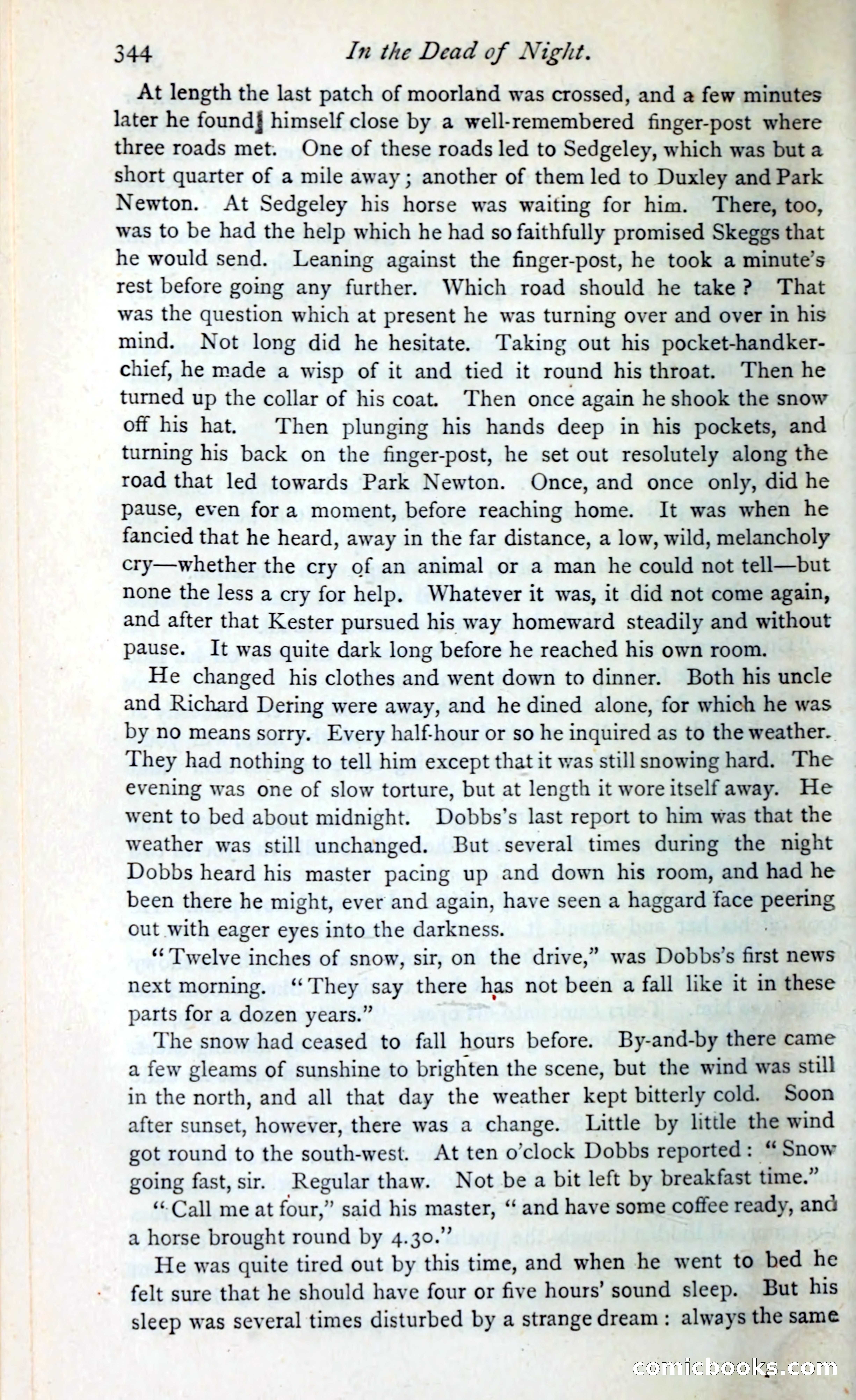
A restored page from Pulp Fiction, 1865. Page through the whole issue in the reader above.
📄 Transcribed text from this page (OCR, searchable)
Machine-transcribed from the original scan — historical spelling and the odd misread are preserved.
mf 344 In the Dead of Night. At length the last patch of moorland was crossed, and a few minutes later he found§ himself close by a well-remembered finger-post where three roads met. One of these roads led to Sedgeley, which was but a short quarter of a mile away; another of them led to Duxley and Park Newton. At Sedgeley his horse was waiting for him. There, too, was to be had the help which he had so faithfully promised Skeggs that he would send. Leaning against the finger-post, he took a minute’s rest before going any further. Which road should he take? That was the question which at present he was turning over and over in his mind. Not long did he hesitate. Taking out his pocket-handker- chief, he made a wisp of it and tied it round his throat. Then he turned up the collar of his coat. Then once again he shook the snow off his hat. Then plunging his hands deep in his pockets, and turning his back on the finger-post, he set out resolutely along the road that led towards Park Newton. Once, and once only, did he pause, even fora moment, before reaching home. It was when he fancied that he heard, away in the far distance, a low, wild, melancholy cry—whether the cry of an animal or a man he could not tell—but none the less a cry for help. Whatever it was, it did not come again, and after that Kester pursued his way homeward steadily and without pause. It was quite dark long before he reached his own room. He changed his clothes and went down to dinner. Both his uncle and Richard Dering were away, and he dined alone, for which he was by no means sorry. Every half-hour or so he inquired as to the weather- They had nothing to tell him except that it was still snowing hard. The evening was one of slow torture, but at length it wore itself away. He went to bed about midnight. Dobbs’s last report to him was that the weather was still unchanged. But several times during the night Dobbs heard his master pacing up and down his room, and had he been there he might, ever and again, have seen a haggard face prere out with eager eyes into the darkness. ‘Twelve inches of snow, sir, on the drive,” was Dobbs’s frst news next morning. ‘They say there has not been a fall like it in these parts for a dozen years.” The snow had ceased to fall hours before. By-and-by there came a few gleams of sunshine to brighten the scene, but the wind was still in the north, and all that day the weather kept bitterly cold. Soon after sunset, however, there was a change. Little by little the wind got round to the south-west. At ten o’clock Dobbs reported: “Snow going fast, sir. Regular thaw. Not be a bit left by breakfast time.” “Call me at four,” said his master; ‘and have some coffee ready, and a horse brought round by 4.30.” He was quite tired out by this time, and when he went to bed he felt sure that he should have four or five hours’ sound sleep. But his sleep was several times disturbed by a strange dream: always the same Gomicbooks.com