
Pulp Fiction, 1865 · page 112 of 400
The Argosy — page 112: what you’re looking at
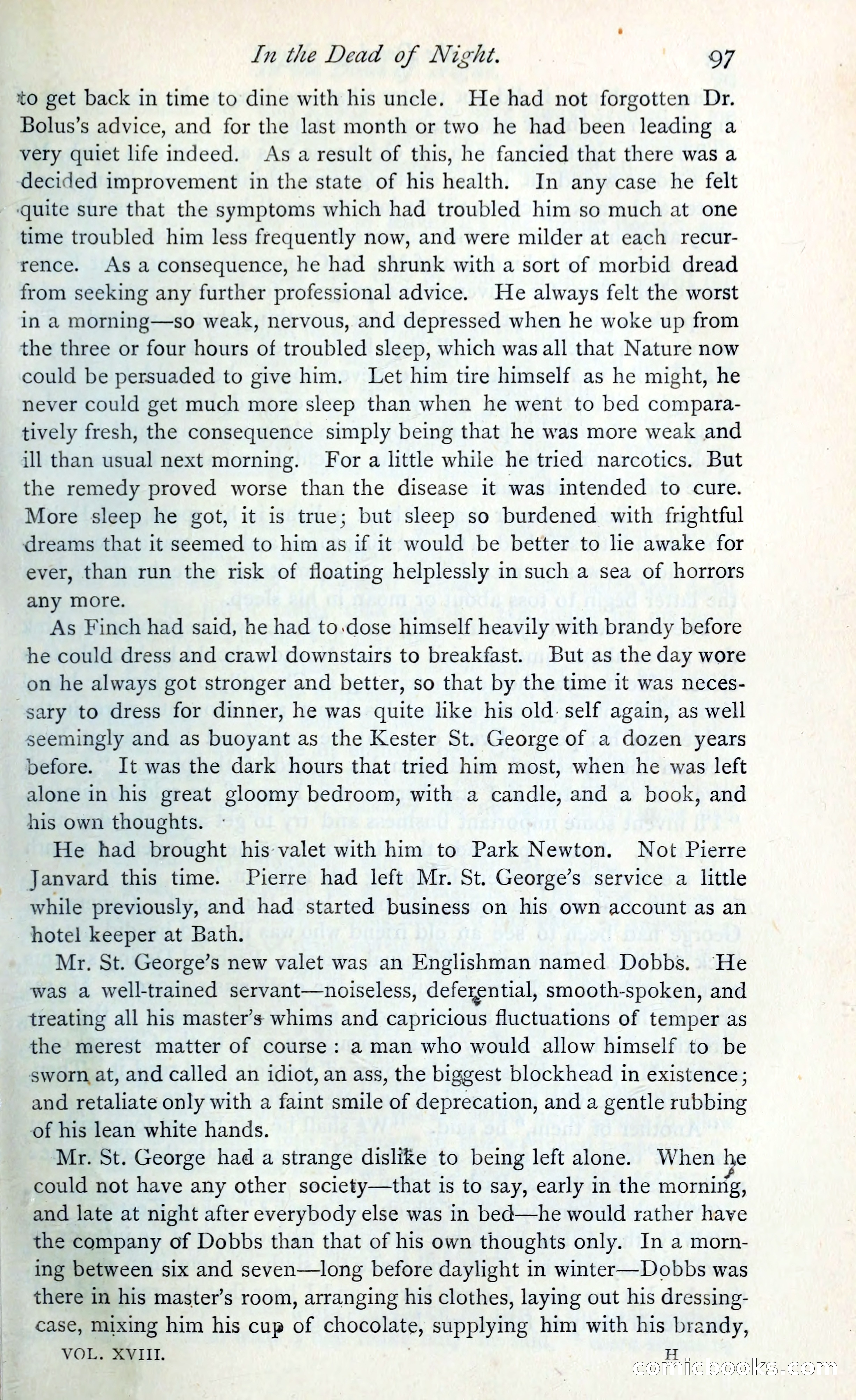
A restored page from Pulp Fiction, 1865. Page through the whole issue in the reader above.
📄 Transcribed text from this page (OCR, searchable)
Machine-transcribed from the original scan — historical spelling and the odd misread are preserved.
In the Dead of Night. 97 to get back in time to dine with his uncle. He had not forgotten Dr. Bolus’s advice, and for the last month or two he had been leading a very quiet life indeed. Asa result of this, he fancied that there was a decided improvement in the state of his health. In any case he felt quite sure that the symptoms which had troubled him so much at one time troubled him less frequently now, and were milder at each recur- rence. Asa consequence, he had shrunk with a sort of morbid dread from seeking any further professional advice. He always felt the worst in a morning—so weak, nervous, and depressed when he woke up from the three or four hours of troubled sleep, which was all that Nature now could be persuaded to give him. Let him tire himself as he might, he never could get much more sleep than when he went to bed compara- tively fresh, the consequence simply being that he was more weak and ill than usual next morning. For a little while he tried narcotics. But the remedy proved worse than the disease it was intended to cure. More sleep he got, it is true; but sleep so burdened with frightful dreams that it seemed to him as if it would be better to lie awake for ever, than run the risk of floating helplessly in such a sea of horrors any more. As Finch had said, he had to.dose himself heavily with brandy before he could dress and crawl downstairs to breakfast. But as the day wore on he always got stronger and better, so that by the time it was neces- sary to dress for dinner, he was quite like his old self again, as well seemingly and as buoyant as the Kester St. George of a dozen years before. It was the dark hours that tried him most, when he was left alone in his great gloomy bedroom, with a candle, and a book, and his own thoughts. He had brought his valet with him to Park Newton. Not Pierre Janvard this time. Pierre had left Mr. St. George’s service a little while previously, and had started business on his own account as an hotel keeper at Bath. Mr. St. George’s new valet was an Englishman named Dobbs. He was a well-trained servant—noiseless, deferential, smooth-spoken, and treating all his master’s whims and capricious fluctuations of temper as the merest matter of course: a man who would allow himself to be sworn at, and called an idiot, an ass, the biggest blockhead in existence; and retaliate only with a faint smile of deprecation, and a gentle rubbing of his lean white hands. ‘Mr. St. George had a strange dislike to being left alone. When he could not have any other society—that is to say, early in the morning, and late at night after everybody else was in bed—he would rather have the company of Dobbs than that of his own thoughts only. In a morn- ing between six and seven—long before daylight in winter—Dobbs was there in his master’s room, arranging his clothes, laying out his dressing- case, mixing him his cup of chocolate, supplying him with his brandy, VOL. XVIII. | H GONG OOO CS (©)