
Pulp Fiction, 1865 · page 111 of 400
The Argosy — page 111: what you’re looking at
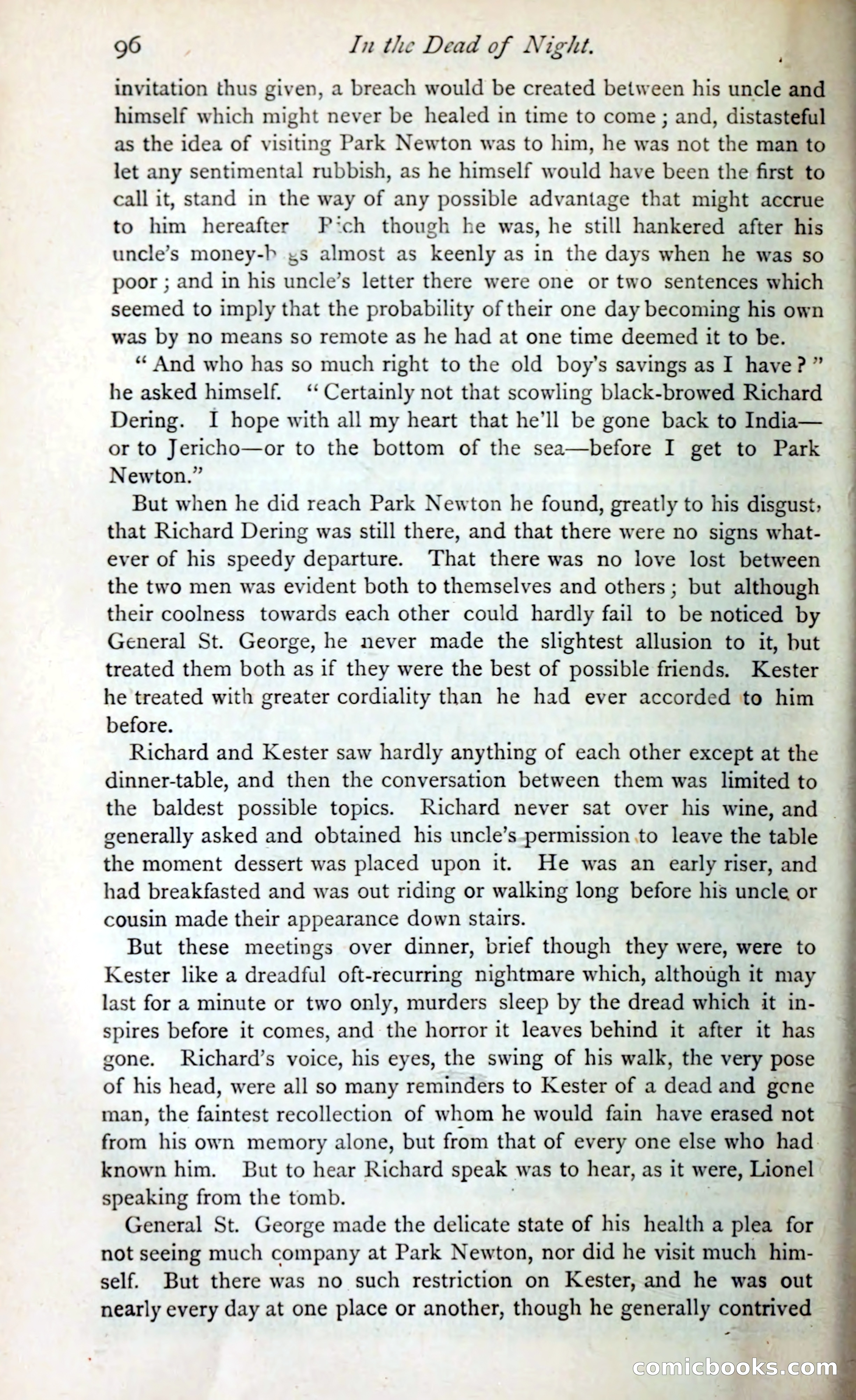
A restored page from Pulp Fiction, 1865. Page through the whole issue in the reader above.
📄 Transcribed text from this page (OCR, searchable)
Machine-transcribed from the original scan — historical spelling and the odd misread are preserved.
96 In the Dead of Night. iS ‘>. 4 invitation thus given, a breach would be created between his uncle and — himself which might never be healed in time to come; and, distas é A as the idea of visiting Park Newton was to him, he waa not the man to — let any sentimental rubbish, as he himself would have been the first to _ call it, stand in the way of any possible advantage that might accrue to him hereafter Pich though he was, he still hankered after his uncle’s money-h xs almost as keenly as in the days when he was so poor ; and in his uncle’s letter there were one or two sentences which seemed to imply that the probability of their one day becoming his own was by no means so remote as he had at one time deemed it to be. “ And who has so much right to the old boy’s savings as I have?” he asked himself. ‘‘ Certainly not that scowling black-browed Richard Dering. I hope with all my heart that he’ll be gone back to India— or to Jericho—or to the bottom of the sea—before I get to Park Newton.” But when he did reach Park Newton he found, greatly to his disgust, that Richard Dering was still there, and that there were no signs what- ever of his speedy departure. That there was no love lost between the two men was evident both to themselves and others; but although their coolness towards each other could hardly fail to be noticed by General St. George, he never made the slightest allusion to it, but treated them both as if they were the best of possible friends. Kester he treated with greater cordiality than he had ever accorded to him before. Richard and Kester saw hardly anything of each other except at the dinner-table, and then the conversation between them was limited to the baldest possible topics. Richard never sat over his wine, and | generally asked and obtained his uncle’s-permission to leave the table the moment dessert was placed upon it. He was an early riser, and had breakfasted and was out riding or walking long before his uncle or cousin made their appearance down stars. But these meetings over dinner, brief though they were, were to Kester like a dreadful oft-recurring nightmare which, although it may last for a minute or two only, murders sleep by the dread which it in- spires before it comes, and the horror it leaves behind it after it has gone. Richard’s voice, his eyes, the swing of his walk, the very pose of his head, were all so many reminders to Kester of a dead and gene man, the faintest recollection of whom he would fain have erased not from his own memory alone, but from that of every one else who had known him. But to hear Richard speak was to hear, as it wee Lionel | speaking from the tomb. | General St. George made the delicate state of his health a plea for not seeing much company at Park Newton, nor did he visit much him- — self. But there was no such restriction on Kester, and he was out — nearly every day at one place or another, though he generally contrived — Comicbooks.con ~