
Pulp Fiction, 1865 · page 319 of 400
The Argosy — page 319: what you’re looking at
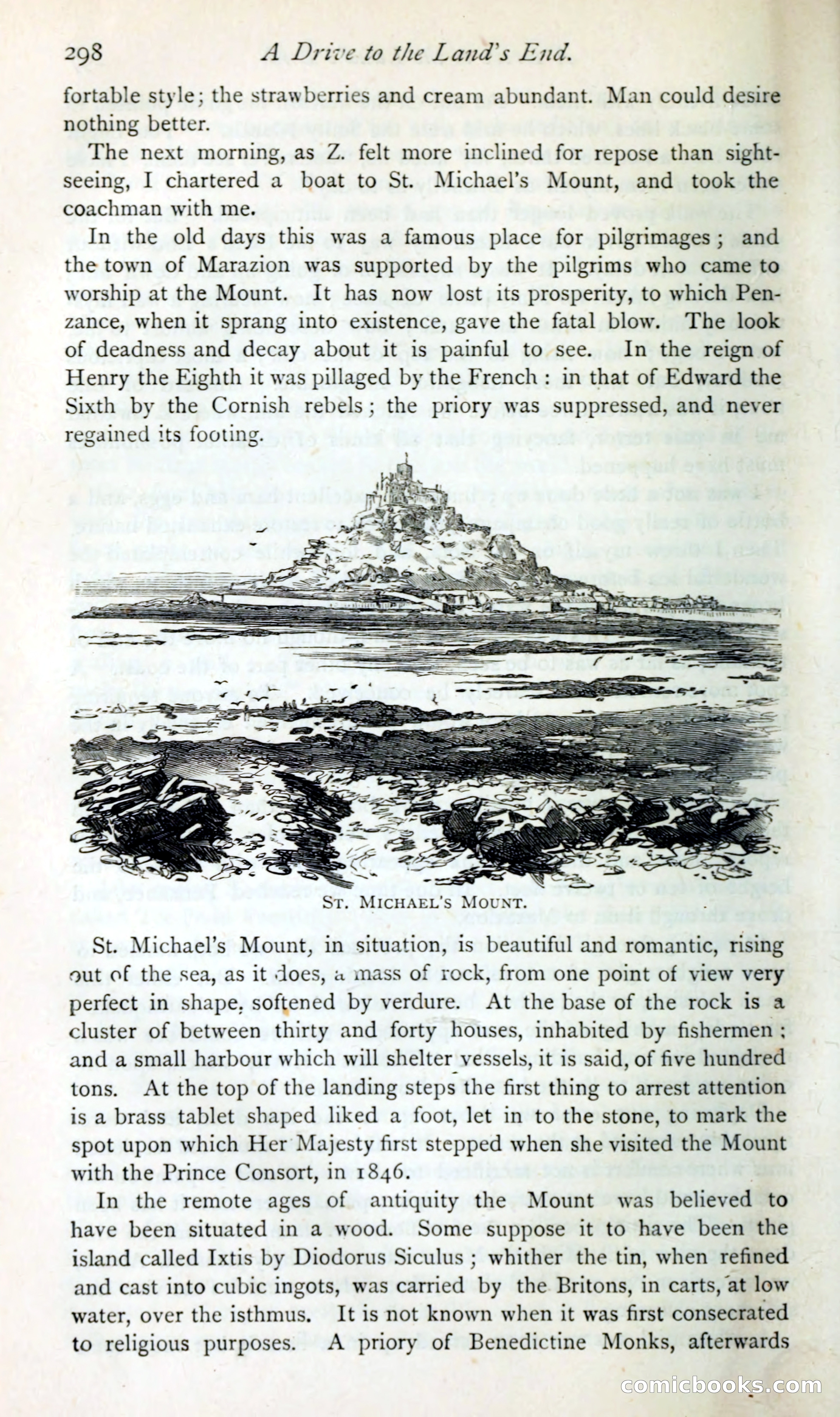
A restored page from Pulp Fiction, 1865. Page through the whole issue in the reader above.
📄 Transcribed text from this page (OCR, searchable)
Machine-transcribed from the original scan — historical spelling and the odd misread are preserved.
298 A Drive to the Land’s End. fortable style; the strawberries and cream abundant. Man could desire nothing better. The next morning, as Z. felt more inclined for repose than sight- seeing, I chartered a boat to St. Michael’s Mount, and took the coachman with me. In the old days this was a famous place for pilgrimages; and the town of Marazion was supported by the pilgrims who came to worship at the Mount. It has now lost its prosperity, to which Pen- zance, when it sprang into existence, gave the fatal blow. The look of deadness and decay about it is painful to see. In the reign of Henry the Eighth it was pillaged by the French: in that of Edward the Sixth by the Cornish rebels; the priory was suppressed, and never regained its footing. St. MICHAEL’S MOUNT. St. Michael’s Mount, in situation, is beautiful and romantic, rising out of the sea, as it does, a mass of rock, from one point of view very perfect in shape, softened by verdure. At the base of the rock is a cluster of between thirty and forty houses, inhabited by fishermen ; and a small harbour which will shelter vessels, it is said, of five hundred tons. At the top of the landing steps the first thing to arrest attention is a brass tablet shaped liked a foot, let in to the stone, to mark the spot upon which Her Majesty first stepped when she visited the Mount with the Prince Consort, in 1846. In the remote ages of antiquity the Mount was believed to have been situated in a wood. Some suppose it to have been the island called Ixtis by Diodorus Siculus ; whither the tin, when refined and cast into cubic ingots, was carried by the Britons, in carts, at low water, over the isthmus. It is not known when it was first consecrated to religious purposes. A priory of Benedictine Monks, afterwards cComicbooks.co m