
Pulp Fiction, 1865 · page 311 of 400
The Argosy — page 311: what you’re looking at
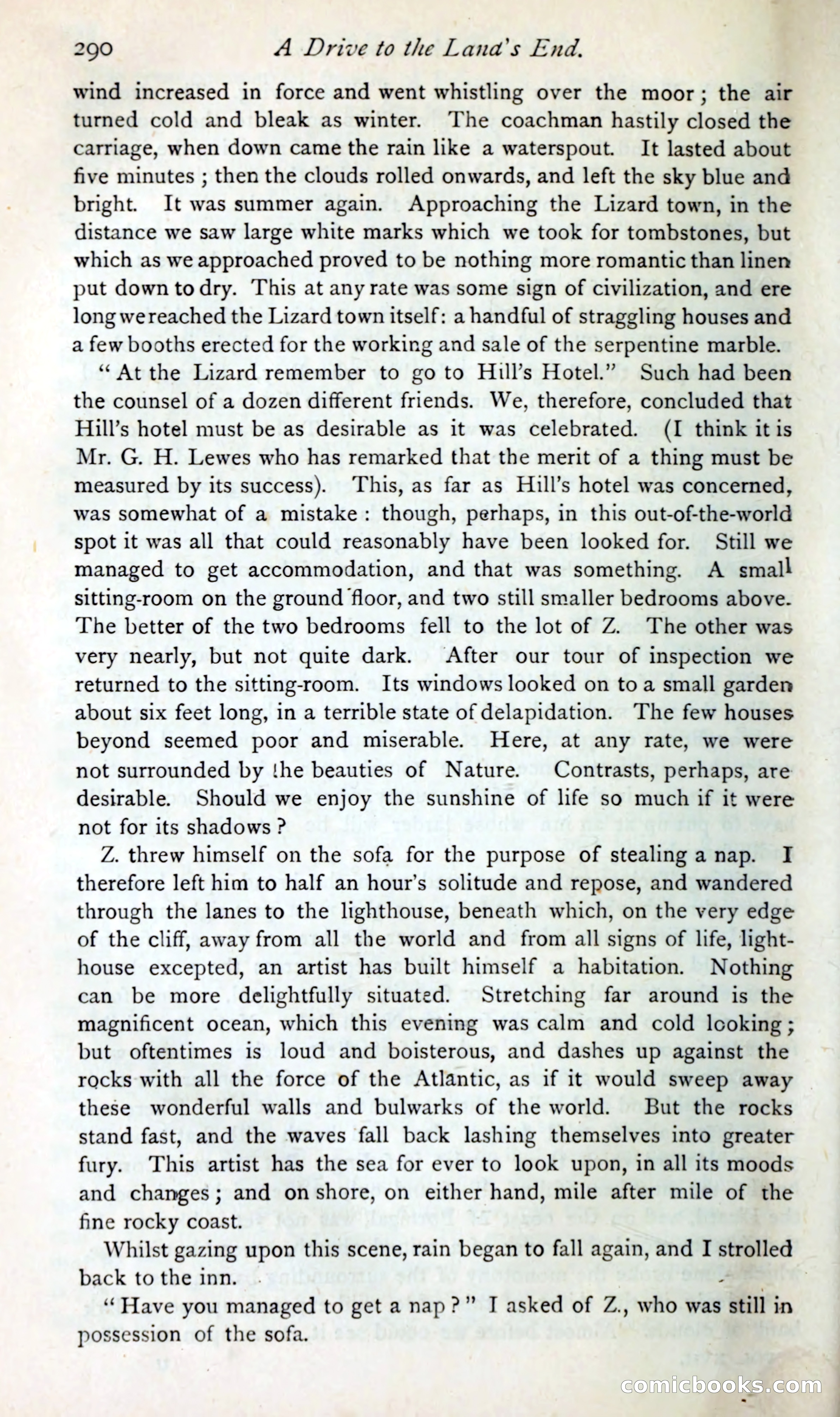
A restored page from Pulp Fiction, 1865. Page through the whole issue in the reader above.
📄 Transcribed text from this page (OCR, searchable)
Machine-transcribed from the original scan — historical spelling and the odd misread are preserved.
290 A Drive to the Lana's End. wind increased in force and went whistling over the moor; the air turned cold and bleak as winter. The coachman hastily closed the carriage, when down came the rain like a waterspout. It lasted about five minutes ; then the clouds rolled onwards, and left the sky blue and bright. It was summer again. Approaching the Lizard town, in the distance we saw large white marks which we took for tombstones, but which as we approached proved to be nothing more romantic than linen put down todry. This at any rate was some sign of civilization, and ere long wereached the Lizard town itself: a handful of straggling houses and a few booths erected for the working and sale of the serpentine marble. ‘“‘ At the Lizard remember to goto Hill’s Hotel.” Such had been the counsel of a dozen different friends. We, therefore, concluded that Hill’s hotel must be as desirable as it was celebrated. (I think itis Mr. G. H. Lewes who has remarked that the merit of a thing must be measured by its success). ‘This, as far as Hill’s hotel was concerned, was somewhat of a mistake: though, perhaps, in this out-of-the-world spot it was all that could reasonably have been looked for. Still we managed to get accommodation, and that was something. A small sitting-room on the ground floor, and two still smaller bedrooms above. The better of the two bedrooms fell to the lot of Z. The other was very nearly, but not quite dark. After our tour of inspection we returned to the sitting-room. Its windows looked on toa small garden about six feet long, in a terrible state of delapidation. The few houses beyond seemed poor and miserable. Here, at any rate, we were not surrounded by the beauties of Nature. Contrasts, perhaps, are desirable. Should we enjoy the sunshine of life so much if it were not for its shadows P Z. threw himself on the sofa for the purpose of stealing a nap. I therefore left him to half an hour’s solitude and repose, and wandered through the lanes to the lighthouse, beneath which, on the very edge of the cliff, away from all the world and from all signs of life, light- house excepted, an artist has built himself a habitation. Nothing can be more delightfully situated. Stretching far around is the magnificent ocean, which this evening was calm and cold looking ; but oftentimes is loud and boisterous, and dashes up against the rocks with all the force of the Atlantic, as if it would sweep away these wonderful walls and bulwarks of the world. But the rocks stand fast, and the waves fall back lashing themselves into greater fury. This artist has the sea for ever to look upon, in all its moods and changes; and onshore, on either hand, mile after mile of the fine rocky coast. Whilst gazing upon this scene, rain began to fall again, and I strolled back tothe inn. . Ane ‘Have you managed to get a nap?” I asked of Z., who was still in possession of the sofa. an) COMMICELCX SEC)