
Pulp Fiction, 1865 · page 106 of 400
The Argosy — page 106: what you’re looking at
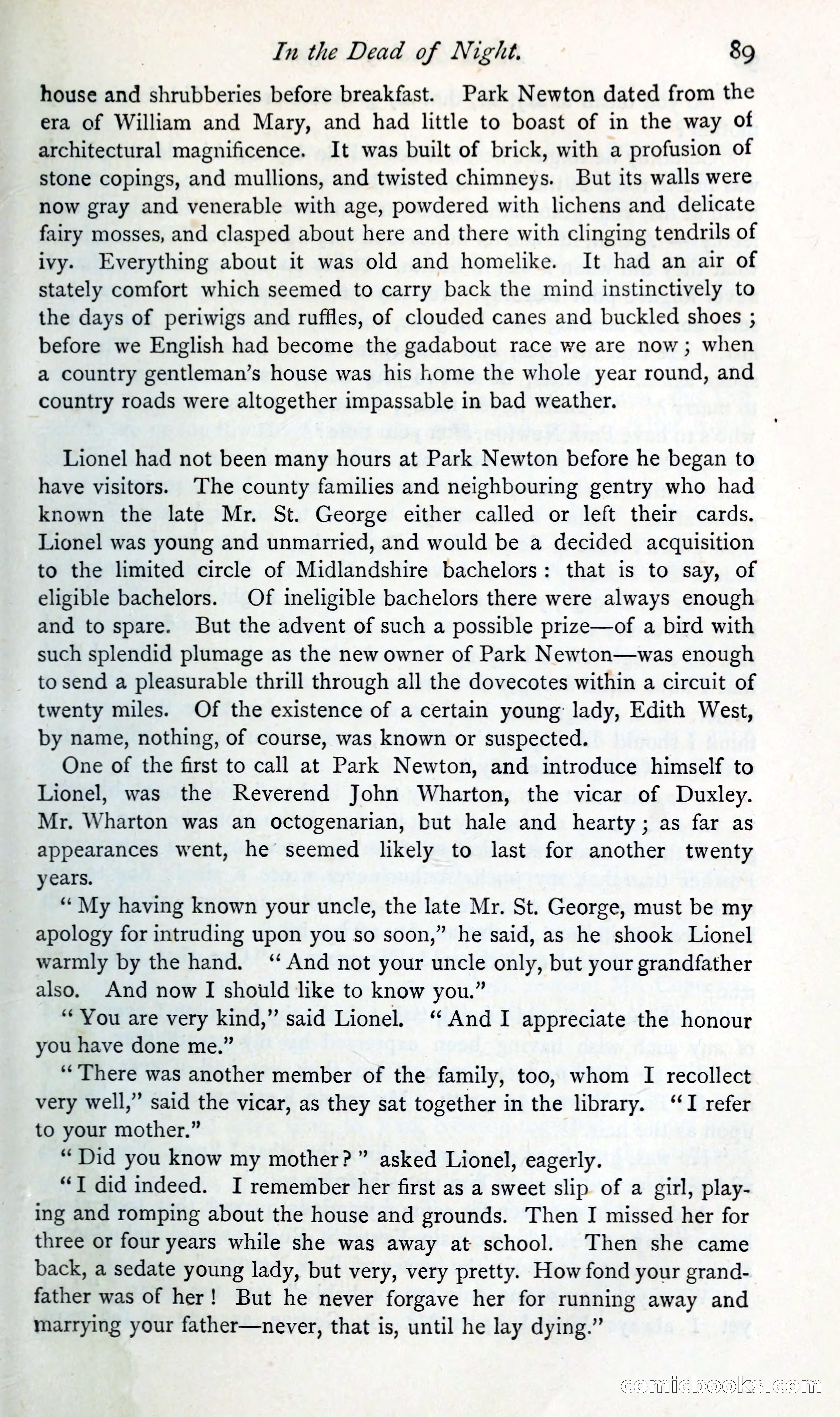
A restored page from Pulp Fiction, 1865. Page through the whole issue in the reader above.
📄 Transcribed text from this page (OCR, searchable)
Machine-transcribed from the original scan — historical spelling and the odd misread are preserved.
In the Dead of Night. 89 house and shrubberies before breakfast. Park Newton dated from the era of William and Mary, and had little to boast of in the way of architectural magnificence. It was built of brick, with a profusion of stone copings, and mullions, and twisted chimneys. But its walls were now gray and venerable with age, powdered with lichens and delicate fairy mosses, and clasped about here and there with clinging tendrils of ivy. Everything about it was old and homelike. It had an air of stately comfort which seemed to carry back the mind instinctively to the days of periwigs and ruffles, of clouded canes and buckled shoes ; before we English had become the gadabout race we are now; when a country gentleman’s house was his home the whole year round, and country roads were altogether impassable in bad weather. Lionel had not been many hours at Park Newton before he began to have visitors. ‘The county families and neighbouring gentry who had known the late Mr. St. George either called or left their cards. Lionel was young and unmarried, and would be a decided acquisition to the limited circle of Midlandshire bachelors: that is to say, of eligible bachelors. Of ineligible bachelors there were always enough and to spare. But the advent of such a possible prize—of a bird with such splendid plumage as the new owner of Park Newton—was enough to send a pleasurable thrill through all the dovecotes within a circuit of twenty miles. Of the existence of a certain young lady, Edith West, by name, nothing, of course, was known or suspected. One of the first to call at Park Newton, and introduce himself to Lionel, was the Reverend John Wharton, the vicar of Duxley. Mr. Wharton was an octogenarian, but hale and hearty; as far as appearances went, he seemed likely to last for another twenty years. “My having known your uncle, the late Mr. St. George, must be my apology for intruding upon you so soon,” he said, as he shook Lionel warmly by the hand. ‘And not your uncle only, but your grandfather also. And now I should like to know you.” ‘You are very kind,” said Lionel. “And I appreciate the honour you have done me.” ‘There was another member of the family, too, whom I recollect very well,” said the vicar, as they sat together in the library. “I refer to your mother.” “Did you know my mother?” asked Lionel, eagerly. “YT did indeed. I remember her first as a sweet slip of a girl, play- ing and romping about the house and grounds. Then I missed her for three or four years while she was away at school. Then she came back, a sedate young lady, but very, very pretty. How fond your grand- father was of her! But he never forgave her for running away and marrying your father—never, that is, until he lay dying.” CoOnmiclooolkks (C(O)