
Pulp Fiction, 1865 · page 105 of 400
The Argosy — page 105: what you’re looking at
A restored page from Pulp Fiction, 1865. Page through the whole issue in the reader above.
📄 Transcribed text from this page (OCR, searchable)
Machine-transcribed from the original scan — historical spelling and the odd misread are preserved.
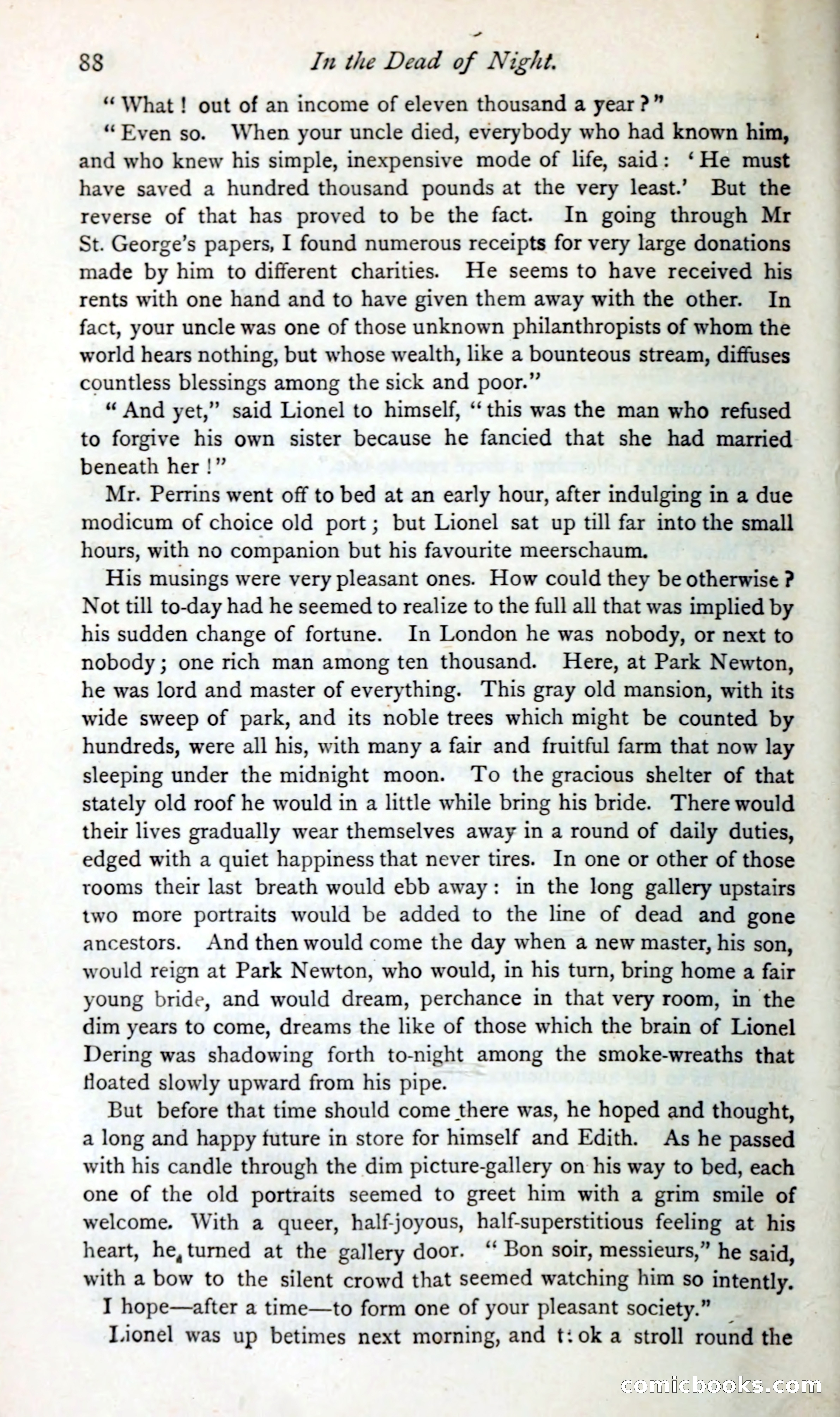
88 In the Dead of Night. “ What ! out of an income of eleven thousand a year ?” “Even so. When your uncle died, everybody who had known him, and who knew his simple, inexpensive mode of life, said: ‘He must have saved a hundred thousand pounds at the very least.’ But the reverse of that has proved to be the fact. In going through Mr St. George’s papers, I found numerous receipts for very large donations made by him to different charities. He seems to have received his rents with one hand and to have given them away with the other. In fact, your uncle was one of those unknown philanthropists of whom the world hears nothing, but whose wealth, like a bounteous stream, diffuses countless blessings among the sick and poor.” “ And yet,” said Lionel to himself, “this was the man who refused to forgive his own sister because he fancied that she had married beneath her !” Mr. Perrins went off to bed at an early hour, after indulging in a due modicum of choice old port; but Lionel sat up till far into the small hours, with no companion but his favourite meerschaum, His musings were very pleasant ones. How could they be otherwise ? Not till to-day had he seemed to realize to the full all that was implied by his sudden change of fortune. In London he was nobody, or next to nobody; one rich man among ten thousand. Here, at Park Newton, he was lord and master of everything. This gray old mansion, with its wide sweep of park, and its noble trees which might be counted by hundreds, were all his, with many a fair and fruitful farm that now lay sleeping under the midnight moon. To the gracious shelter of that stately old roof he would in a little while bring his bride. There would their lives gradually wear themselves away in a round of daily duties, edged with a quiet happiness that never tires. In one or other of those rooms their last breath would ebb away: in the long gallery upstairs two more portraits would be added to the line of dead and gone ancestors. And then would come the day when a new master, his son, would reign at Park Newton, who would, in his turn, bring home a fair young bride, and would dream, perchance in that very room, in the dim years to come, dreams the like of those which the brain of Lionel Dering was shadowing forth to-night among the smoke-wreaths that Hoated slowly upward from his pipe. But before that time should come there was, he hoped and thought, a long and happy future in store for himself and Edith. As he passed with his candle through the dim picture-gallery on his way to bed, each one of the old portraits seemed to greet him with a grim smile of welcome. With a queer, half-joyous, half-superstitious feeling at his heart, he,turned at the gallery door. ‘“ Bon soir, messieurs,” he said, with a bow to the silent crowd that seemed watching him so intently. I hope—after a time—to form one of your pleasant society.” _ Lionel was up betimes next morning, and t:ok a stroll round the Gomicbooks.co m