
Pulp Fiction, 1875 · page 380 of 400
The Argosy — page 380: what you’re looking at
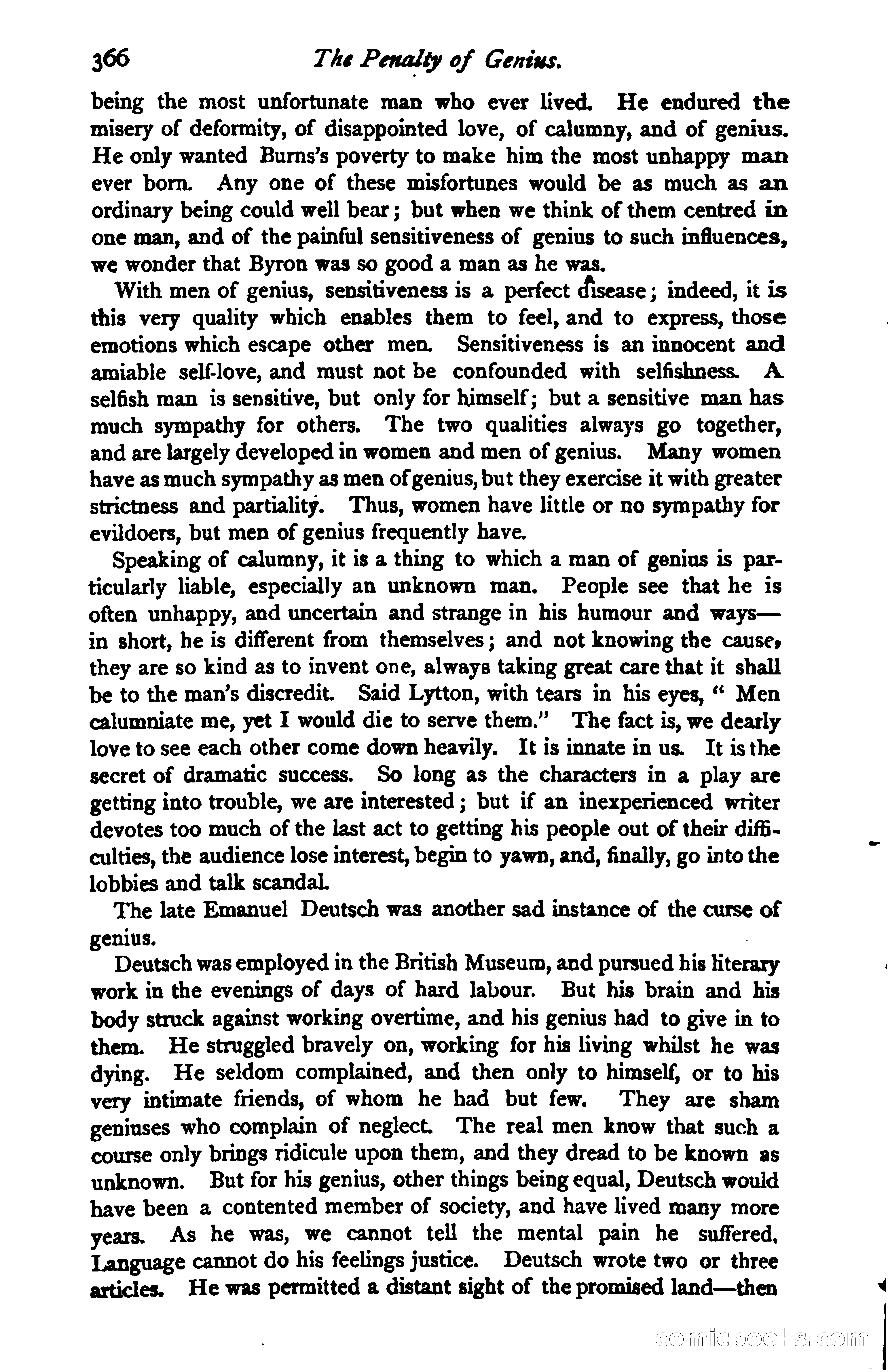
A restored page from Pulp Fiction, 1875. Page through the whole issue in the reader above.
📄 Transcribed text from this page (OCR, searchable)
Machine-transcribed from the original scan — historical spelling and the odd misread are preserved.
366 The Penalty of Genius. being the most unfortunate man who ever lived. He endured the misery of deformity, of disappointed love, of calumny, and of genius. He only wanted Burns’s poverty to make him the most unhappy man ever born. Any one of these misfortunes would be as much as an ordinary being could well bear; but when we think of them centred in one man, and of the painful sensitiveness of genius to such influences, we wonder that Byron was so good a man as he was. With men of genius, sensitiveness is a perfect disease ; indeed, it is this very quality which enables them to feel, and to express, those emotions which escape other men. Sensitiveness is an innocent and amiable self-love, and must not be confounded with selfishness) A selfish man is sensitive, but only for himself; but a sensitive man has much sympathy for others. The two qualities always go together, and are largely developed in women and men of genius. Many women have as much sympathy as men of genius, but they exercise it with greater strictness and partiality. Thus, women have little or no sympathy for evildoers, but men of genius frequently have. Speaking of calumny, it is a thing to which a man of genius is par- ticularly liable, especially an unknown man. People see that he 1s often unhappy, and uncertain and strange in his humour and ways— in short, he is different from themselves; and not knowing the causes they are so kind as to invent one, always taking great care that it shall be to the man’s discredit. Said Lytton, with tears in his eyes, “ Men calumniate me, yet I would die to serve them.” The fact is, we dearly love to see each other come down heavily. It is innate in us. It isthe secret of dramatic success. So long as the characters in a play are getting into trouble, we are interested ; but if an inexperienced writer devotes too much of the last act to getting his people out of their diff- culties, the audience lose interest, begin to yawn, and, finally, go into the lobbies and talk scandal. The late Emanuel Deutsch was another sad instance of the curse of genius. . Deutsch was employed in the British Museum, and pursued his literary work in the evenings of days of hard labour. But his brain and his body struck against working overtime, and his gentus had to give in to them. He struggled bravely on, working for his living whilst he was dying. He seldom complained, and then only to himself, or to his very intimate friends, of whom he had but few. They are sham geniuses who complain of neglect. The real men know that such a course only brings ndicule upon them, and they dread to be known as unknown. But for his genius, other things being equal, Deutsch would have been a contented member of society, and have lived many more years. As he was, we cannot tell the mental pain he suffered, Language cannot do his feelings justice. Deutsch wrote two or three articles. He was permitted a distant sight of the promised land—then GONMGIOO SS (CO)