
Pulp Fiction, 1875 · page 300 of 400
The Argosy — page 300: what you’re looking at
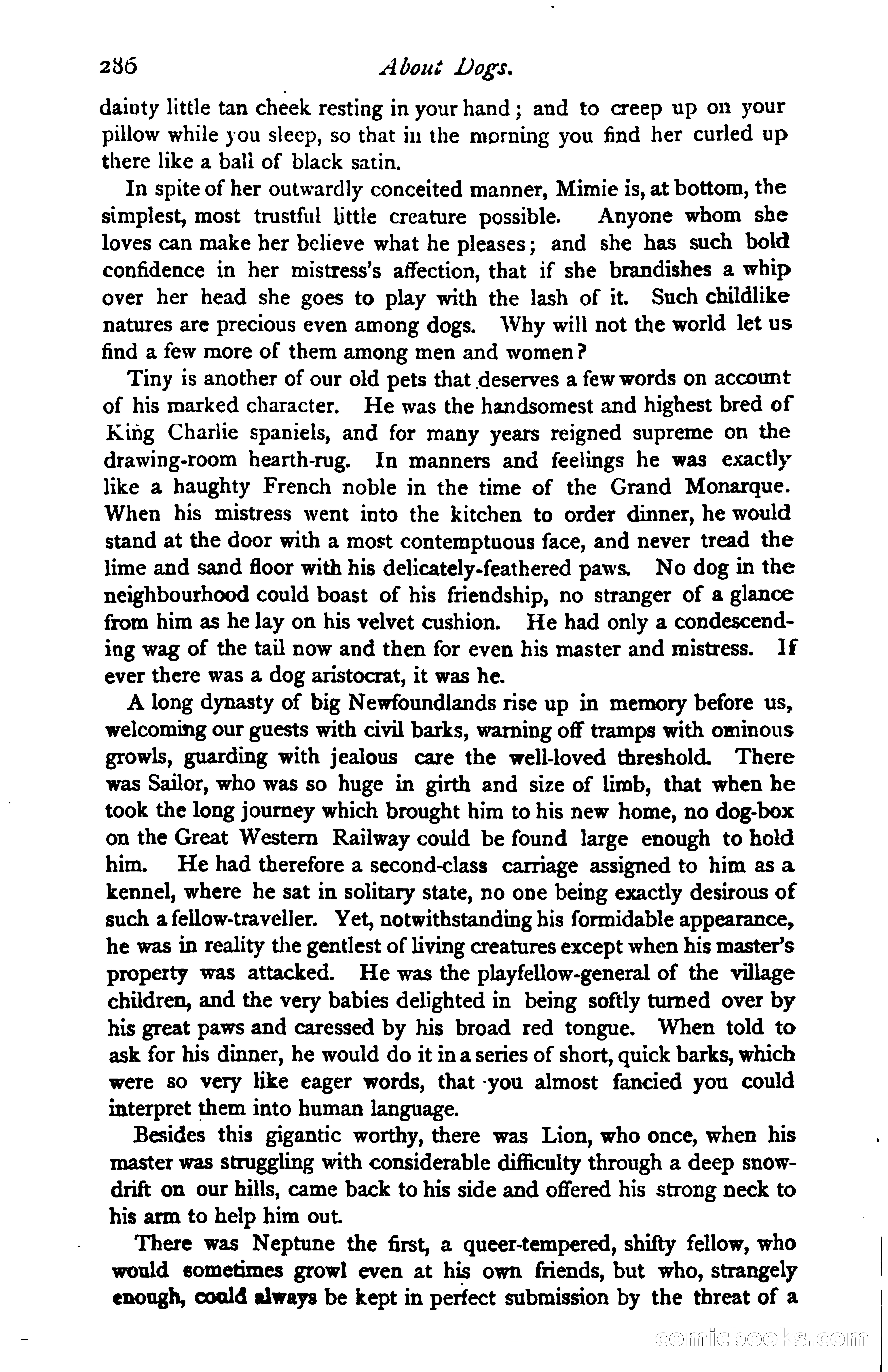
A restored page from Pulp Fiction, 1875. Page through the whole issue in the reader above.
📄 Transcribed text from this page (OCR, searchable)
Machine-transcribed from the original scan — historical spelling and the odd misread are preserved.
286 About Dogs. dainty little tan cheek resting in your hand; and to creep up on your pillow while you sleep, so that in the morning you find her curled up there like a bali of black satin. In spite of her outwardly conceited manner, Mimie is, at bottom, the simplest, most trustful little creature possible. Anyone whom she loves can make her believe what he pleases; and she has such bold confidence in her mistress’s affection, that if she brandishes a whip over her head she goes to play with the lash of it. Such childlike natures are precious even among dogs. Why will not the world let us find a few more of them among men and women? Tiny is another of our old pets that deserves a few words on account of his marked character. He was the handsomest and highest bred of King Charlie spamiels, and for many years reigned supreme on the drawing-room hearth-rug. In manners and feelings he was exactly like a haughty French noble in the time of the Grand Monarque. When his mistress went into the kitchen to order dinner, he would stand at the door with a most contemptuous face, and never tread the lime and sand floor with his delicately-feathered paws. No dog in the neighbourhood could boast of his friendship, no stranger of a glance from him as he lay on his velvet cushion. He had only a condescend- ing wag of the tail now and then for even his master and mistress. If ever there was a dog aristocrat, it was he. A long dynasty of big Newfoundilands rise up in memory before us, welcoming our guests with civil barks, warning off tramps with ominous growls, guarding with jealous care the well-loved threshold. There was Sailor, who was so huge in girth and size of limb, that when he took the long journey which brought him to his new home, no dog-box on the Great Western Railway could be found large enough to hold him. He had therefore a second-class carriage assigned to him as a kennel, where he sat in solitary state, no one being exactly desirous of such a fellow-traveller. Yet, notwithstanding his formidable appearance, he was in reality the gentlest of living creatures except when his master’s property was attacked. He was the playfellow-general of the village children, and the very babies delighted in being softly tumed over by his great paws and caressed by his broad red tongue. When told to ask for his dinner, he would do it inaseries of short, quick barks, which were so very like eager words, that -you almost fancied you could interpret them into human language. Besides this gigantic worthy, there was Lion, who once, when his master was struggling with considerable difficulty through a deep snow- drift on our hills, came back to his side and offered his strong neck to his arm to help him out. There was Neptune the first, a queer-tempered, shifty fellow, who would sometimes growl even at his own friends, but who, strangely enough, coald always be kept in perfect submission by the threat of a CORnniclooolkks (CO)