
Pulp Fiction, 1875 · page 280 of 400
The Argosy — page 280: what you’re looking at
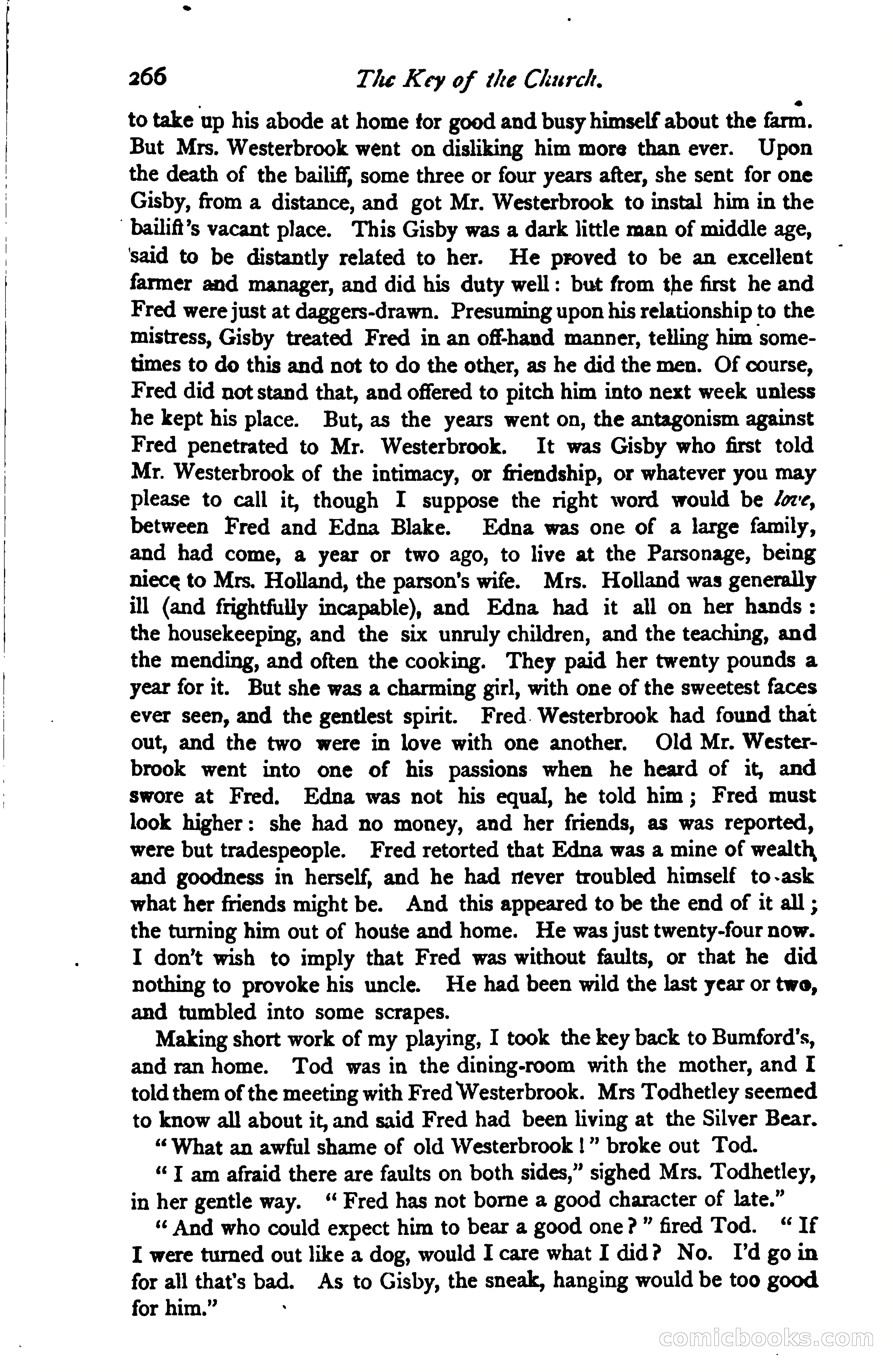
A restored page from Pulp Fiction, 1875. Page through the whole issue in the reader above.
📄 Transcribed text from this page (OCR, searchable)
Machine-transcribed from the original scan — historical spelling and the odd misread are preserved.
266 The Key of the Church. to take up his abode at home for good and busy himself about the farm. But Mrs. Westerbrook went on disliking him more than ever. Upon the death of the bailiff, some three or four years after, she sent for one Gisby, from a distance, and got Mr. Westerbrook to instal him in the -baulift’s vacant place. This Gisby was a dark little man of middle age, said to be distantly related to her. He proved to be an excellent farmer and manager, and did his duty well: but from the first he and Fred were just at daggers-drawn. Presuming upon his relationship to the mistress, Gisby treated Fred in an off-hand manner, telling him some- times to do this and not to do the other, as he did the men. Of course, Fred did not stand that, and offered to pitch him into next week unless he kept his place. But, as the years went on, the antagonism against Fred penetrated to Mr. Westerbrook. It was Gisby who first told Mr. Westerbrook of the intimacy, or friendship, or whatever you may please to call it, though I suppose the right word would be Joe, between Fred and Edna Blake. Edna was one of a large family, and had come, a year or two ago, to live at the Parsonage, being niece to Mrs. Holland, the parson’s wife. Mrs. Holland was generally ill (and frightfully incapable), and Edna had it all on her hands: the housekeeping, and the six unruly children, and the teaching, and the mending, and often the cooking. They paid her twenty pounds a year for it. But she was a charming girl, with one of the sweetest faces ever seen, and the gentlest spirit. Fred. Westerbrook had found that out, and the two were in love with one another. Old Mr. Wester- brook went into one of his passions when he heard of it, and swore at Fred. Edna was not his equal, he told him; Fred must look higher: she had no money, and her friends, as was reported, were but tradespeople. Fred retorted that Edna was a mine of wealth and goodness in herself, and he had rfever troubled himself to-ask what her friends might be. And this appeared to be the end of it all ; the turning him out of house and home. He was just twenty-four now. I don’t wish to imply that Fred was without faults, or that he did nothing to provoke his uncle. He had been wild the last year or twa, and tumbled into some scrapes. Making short work of my playing, I took the key back to Bumford'’s, and ran home. Tod was in the dining-room with the mother, and I told them of the meeting with Fred Westerbrook. Mrs Todhetley seemed to know all about it, and said Fred had been living at the Silver Bear. ‘What an awful shame of old Westerbrook !” broke out Tod. “T am afraid there are faults on both sides,” sighed Mrs. Todhetley, in her gentle way. “Fred has not borne a good character of late.” ‘“¢ And who could expect him to bear a good one?” fired Tod. “ If I were turned out like a dog, would I care what I did? No. I’d goin for all that’s bad. As to Gisby, the sneak, hanging would be too good for him.” _ (CO) ecomniclooolkks