
Pulp Fiction, 1875 · page 279 of 400
The Argosy — page 279: what you’re looking at
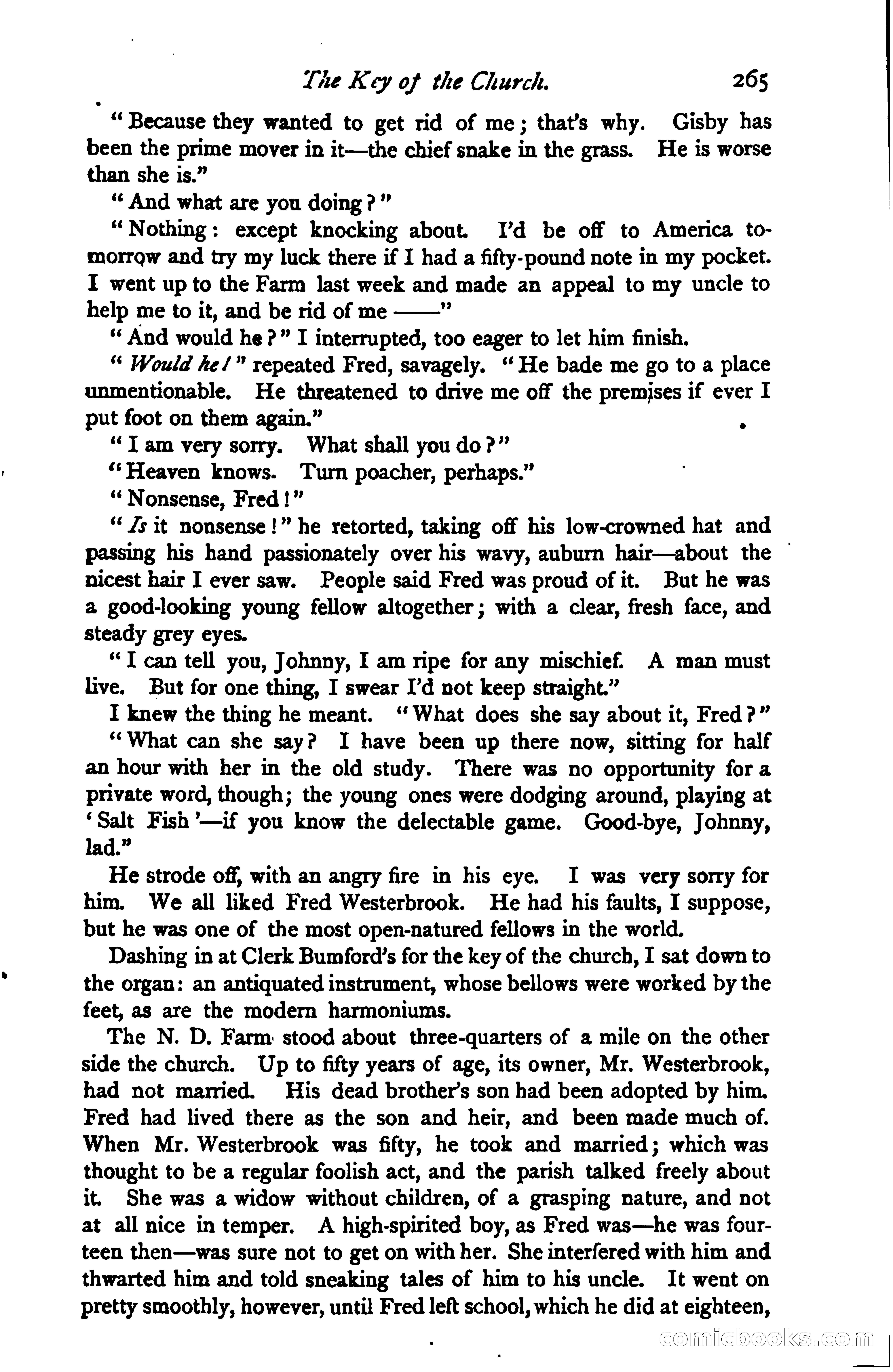
A restored page from Pulp Fiction, 1875. Page through the whole issue in the reader above.
📄 Transcribed text from this page (OCR, searchable)
Machine-transcribed from the original scan — historical spelling and the odd misread are preserved.
lhe Key of the Church. 205 “ Because they wanted to get rid of me; that’s why. Gisby has been the prime mover in it—the chief snake in the grass. He is worse than she is.” “‘ And what are you doing ?” “Nothing: except knocking about. I’d be off to America to- morrow and try my luck there if I had a fifty-pound note in my pocket. I went up to the Farm last week and made an appeal to my uncle to help me to it, and be rid of me ——” ‘And would he ?” I interrupted, too eager to let him finish. ““ Would he/” repeated Fred, savagely. ‘‘ He bade me go to a place unmentionable. He threatened to drive me off the premjses if ever I put foot on them again.” . “‘T am very sorry. What shall you do?” “‘Heaven knows. Turn poacher, perhaps.” ‘““ Nonsense, Fred !” * 7s it nonsense!” he retorted, taking off his low-crowned hat and passing his hand passionately over his wavy, auburn hair—about the — nicest hair I ever saw. People said Fred was proud of it. But he was a good-looking young fellow altogether; with a clear, fresh face, and steady grey eyes. ‘TI can tell you, Johnny, I am npe for any mischief. A man must live. But for one thing, I swear I’d not keep straight.” I knew the thing he meant. ‘‘ What does she say about it, Fred ?” ‘What can she say? I have been up there now, sitting for half an hour with her in the old study. There was no opportunity fora private word, though; the young ones were dodging around, playing at ‘Salt Fish —if you know the delectable game. Good-bye, Johnny, lad.” He strode off, with an angry fire in his eye. I was very sorry for him. We all liked Fred Westerbrook. He had his faults, I suppose, but he was one of the most open-natured fellows in the world. Dashing in at Clerk Bumford’s for the key of the church, I sat down to the organ: an antiquated instrument, whose bellows were worked by the feet, as are the modern harmoniums. The N. D. Farm: stood about three-quarters of a mile on the other side the church. Up to fifty years of age, its owner, Mr. Westerbrook, had not married. His dead brother’s son had been adopted by him. Fred had lived there as the son and heir, and been made much of. When Mr. Westerbrook was fifty, he took and married; which was thought to be a regular foolish act, and the parish talked freely about it. She was a widow without children, of a grasping nature, and not at all nice in temper. A high-spirited boy, as Fred was—he was four- teen then—was sure not to get on with her. She interfered with him and thwarted him and told sneaking tales of him to his uncle. It went on pretty smoothly, however, until Fred left school, which he did at eighteen, EOMRniilElooe SS (CO)