
Pulp Fiction, 1875 · page 250 of 400
The Argosy — page 250: what you’re looking at
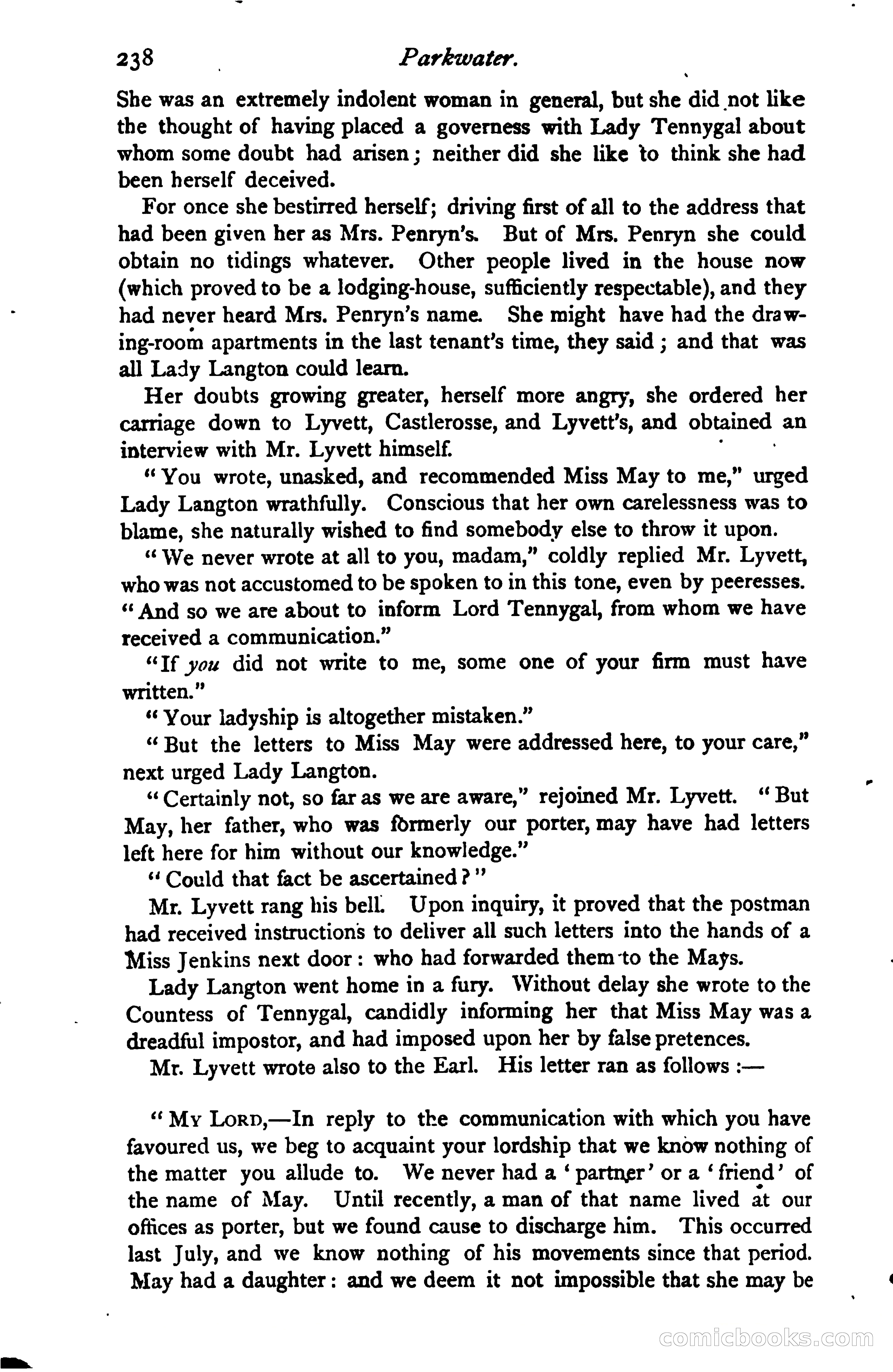
A restored page from Pulp Fiction, 1875. Page through the whole issue in the reader above.
📄 Transcribed text from this page (OCR, searchable)
Machine-transcribed from the original scan — historical spelling and the odd misread are preserved.
238 | Parkwater. She was an extremely indolent woman in general, but she did not like the thought of having placed a governess with Lady Tennygal about whom some doubt had arisen; neither did she like to think she had been herself deceived. For once she bestirred herself; driving first of all to the address that had been given her as Mrs. Penryn’s. But of Mrs. Penryn she could obtain no tidings whatever. Other people lived in the house now (which proved to be a lodging-house, sufficiently respectable), and they had never heard Mrs. Penryn’s name. She might have had the draw- ing-room apartments in the last tenant’s time, they said ; and that was all Lady Langton could learn. Her doubts growing greater, herself more angry, she ordered her carriage down to Lyvett, Castlerosse, and Lyvett’s, and obtained an interview with Mr. Lyvett himself. ‘You wrote, unasked, and recommended Miss May to me,” urged Lady Langton wrathfully. Conscious that her own carelessness was to blame, she naturally wished to find somebody else to throw it upon. ‘We never wrote at all to you, madam,” coldly replied Mr. Lyvett, who was not accustomed to be spoken to 1n this tone, even by peeresses. ‘And so we are about to inform Lord Tennygal, from whom we have received a communication.” “If you did not write to me, some one of your firm must have written.” ‘Your ladyship is altogether mistaken.” ‘But the letters to Miss May were addressed here, to your care,” next urged Lady Langton. ‘‘ Certainly not, so far as we are aware,” rejoined Mr. Lyvett. ‘“‘ But May, her father, who was formerly our porter, may have had letters left here for him without our knowledge.” ‘¢ Could that fact be ascertained ?”’ Mr. Lyvett rang his bell. Upon inquiry, it proved that the postman had received instructions to deliver all such letters into the hands of a Miss Jenkins next door: who had forwarded them to the Mays. Lady Langton went home in a fury. Without delay she wrote to the Countess of Tennygal, candidly informing her that Miss May was a dreadful impostor, and had imposed upon her by false pretences. Mr. Lyvett wrote also to the Earl. His letter ran as follows :— ‘‘My Lorp,—In reply to tke communication with which you have favoured us, we beg to acquaint your eran that we know nothing of the matter you allude to. We never had a ‘ partner’ or a ‘friend’ of the name of May. Until recently, a man of that name lived at our offices as porter, but we found cause to discharge him. This occurred last July, and we know nothing of his movements since that period. May had a daughter: and we deem it not impossible that she may be ecomniclooolkks _ (CO)