
Pulp Fiction, 1875 · page 249 of 400
The Argosy — page 249: what you’re looking at
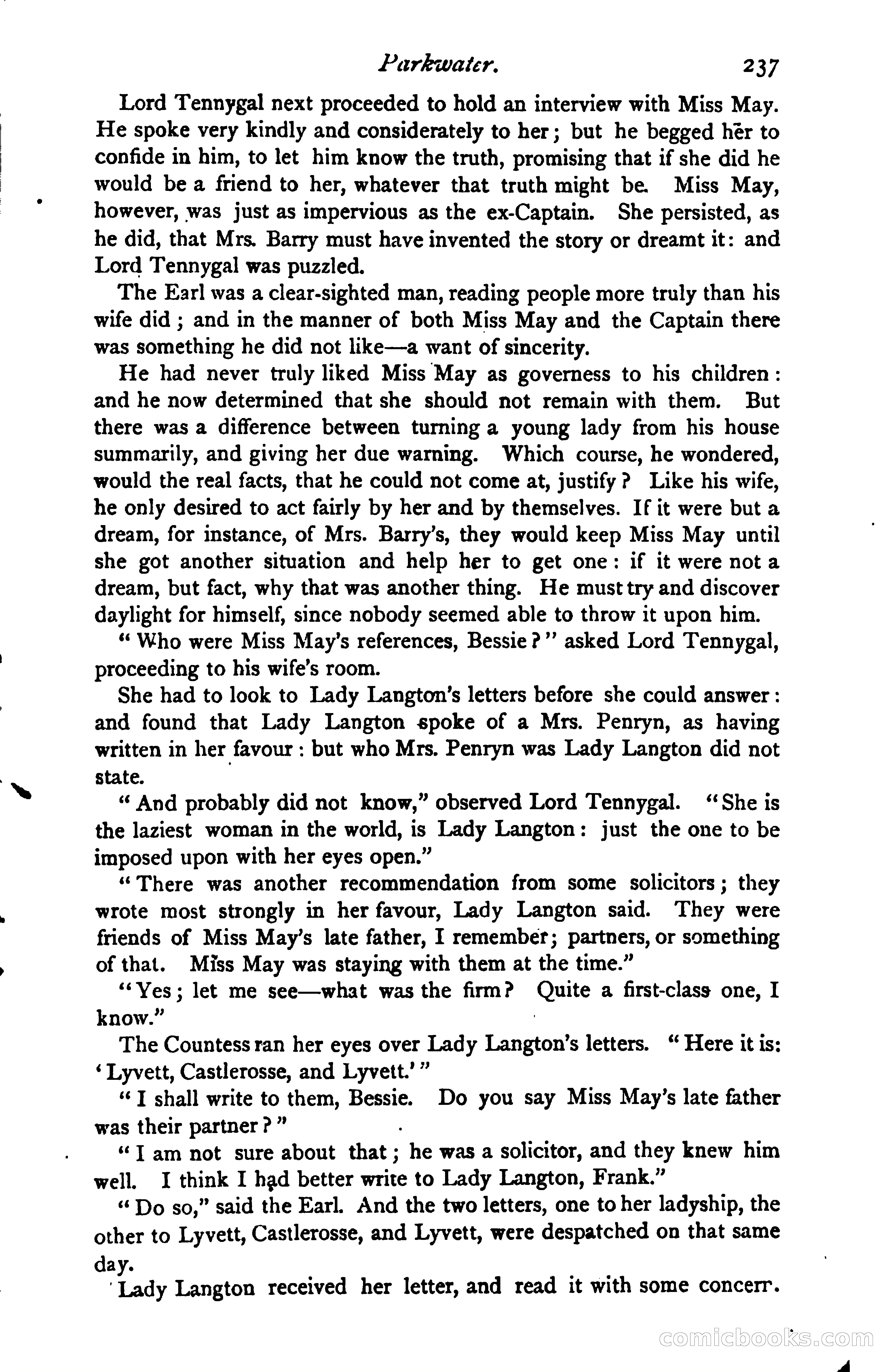
A restored page from Pulp Fiction, 1875. Page through the whole issue in the reader above.
📄 Transcribed text from this page (OCR, searchable)
Machine-transcribed from the original scan — historical spelling and the odd misread are preserved.
Parkwater. 237 Lord Tennygal next proceeded to hold an interview with Miss May. He spoke very kindly and considerately to her; but he begged hér to confide in him, to let him know the truth, promising that if she did he would be a friend to her, whatever that truth might be. Miss May, however, was just as impervious as the ex-Captain. She persisted, as he did, that Mrs. Barry must have invented the story or dreamt it: and Lord Tennygal was puzzled. The Earl was a clear-sighted man, reading people more truly than his wife did ; and in the manner of both Miss May and the Captain there was something he did not like—a want of sincerity. He had never truly liked Miss May as governess to his children : and he now determined that she should not remain with them. But there was a difference between turning a young lady from his house summarily, and giving her due warning. Which course, he wondered, would the real facts, that he could not come at, justify? Like his wife, he only desired to act fairly by her and by themselves. If it were but a dream, for instance, of Mrs. Barry’s, they would keep Miss May until she got another situation and help her to get one: if it were nota dream, but fact, why that was another thing. He musttry and discover daylight for himself, since nobody seemed able to throw it upon him. “Who were Miss May’s references, Bessie ?”’ asked Lord Tennygal, proceeding to his wife’s room. She had to look to Lady Langton’s letters before she could answer: and found that Lady Langton spoke of a Mrs. Penryn, as having written in her favour: but who Mrs. Penryn was Lady Langton did not state. ‘“ And probably did not know,” observed Lord Tennygal. ‘She is the laziest woman in the world, is Lady Langton: just the one to be imposed upon with her eyes open.” ‘There was another recommendation from some solicitors; they wrote most strongly in her favour, Lady Langton said. They were friends of Miss May’s late father, I remember; partners, or something of that. Miss May was staying with them at the time.” ‘‘Yes; let me see—what was the firme Quite a first-class one, I know.” The Countess ran her eyes over Lady Langton’ s letters. “ Here itis: ‘Lyvett, Castlerosse, and Lyvett.’” ‘‘T shall write to them, Bessie. Do you say Miss May’s late father was their partner P” ‘¢T am not sure about that; he was a solicitor, and they knew him well. JI think I had better write to Lady Langton, Frank.” “Do so,” said the Earl. And the two letters, one to her ladyship, the other to Lyvett, Castlerosse, and Lyvett, were despatched on that same da ‘Lady Langton received her letter, and read it with some concerr. EOMRniilElooe _ (CO)