
Pulp Fiction, 1875 · page 228 of 400
The Argosy — page 228: what you’re looking at
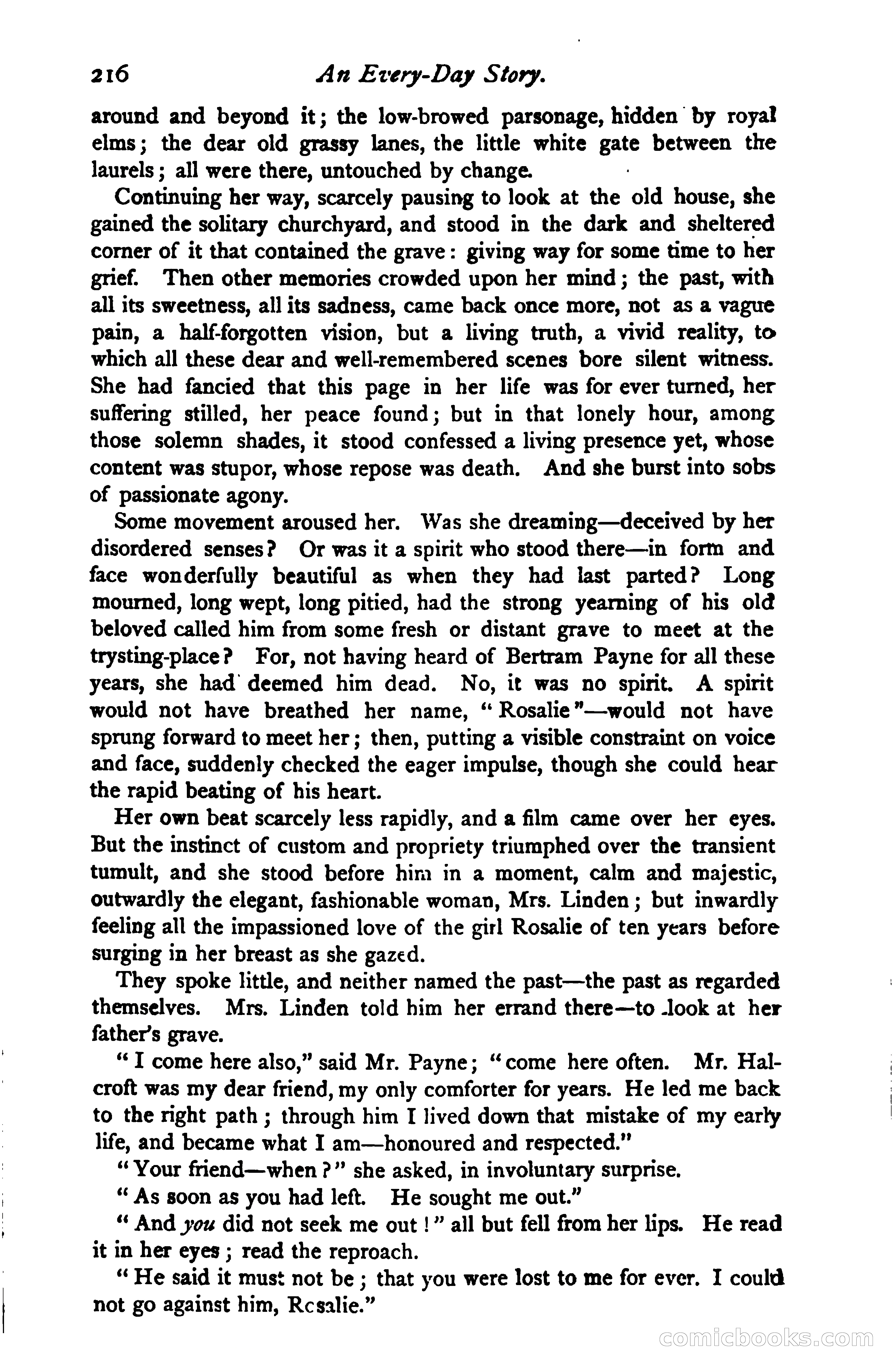
A restored page from Pulp Fiction, 1875. Page through the whole issue in the reader above.
📄 Transcribed text from this page (OCR, searchable)
Machine-transcribed from the original scan — historical spelling and the odd misread are preserved.
216 An Every-Day Story. around and beyond it; the low-browed parsonage, hidden by royal elms; the dear old grassy lanes, the little white gate between the laurels ; all were there, untouched by change. Continuing her way, scarcely pausing to look at the old house, she gained the solitary churchyard, and stood in the dark and sheltered corner of it that contained the grave: giving way for some time to her grief. ‘Then other memories crowded upon her mind; the past, with all its sweetness, all its sadness, came back once more, not as a vague pain, a half-forgotten vision, but a living truth, a vivid reality, to which all these dear and well-remembered scenes bore silent witness. She had fancied that this page in her life was for ever turned, her suffering stilled, her peace found; but in that lonely hour, among those solemn shades, it stood confessed a living presence yet, whose content was stupor, whose repose was death. And she burst into sobs of passionate agony. Some movement aroused her. Was she dreaming—deceived by her disordered senses? Or was it a spirit who stood there—in form and face wonderfully beautiful as when they had last parted? Long mourned, long wept, long pitied, had the strong yearning of his old beloved called him from some fresh or distant grave to meet at the trysting-place? For, not having heard of Bertram Payne for all these years, she had deemed him dead. No, it was no spirit. A spimt would not have breathed her name, ‘“ Rosalie”—would not have sprung forward to meet her; then, putting a visible constraint on voice and face, suddenly checked the eager impulse, though she could hear the rapid beating of his heart. Her own beat scarcely less rapidly, and a film came over her eyes. But the instinct of custom and propriety triumphed over the transient tumult, and she stood before him in a moment, calm and majestic, outwardly the elegant, fashionable woman, Mrs. Linden; but inwardly feeling all the impassioned love of the girl Rosalie of ten years before surging in her breast as she gazed. They spoke httle, and neither named the past—the past as regarded themselves. Mrs. Linden told him her errand there—to -look at her father’s grave. “‘T come here also,” said Mr. Payne; “come here often. Mr. Hal- croft was my dear friend, my only comforter for years. He led me back to the right path ; through him I lived down that mistake of my early life, and became what I am—honoured and respected.” “Your friend—when ?” she asked, in involuntary surprise. “As soon as you had left. He sought me out.” “ And you did not seek me out!” all but fell from her lips. He read it in her eyes ; read the reproach. “He said it must not be ; that you were lost to me for ever. I could not go against him, Rcsalie.” EOMRniilElooe _ SS (CO)