
Pulp Fiction, 1875 · page 156 of 400
The Argosy — page 156: what you’re looking at
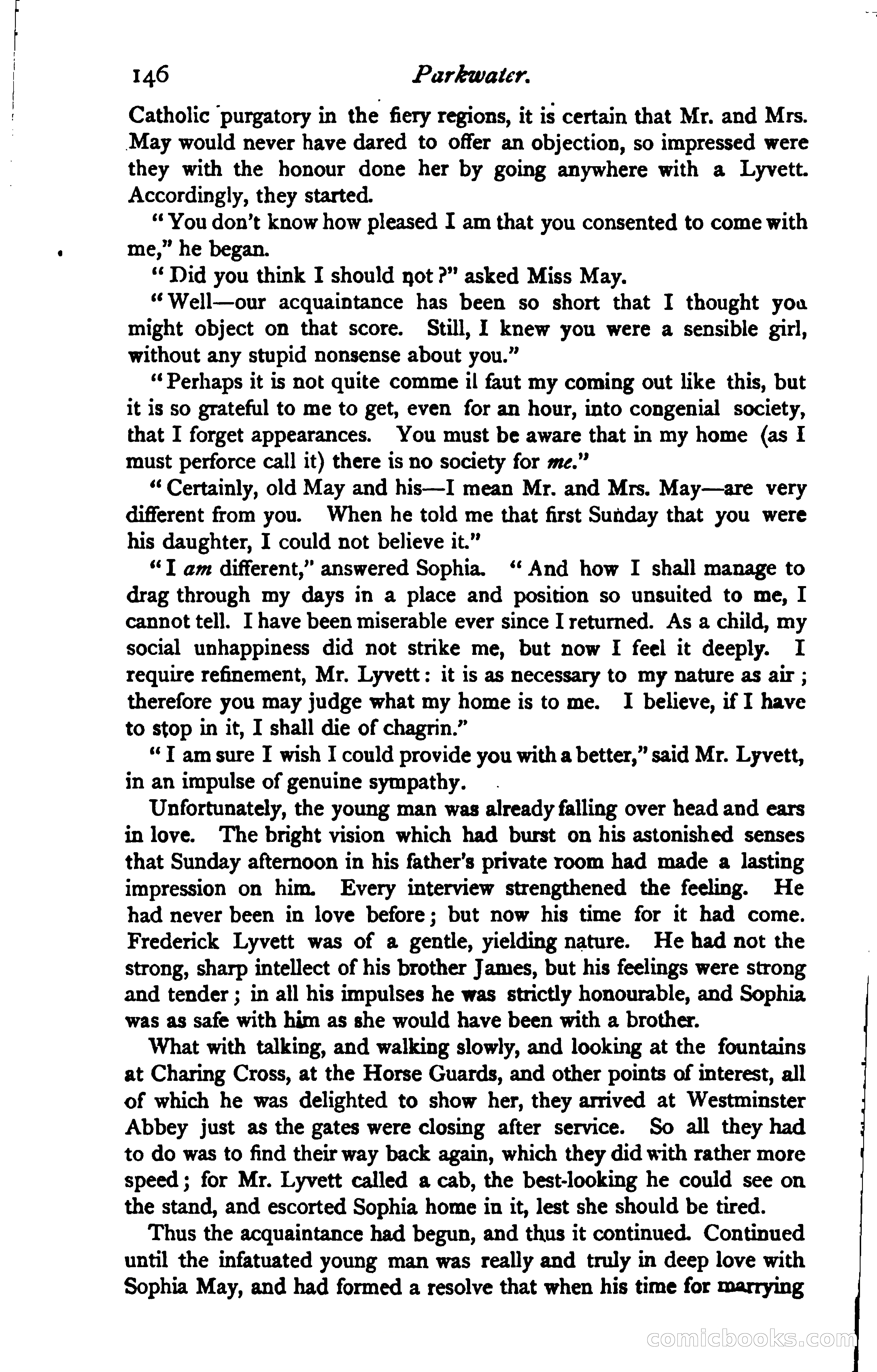
A restored page from Pulp Fiction, 1875. Page through the whole issue in the reader above.
📄 Transcribed text from this page (OCR, searchable)
Machine-transcribed from the original scan — historical spelling and the odd misread are preserved.
146 Parkwater. Catholic purgatory in the fiery regions, it is certain that Mr. and Mrs. May would never have dared to offer an objection, so impressed were they with the honour done her by going anywhere with a Lyvett. Accordingly, they started. “You don’t know how pleased I am that you consented to come with me,” he began. ‘Did you think I should not ?” asked Miss May. “ Well—our acquaintance has been so short that I thought you might object on that score. Still, I knew you were a sensible girl, without any stupid nonsense about you.” ‘Perhaps it is not quite comme il faut my coming out like this, but it is So grateful to me to get, even for an hour, into congenial society, that I forget appearances. You must be aware that in my home (as I must perforce call it) there is no society for me.” ‘‘ Certainly, old May and his—I mean Mr. and Mrs. May—are very different from you. When he told me that first Sunday that you were his daughter, I could not believe it.” ‘‘T am different,” answered Sophia. ‘ And how I shall manage to drag through my days in a place and position so unsuited to me, I cannot tell. I have been miserable ever since I returned. As a child, my social unhappiness did not strike me, but now I feel it deeply. I require refinement, Mr. Lyvett: it is as necessary to my nature as alr ; therefore you may judge what my home is to me. I believe, if I have to stop in it, I shall die of chagrin.” “‘T am sure I wish I could provide you with a better,” said Mr. Lyvett, in an impulse of genuine sympathy. Unfortunately, the young man was already falling over head and ears in love. The bright vision which had burst on his astonished senses that Sunday afternoon in his father’s private room had made a lasting impression on him. Every interview strengthened the feeling. He had never been in love before; but now his time for it had come. Frederick Lyvett was of a gentle, yielding nature. He had not the strong, sharp intellect of his brother James, but his feelings were strong and tender ; in all his impulses he was strictly honourable, and Sophia was as safe with him as she would have been with a brother. What with talking, and walking slowly, and looking at the fountains at Charing Cross, at the Horse Guards, and other points of interest, all of which he was delighted to show her, they arrived at Westminster Abbey just as the gates were closing after service. So all they had to do was to find their way back again, which they did with rather more speed ; for Mr. Lyvett called a cab, the best-looking he could see on the stand, and escorted Sophia home in it, lest she should be tired. Thus the acquaintance had begun, and thus it continued. Continued until the infatuated young man was really and truly in deep love with Sophia May, and had formed a resolve that when his time for marrying CORNICE OOS (GO) _