
Pulp Fiction, 1875 · page 155 of 400
The Argosy — page 155: what you’re looking at
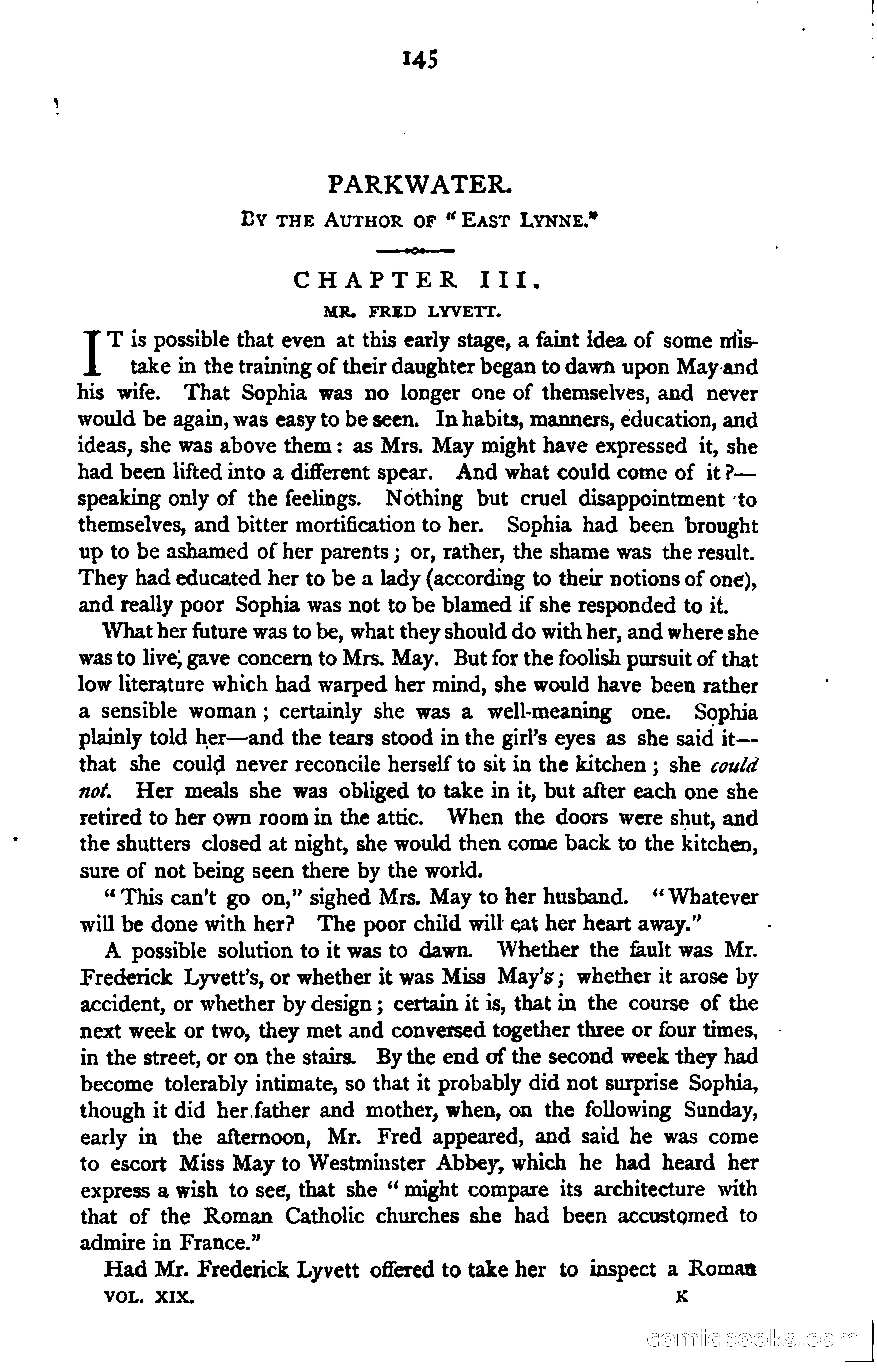
A restored page from Pulp Fiction, 1875. Page through the whole issue in the reader above.
📄 Transcribed text from this page (OCR, searchable)
Machine-transcribed from the original scan — historical spelling and the odd misread are preserved.
145 PARKWATER. CY THE AUTHOR oF “East LYNNE.” CHAPTER III. MR, FRED LYVETT. [* is possible that even at this early stage, a faint idea of some niis- take in the training of their daughter began to dawn upon May-and his wife. That Sophia was no longer one of themselves, and never would be again, was easy to be seen. In habits, manners, education, and ideas, she was above them: as Mrs. May might have expressed it, she had been lifted into a different spear. And what could come of it P— speaking only of the feelings. Nothing but cruel disappointment ‘to themselves, and bitter mortification to her. Sophia had been brought up to be ashamed of her parents ; or, rather, the shame was the result. They had educated her to be a lady (according to their notions of one), and really poor Sophia was not to be blamed if she responded to it. What her future was to be, what they should do with her, and where she was to live, gave concern to Mrs. May. But for the foolish pursuit of that low literature which had warped her mind, she would have been rather a sensible woman ; certainly she was a well-meaning one. Sophia plainly told her—and the tears stood in the girl’s eyes as she said it—- that she could never reconcile herself to sit in the kitchen ; she coudd not. Her meals she was obliged to take in it, but after each one she retired to her own room in the attic. When the doors were shut, and the shutters closed at night, she would then come back to the kitchen, sure of not being seen there by the world. “This can’t go on,” sighed Mrs. May to her husband. ‘‘ Whatever will be done with her? The poor child will eat her heart away.” A possible solution to it was to dawn. Whether the fault was Mr. Frederick Lyvett’s, or whether it was Miss May’s; whether it arose by accident, or whether by design ; certain it 1s, that in the course of the next week or two, they met and conversed together three or four times, in the street, or on the stairs. By the end of the second week they had become tolerably intimate, so that it probably did not surprise Sophia, though it did her.father and mother, when, on the following Sunday, early in the afternoon, Mr. Fred appeared, and said he was come to escort Miss May to Westminster Abbey, which he had heard her express a wish to see, that she “ might compare its architecture with that of the Roman Catholic churches she had been accustomed to admire in France.” Had Mr. Frederick Lyvett offered to take her to inspect a Roman VOL. XIX. K ECOMRRIC OOO Ss (GO)