
Pulp Fiction, 1865 · page 290 of 399
The Argosy — page 290: what you’re looking at
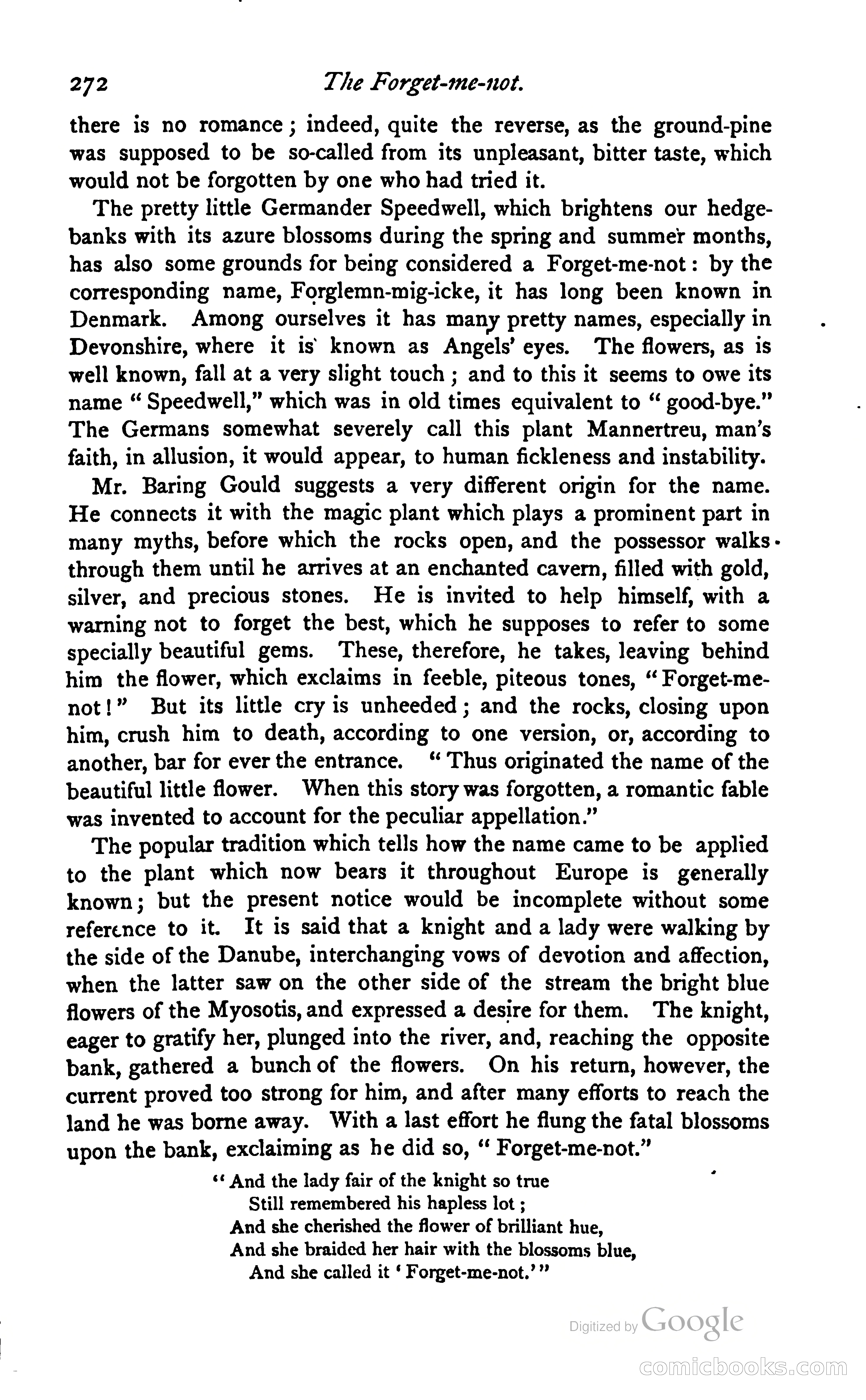
A restored page from Pulp Fiction, 1865. Page through the whole issue in the reader above.
📄 Transcribed text from this page (OCR, searchable)
Machine-transcribed from the original scan — historical spelling and the odd misread are preserved.
272 Lhe Forget-me-not. there is no romance ; indeed, quite the reverse, as the ground-pine was supposed to be so-called from its unpleasant, bitter taste, which would not be forgotten by one who had tried it. The pretty little Germander Speedwell, which brightens our hedge- banks with its azure blossoms during the spring and summer months, has also some grounds for being considered a Forget-me-not: by the corresponding name, Forglemn-mig-icke, it has long been known in Denmark. Among ourselves it has many pretty names, especially in Devonshire, where it is known as Angels’ eyes. The flowers, as 1s well known, fall at a very slight touch ; and to this it seems to owe its name “ Speedwell,” which was in old times equivalent to “ good-bye.” The Germans somewhat severely call this plant Mannertreu, man’s faith, in allusion, 1t would appear, to human fickleness and instability. Mr. Baring Gould suggests a very different ongin for the name. He connects it with the magic plant which plays a prominent part in many myths, before which the rocks open, and the possessor walks- through them until he arrives at an enchanted cavern, filled with gold, silver, and precious stones. He is invited to help himself, with a warning not to forget the best, which he supposes to refer to some specially beautiful gems. These, therefore, he takes, leaving behind him the flower, which exclaims in feeble, piteous tones, “ Forget-me- not!” But its little cry is unheeded; and the rocks, closing upon him, crush him to death, according to one version, or, according to another, bar for ever the entrance. ‘Thus originated the name of the beautiful little flower. When this story was forgotten, a romantic fable was invented to account for the peculiar appellation.” The popular tradition which tells how the name came to be applied to the plant which now bears it throughout Europe is generally known; but the present notice would be incomplete without some reference to it. It is said that a knight and a lady were walking by the side of the Danube, interchanging vows of devotion and affection, when the latter saw on the other side of the stream the bright blue flowers of the Myosotis, and expressed a desire for them. The knight, eager to gratify her, plunged into the river, and, reaching the opposite bank, gathered a bunch of the flowers. On his return, however, the current proved too strong for him, and after many efforts to reach the land he was borne away. With a last effort he flung the fatal blossoms upon the bank, exclaiming as he did so, “ Forget-me-not. ‘¢ And the lady fair of the knight so true Still remembered his hapless lot ; And she cherished the flower of brilliant hue, And she braided her hair with the blossoms blue, And she called it ‘ Forget-me-not.’” be ] (CO) @ JOO SS (CO)