
Pulp Fiction, 1865 · page 289 of 399
The Argosy — page 289: what you’re looking at
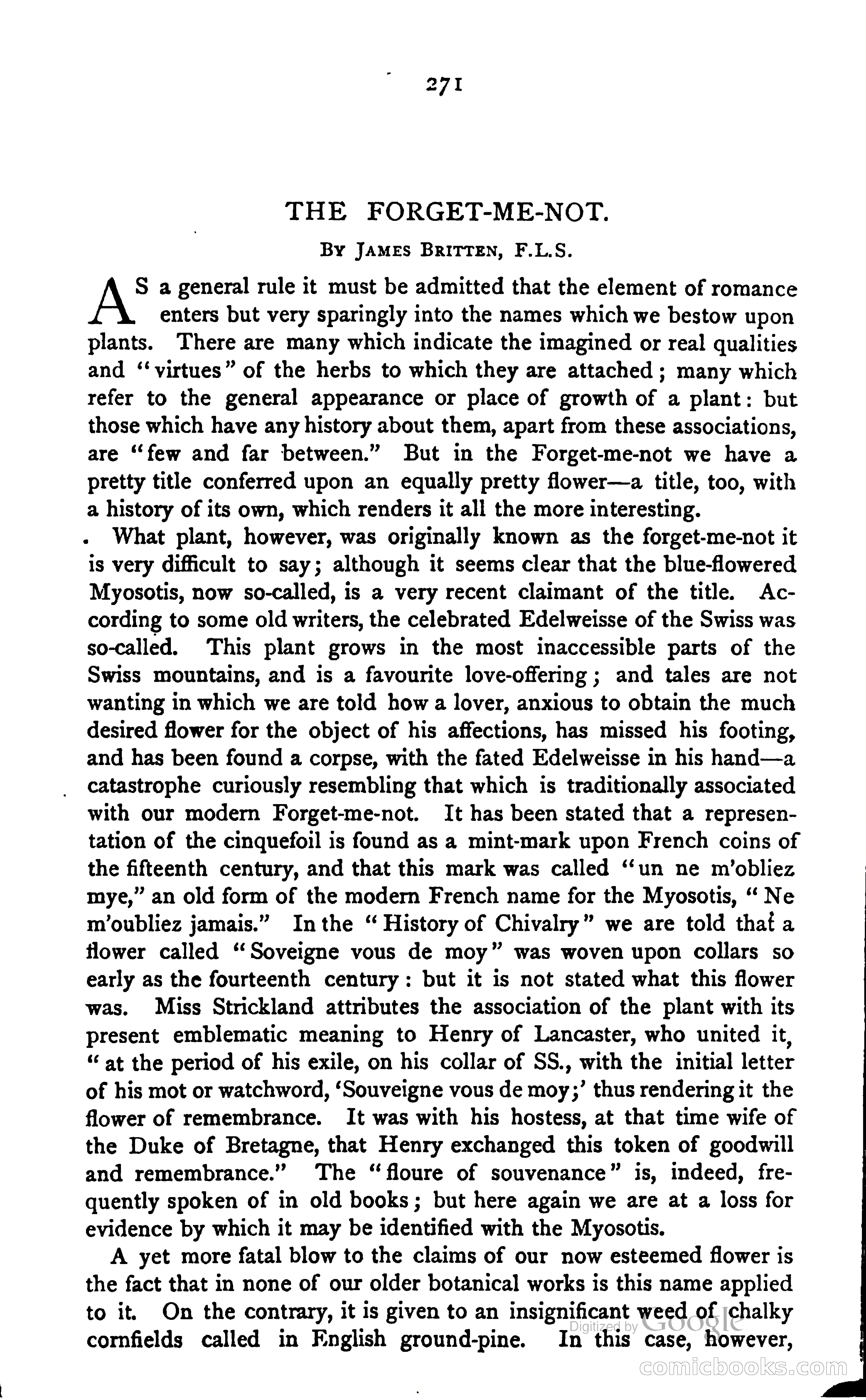
A restored page from Pulp Fiction, 1865. Page through the whole issue in the reader above.
📄 Transcribed text from this page (OCR, searchable)
Machine-transcribed from the original scan — historical spelling and the odd misread are preserved.
THE FORGET-ME-NOT. By JAMES BRITTEN, F.L.S. S a general rule it must be admitted that the element of romance enters but very sparingly into the names which we bestow upon plants. There are many which indicate the imagined or real qualities and ‘‘ virtues” of the herbs to which they are attached ; many which refer to the general appearance or place of growth of a plant: but those which have any history about them, apart from these associations, are “few and far between.” But in the Forget-me-not we have a pretty title conferred upon an equally pretty flower—a title, too, with a history of its own, which renders it all the more interesting. . What plant, however, was originally known as the forget-me-not it is very difficult to say; although it seems clear that the blue-flowered Myosotis, now so-called, is a very recent claimant of the title. Ac- cording to some old writers, the celebrated Edelweisse of the Swiss was so-called. This plant grows in the most inaccessible parts of the Swiss mountains, and is a favourite love-offering ; and tales are not wanting in which we are told how a lover, anxious to obtain the much desired flower for the object of his affections, has missed his footing, and has been found a corpse, with the fated Edelweisse in his hand—a catastrophe curiously resembling that which is traditionally associated with our modern Forget-me-not. It has been stated that a represen- tation of the cinquefoil is found as a mint-mark upon French coins of the fifteenth century, and that this mark was called ‘“‘un ne m’obliez mye,” an old form of the modern French name for the Myosotis, “ Ne m’oubliez jamais.” Inthe “ History of Chivalry” we are told that a flower called ‘‘Soveigne vous de moy” was woven upon collars so early as the fourteenth century: but it 1s not stated what this flower was. Miss Strickland attnbutes the association of the plant with its present emblematic meaning to Henry of Lancaster, who united it, “at the period of his exile, on his collar of SS., with the initial letter of his mot or watchword, ‘Souveigne vous de moy;;’ thus rendering it the flower of remembrance. It was with his hostess, at that time wife of the Duke of Bretagne, that Henry exchanged this token of goodwill and remembrance.” The “floure of souvenance” is, indeed, fre- quently spoken of in old books; but here again we are at a loss for evidence by which it may be identified with the Myosotis. A yet more fatal blow to the claims of our now esteemed flower is the fact that in none of our older botanical works is this name applied to it. On the contrary, it is given to an insignificant weed of jchalky cornfields called in English ground-pine. In this case, however, COMIcoO©oks.conm