
Pulp Fiction, 1865 · page 23 of 399
The Argosy — page 23: what you’re looking at
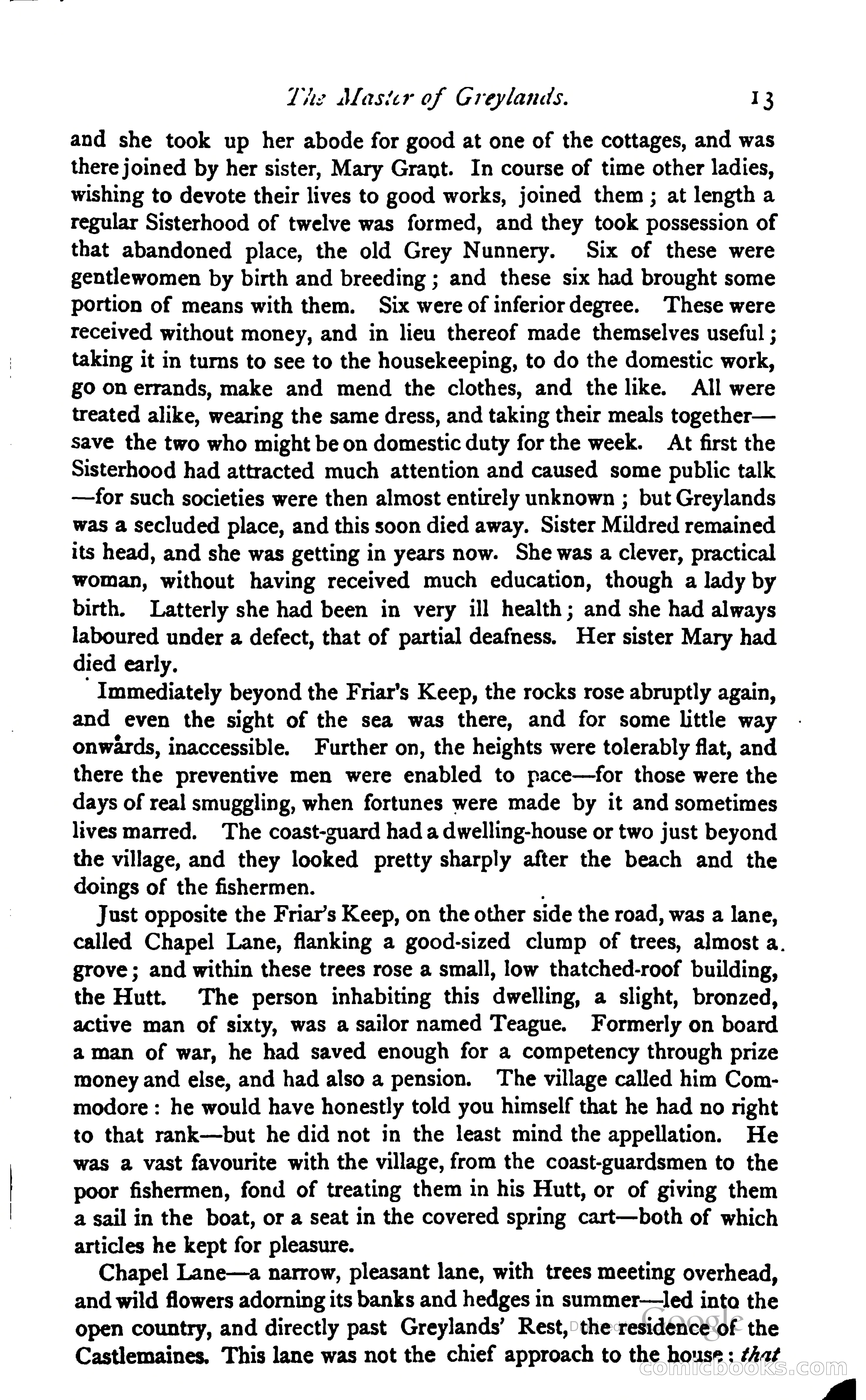
A restored page from Pulp Fiction, 1865. Page through the whole issue in the reader above.
📄 Transcribed text from this page (OCR, searchable)
Machine-transcribed from the original scan — historical spelling and the odd misread are preserved.
Lie Master of Greylands. 13 and she took up her abode for good at one of the cottages, and was there joined by her sister, Mary Grant. In course of time other ladies, wishing to devote their lives to good works, joined them ; at lengtha regular Sisterhood of twelve was formed, and they took possession of that abandoned place, the old Grey Nunnery. Six of these were gentlewomen by birth and breeding ; and these six had brought some portion of means with them. Six were of inferior degree. ‘These were received without money, and in lieu thereof made themselves useful ; taking it in turns to see to the housekeeping, to do the domestic work, go on errands, make and mend the clothes, and the like. All were treated alike, wearing the same dress, and taking their meals together— Save the two who might be on domestic duty for the week. At first the Sisterhood had attracted much attention and caused some public talk —for such societies were then almost entirely unknown ; but Greylands was a secluded place, and this soon died away. Sister Mildred remained its head, and she was getting in years now. She was a clever, practical woman, without having received much education, though a lady by birth. Latterly she had been in very 11] health; and she had always laboured under a defect, that of partial deafness. Her sister Mary had died early. Immediately beyond the Friar’s Keep, the rocks rose abruptly again, and even the sight of the sea was there, and for some little way onwards, inaccessible. Further on, the heights were tolerably flat, and there the preventive men were enabled to pace—for those were the days of real smuggling, when fortunes were made by it and sometimes lives marred. The coast-guard had a dwelling-house or two just beyond the village, and they looked pretty sharply after the beach and the doings of the fishermen. Just opposite the Friar’s Keep, on the other side the road, was a lane, called Chapel Lane, flanking a good-sized clump of trees, almost a. grove; and within these trees rose a small, low thatched-roof building, the Hutt. The person inhabiting this dwelling, a slight, bronzed, active man of sixty, was a sailor named Teague. Formerly on board aman of war, he had saved enough for a competency through prize money and else, and had also a pension. The village called him Com- modore : he would have honestly told you himself that he had no right to that rank—but he did not in the least mind the appellation. He was a vast favourite with the village, from the coast-guardsmen to the poor fishermen, fond of treating them in his Hutt, or of giving them a sail in the boat, or a seat in the covered spring cart—both of which articles he kept for pleasure. Chapel Lane—a narrow, pleasant lane, with trees meeting overhead, and wild flowers adorning its banks and hedges in summer—led into the open country, and directly past Greylands’ Rest, the:residencé-of the Castlemaines. This lane was not the chief approach to the house ; that. (C(O)