
Pulp Fiction, 1865 · page 207 of 399
The Argosy — page 207: what you’re looking at
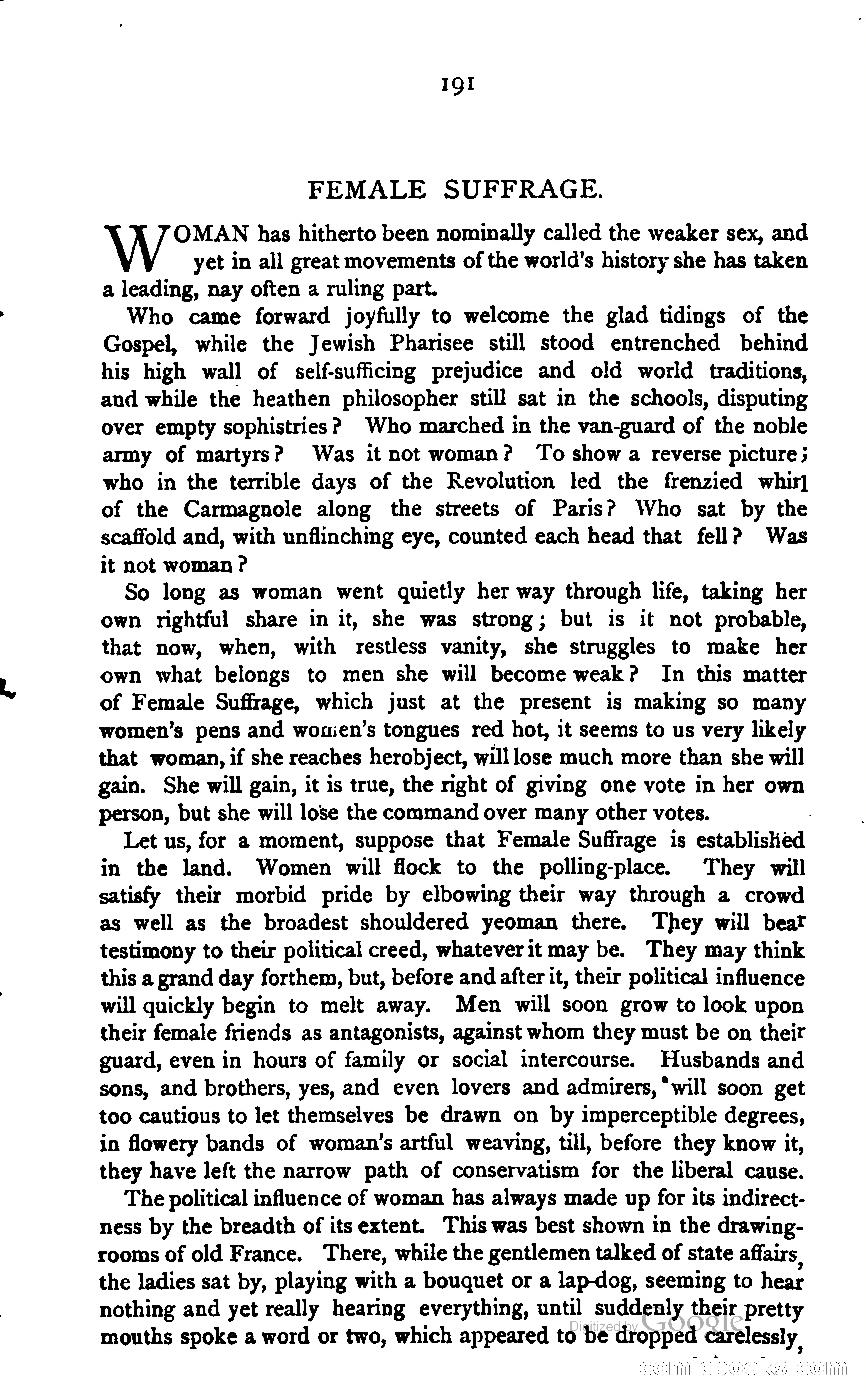
A restored page from Pulp Fiction, 1865. Page through the whole issue in the reader above.
📄 Transcribed text from this page (OCR, searchable)
Machine-transcribed from the original scan — historical spelling and the odd misread are preserved.
19! FEMALE SUFFRAGE. OMAN has hitherto been nominally called the weaker sex, and yet in all great movements of the world’s history she has taken a leading, nay often a ruling part. Who came forward joyfully to welcome the glad tidings of the Gospel, while the Jewish Pharisee still stood entrenched behind his high wall of self-sufficing prejudice and old world traditions, and while the heathen philosopher still sat in the schools, disputing over empty sophistries? Who marched in the van-guard of the noble army of martyrs? Was it not womane To show a reverse picture ; who in the terrible days of the Revolution led the frenzied whir] of the Carmagnole along the streets of Paris? Who sat by the scaffold and, with unflinching eye, counted each head that fell? Was it not woman P So long as woman went quietly her way through life, taking her own rightful share in it, she was strong; but is it not probable, that now, when, with restless vanity, she struggles to make her own what belongs to men she will become weak? In this matter of Female Suffrage, which just at the present is making so many women’s pens and wouien’s tongues red hot, it seems to us very hkely that woman, if she reaches herobject, will lose much more than she will gain. She will gain, it is true, the right of giving one vote in her own person, but she will lose the command over many other votes. Let us, for a moment, suppose that Female Suffrage is established in the land. Women will flock to the polling-place. They will satisfy their morbid pride by elbowing their way through a crowd as well as the broadest shouldered yeoman there. They will bear testimony to their political creed, whateverit may be. They may think this a grand day forthem, but, before and after it, their political influence will quickly begin to melt away. Men will soon grow to look upon their female friends as antagonists, against whom they must be on their guard, even in hours of family or social intercourse. Husbands and sons, and brothers, yes, and even lovers and admirers, “will soon get too cautious to let themselves be drawn on by imperceptible degrees, in flowery bands of woman’s artful weaving, till, before they know it, they have left the narrow path of conservatism for the liberal cause. The political influence of woman has always made up for its indirect- ness by the breadth of its extent. This was best shown in the drawing- rooms of old France. There, while the gentlemen talked of state affairs the ladies sat by, playing with a bouquet or a lap-dog, seeming to hear nothing and yet really hearing everything, until suddenly their pretty mouths spoke a word or two, which appeared to be dropped carelessly COMIC OOOKS. EO