
Pulp Fiction, 1887 · page 368 of 399
The Argosy — page 368: what you’re looking at
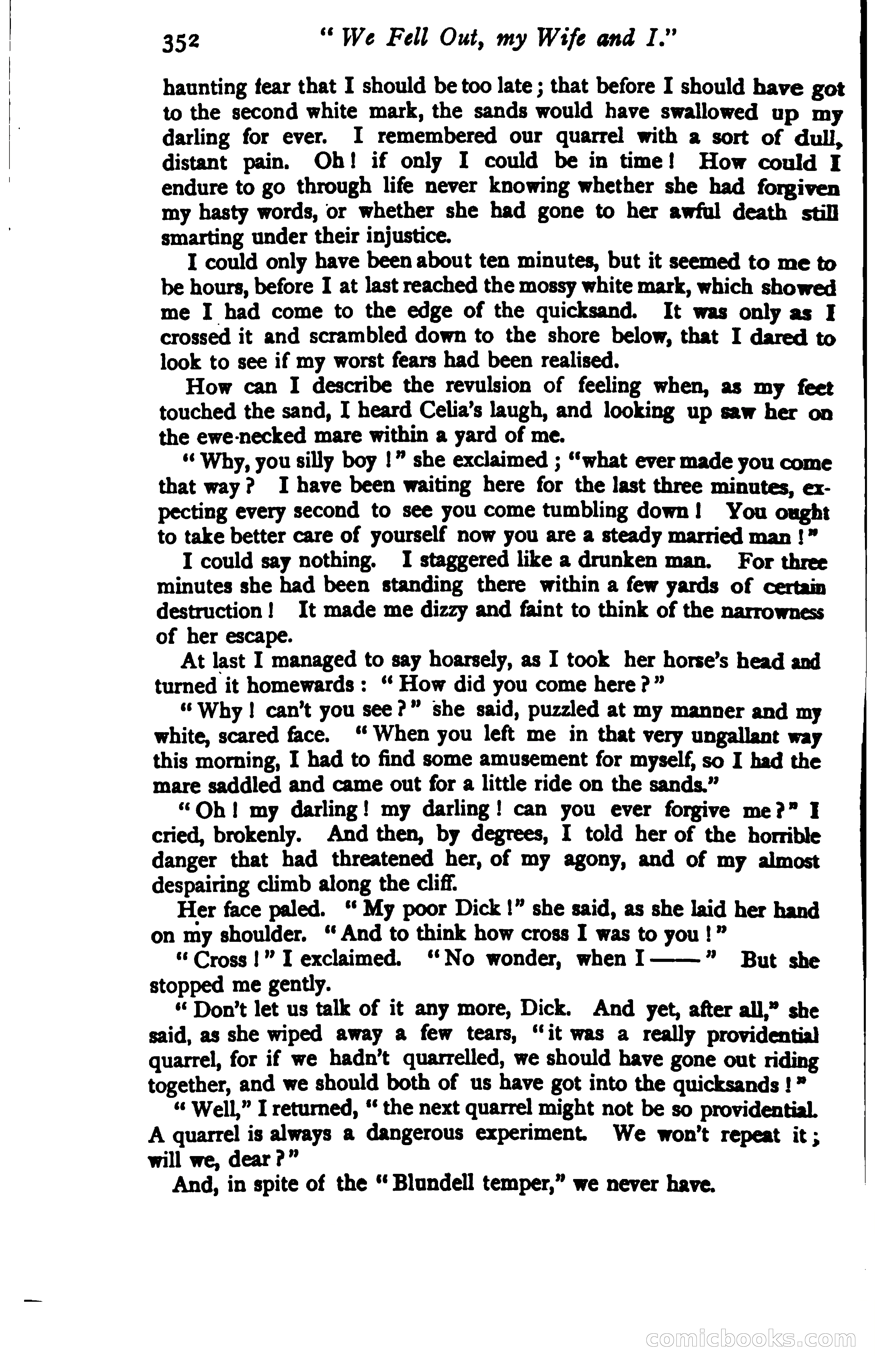
A restored page from Pulp Fiction, 1887. Page through the whole issue in the reader above.
📄 Transcribed text from this page (OCR, searchable)
Machine-transcribed from the original scan — historical spelling and the odd misread are preserved.
352 “We Fell Out, my Wife and I.” haunting fear that I should be too late ; that before I should have got to the second white mark, the sands would have swallowed up my darling for ever. I remembered our quarrel with a sort of dull, distant pain. Oh! if only I could be in time! How could I endure to go through life never knowing whether she had forgiven my hasty words, or whether she had gone to her awful death still smarting under their injustice. I could only have been about ten minutes, but it seemed to me to be hours, before I at last reached the mossy white mark, which showed me I had come to the edge of the quicksand. It was only as I crossed it and scrambled down to the shore below, that I dared to look to see if my worst fears had been realised. How can I describe the revulsion of feeling when, as my feet touched the sand, I heard Celia’s laugh, and looking up saw her on the ewe-necked mare within a yard of me. ‘‘ Why, you silly boy !” she exclaimed ; “‘what ever made you come that way? I have been waiting here for the last three minutes, ex- pecting every second to see you come tumbling down! You ought to take better care of yourself now you are a steady married man !” I could say nothing. I staggered like a drunken man. _ For three minutes she had been standing there within a few yards of certain destruction! It made me dizzy and faint to think of the narrowness of her escape. At last I managed to say hoarsely, as I took her horse’s head and turned it homewards: ‘ How did you come here ?” “Why ! can’t you see?” she said, puzzled at my manner and my white, scared face. ‘‘ When you left me in that very ungallant way this morning, I had to find some amusement for myself, so I had the mare saddled and came out for a little ride on the sands.” ‘Oh! my darling! my darling! can you ever forgive me?” I cried, brokenly. And then, by degrees, I told her of the horrible danger that had threatened her, of my agony, and of my almost despairing climb along the cliff. Her face paled. ‘My poor Dick !” she said, as she laid her hand on my shoulder. “ And to think how cross I was to you !” ‘6 Cross |!” I exclaimed. ‘*No wonder, when I ” But she stopped me gently. ‘ Don’t let us talk of it any more, Dick. And yet, after all,” she said, as she wiped away a few tears, “it was a really providential quarrel, for if we hadn’t quarrelled, we should have gone out riding together, and we should both of us have got into the quicksands !* Well,” I returned, “ the next quarrel might not be so providential. A quarrel is always a dangerous experiment. We won't repeat it ; will we, dear?” And, in spite of the “ Blundell temper,” we never have. IDOOKSHGOl @ COMM