
Pulp Fiction, 1887 · page 367 of 399
The Argosy — page 367: what you’re looking at
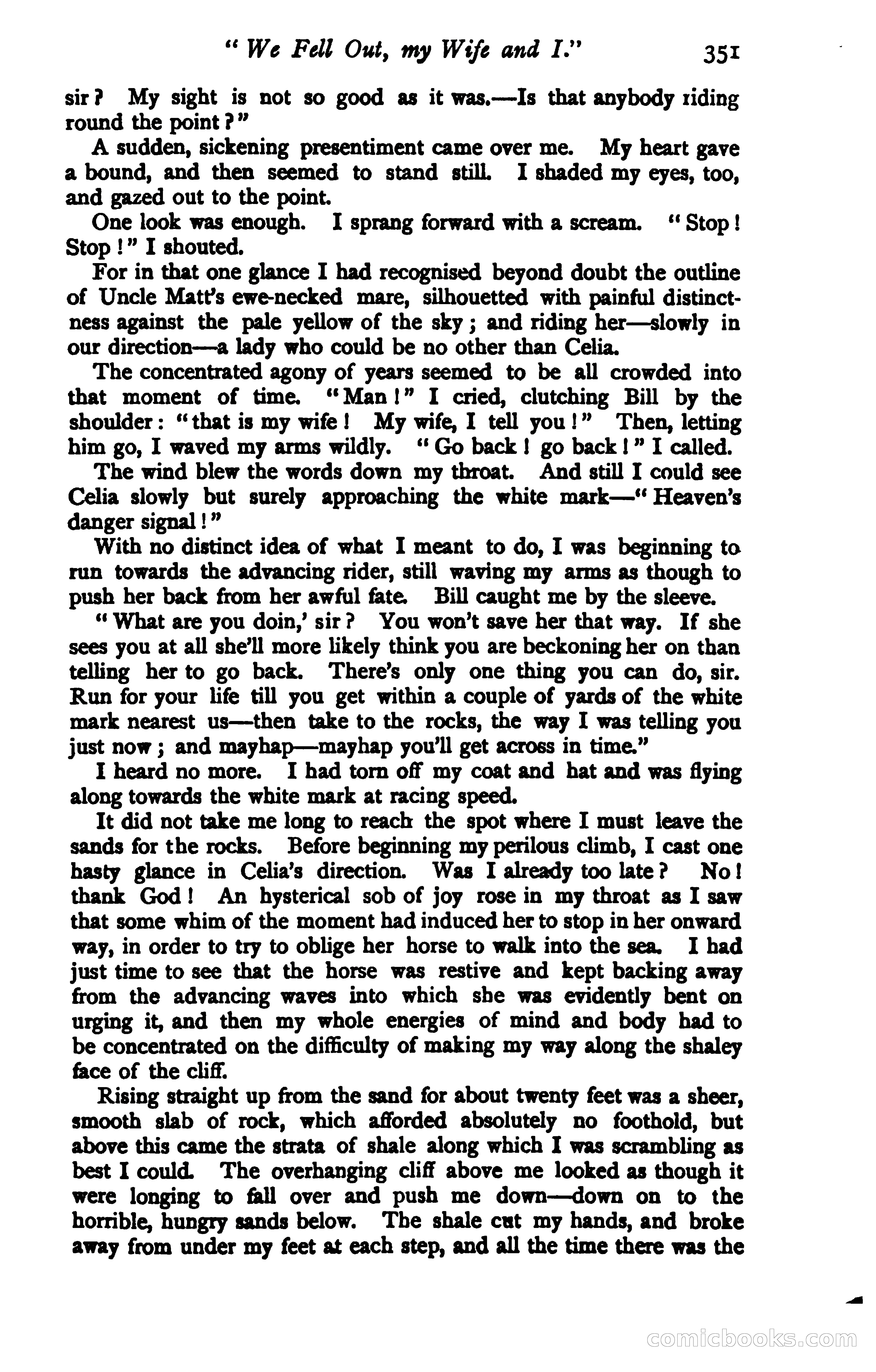
A restored page from Pulp Fiction, 1887. Page through the whole issue in the reader above.
📄 Transcribed text from this page (OCR, searchable)
Machine-transcribed from the original scan — historical spelling and the odd misread are preserved.
“We Fell Out, my Wife and I.” 351 sir? My sight is not so good as it was.—Is that anybody riding round the point ?” A sudden, sickening presentiment came over me. My heart gave a bound, and then seemed to stand still. I shaded my eyes, too, and gazed out to the point. One look was enough. I sprang forward with a scream. ‘Stop! Stop !” I shouted. For in that one glance I had recognised beyond doubt the outline of Uncle Matt’s ewe-necked mare, silhouetted with painful distinct- ness against the pale yellow of the sky ; and riding her—slowly in our direction—a lady who could be no other than Celia. The concentrated agony of years seemed to be all crowded into that moment of time. “Man!” I cried, clutching Bill by the shoulder: “that is my wife! My wife, I tell you!” Then, letting him go, I waved my arms wildly. ‘Go back! go back!” I called. The wind blew the words down my throat. And still I could see Celia slowly but surely approaching the white mark—*‘ Heaven’s danger signal ! ” With no distinct idea of what I meant to do, I was beginning to run towards the advancing rider, still waving my arms as though to push her back from her awful fate. Bill caught me by the sleeve. ‘* What are you doin,’ sir? You won't save her that way. If she sees you at all she'll more likely think you are beckoning her on than telling her to go back. There’s only one thing you can do, sir. Run for your life till you get within a couple of yards of the white mark nearest us—then take to the rocks, the way I was telling you just now ; and mayhap—mayhap you'll get across in time.” I heard no more. I had torn off my coat and hat and was flying along towards the white mark at racing speed. It did not take me long to reach the spot where I must leave the sands for the rocks. Before beginning my perilous climb, I cast one hasty glance in Celia’s direction. Was I already too late? No! thank God! An hysterical sob of joy rose in my throat as I saw that some whim of the moment had induced her to stop in her onward way, in order to try to oblige her horse to walk into the sea. I had just time to see that the horse was restive and kept backing away from the advancing waves into which she was evidently bent on urging it, and then my whole energies of mind and body had to be concentrated on the difficulty of making my way along the shaley face of the cliff. Rising straight up from the sand for about twenty feet was a sheer, smooth slab of rock, which afforded absolutely no foothold, but above this came the strata of shale along which I was scrambling as best I could. The overhanging cliff above me looked as though it were longing to fall over and push me down—down on to the horrible, hungry sands below. The shale cut my hands, and broke away from under my feet at each step, and all the time there was the EOMRRIC OOO SS (GO) i