
Pulp Fiction, 1887 · page 357 of 399
The Argosy — page 357: what you’re looking at
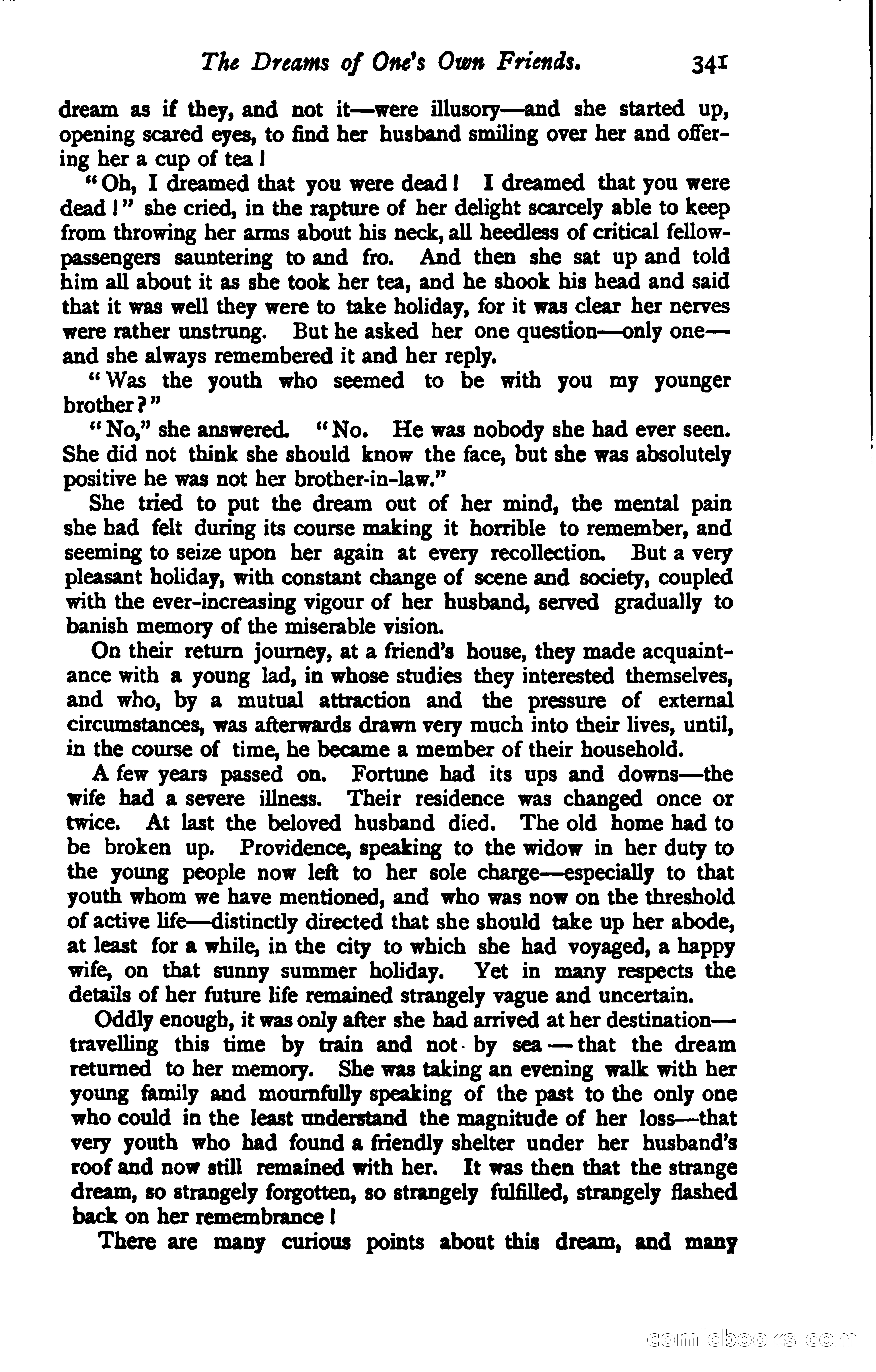
A restored page from Pulp Fiction, 1887. Page through the whole issue in the reader above.
📄 Transcribed text from this page (OCR, searchable)
Machine-transcribed from the original scan — historical spelling and the odd misread are preserved.
The Dreams of One’s Own Friends. 341 dream as if they, and not it—were illusory—and she started up, opening scared eyes, to find her husband smiling over her and offer- ing her a cup of tea! ‘Oh, I dreamed that you were dead! I dreamed that you were dead !” she cried, in the rapture of her delight scarcely able to keep from throwing her arms about his neck, all heedless of critical fellow- passengers sauntering to and fro. And then she sat up and told him all about it as she took her tea, and he shook his head and said that it was well they were to take holiday, for it was clear her nerves were rather unstrung. But he asked her one question—only one— and she always remembered it and her reply. “Was the youth who seemed to be with you my younger brother ?” ** No,” she answered. ‘‘No. He was nobody she had ever seen. She did not think she should know the face, but she was absolutely positive he was not her brother-in-law.” She tried to put the dream out of her mind, the mental pain she had felt during its course making it horrible to remember, and seeming to seize upon her again at every recollection. But a very pleasant holiday, with constant change of scene and society, coupled with the ever-increasing vigour of her husband, served gradually to banish memory of the miserable vision. On their return journey, at a friend’s house, they made acquaint- ance with a young lad, in whose studies they interested themselves, and who, by a mutual attraction and the pressure of external circumstances, was afterwards drawn very much into their lives, until, in the course of time, he became a member of their household. A few years passed on. Fortune had its ups and downs—the wife had a severe illness. Their residence was changed once or twice. At last the beloved husband died. The old home had to be broken up. Providence, speaking to the widow in her duty to the young people now left to her sole charge—especially to that youth whom we have mentioned, and who was now on the threshold of active life—distinctly directed that she should take up her abode, at least for a while, in the city to which she had voyaged, a happy wife, on that sunny summer holiday. Yet in many respects the details of her future life remained strangely vague and uncertain. Oddly enough, it was only after she had arrived at her destination— travelling this time by train and not. by sea—that the dream returned to her memory. She was taking an evening walk with her young family and mournfully speaking of the past to the only one who could in the least understand the magnitude of her loss—that very youth who had found a friendly shelter under her husband’s roof and now still remained with her. It was then that the strange dream, so strangely forgotten, so strangely fulfilled, strangely flashed back on her remembrance |! There are many curious points about this dream, and many EOMRRIC OOO SS (GO) ni